

Why does a brand new battery often fail to bring a dead remote back to life? It’s a common frustration for many drivers in Singapore who find their key fob not working after battery change. You expect a quick, five minute fix, but instead, you’re left unable to lock your vehicle and worried about potential immobiliser issues or expensive dealer repairs.
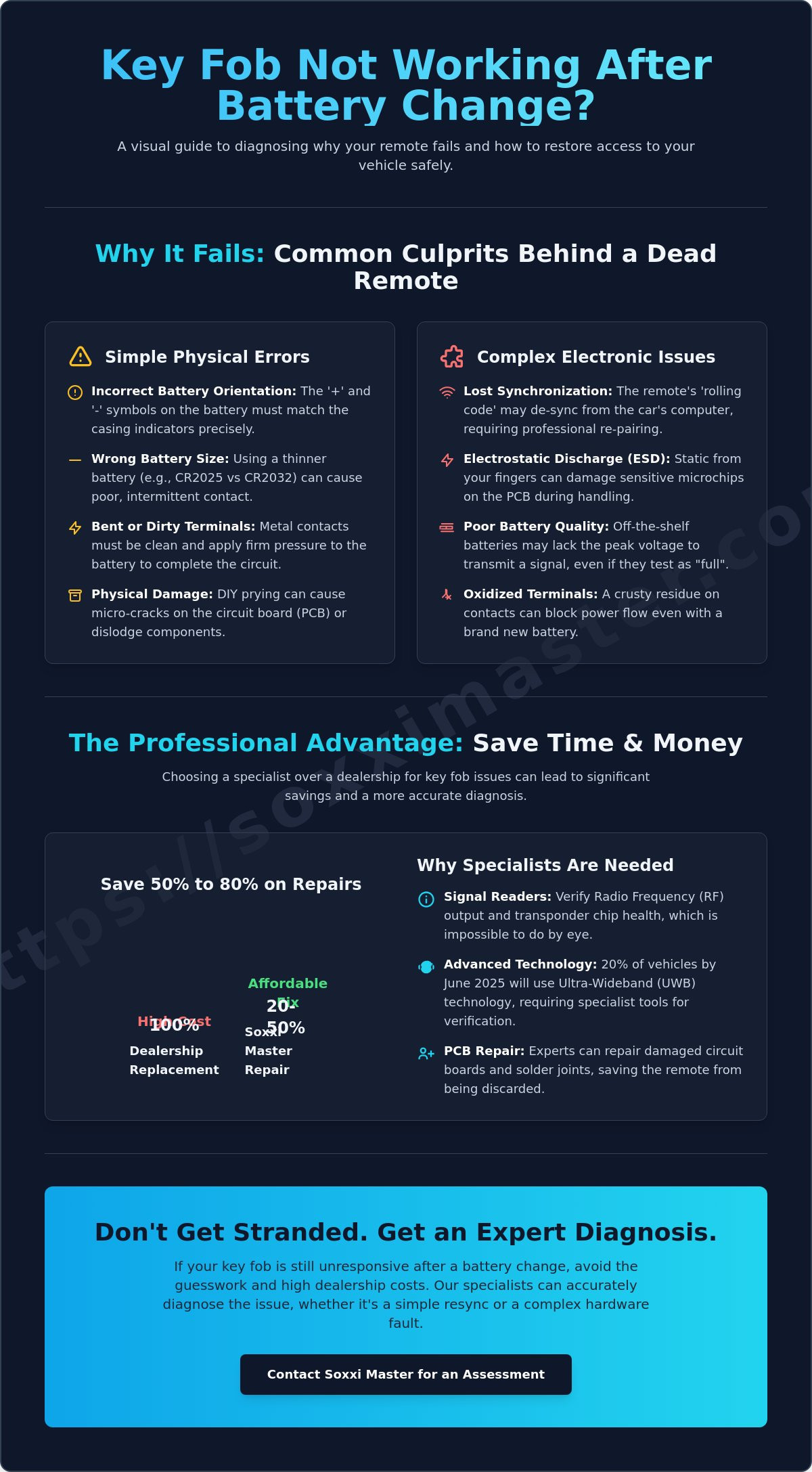
We understand that technical terms like resyncing or transponder coding can feel overwhelming. This guide clarifies the technical reasons for signal loss and outlines the professional steps required to restore your vehicle access safely. You’ll learn why 20% of vehicles produced by June 2025 now utilize Ultra-Wideband (UWB) technology, which often requires specialist equipment to verify. By choosing professional diagnostic services, you can identify if a resync is needed or if hardware damage exists, often saving 50% to 80% compared to dealership replacement costs. We’ll show you how to determine the health of your remote, subject to vehicle compatibility, and how to contact Soxxi Master for an accurate assessment of your specific needs.
Key Takeaways
- Identify common physical causes of failure, such as incorrect battery orientation or poor contact with internal metal terminals.
- Understand why a key fob not working after battery change may require professional synchronization to re-pair the remote’s rolling code with your car’s computer.
- Learn how specialists use signal readers to verify radio frequency (RF) output and the health of the transponder chip independently.
- Discover the benefits of professional PCB repair and diagnostic assessments for damaged remotes, subject to system compatibility.
- Recognize why final confirmation of your vehicle’s specific requirements is necessary through an expert assessment before any service is performed.
Common Reasons Why a Key Fob Fails After a Battery Replacement
Finding your key fob not working after battery change is a common issue that often stems from simple hardware oversights or complex electronic resets. While the process seems straightforward, modern automotive remotes are sensitive electronic devices. A simple mistake like reversing the battery orientation or using a CR2025 instead of a CR2032 can prevent the circuit from completing. Even if the battery fits, the thinner CR2025 may not maintain consistent contact with the internal metal terminals, leading to intermittent signal failure. It’s essential to ensure the “+” and “-” symbols inside the casing match the battery placement exactly.
Beyond physical fit, the Remote Keyless System relies on a precise handshake between the remote and the vehicle. When a battery is removed for an extended period, or if multiple buttons are pressed while the power is disconnected, the rolling code synchronization can be lost. This means the car no longer recognizes the signal, even if the remote is transmitting correctly. Additionally, electrostatic discharge (ESD) from your fingertips can damage the sensitive microcontrollers on the printed circuit board (PCB) during handling, leading to hardware failure that a new battery cannot fix.
The Role of Battery Quality and Voltage
Many drivers opt for “off the shelf” batteries that may have sat in storage for years. These cells often lack the peak voltage required to transmit high-security signals. While a standard CR2032 battery typically costs under $10, a low-quality cell might show 3V on a basic tester but fail under the “load” of a button press. A specialist verifies battery output under actual operating conditions using professional diagnostic tools. We also inspect terminals for oxidation; this buildup creates resistance and prevents power from reaching the PCB, even with a fresh cell.
Physical Handling and PCB Sensitivity
Prying a remote case open without the correct tools often causes more harm than good. It’s common for our specialists to find micro-cracks in the circuit board or dislodged transponder chips after a DIY attempt. These components are surface-mounted and can break with minimal pressure. If your key fob not working after battery change is due to a broken internal button or a cracked solder joint, a simple battery swap won’t solve the problem. Professional casing separation and inspection are necessary to ensure the structural integrity of the remote is maintained. For a reliable diagnosis of your remote’s health, you can contact Soxxi Master for an accurate assessment and confirmation of your specific needs.
Essential Physical Checks for Your Car Remote
If you’ve completed a swap and still find your key fob not working after battery change, the issue often lies in physical alignment. It’s not enough to simply drop a new cell into the compartment. You must verify that the positive (+) and negative (-) indicators on the casing align perfectly with the battery’s surface. Even a slight tilt can prevent the circuit from closing. Modern remotes are precision instruments; a standard CR2032 battery typically costs under $10, yet using the wrong size or orientation is a leading cause of post-service failure.
Inspect the metal contact points, often called “fingers,” for signs of fatigue. These terminals are designed to exert constant pressure on the battery. Over time, or during a rough battery removal, these can bend or lose their tension. If they don’t touch the battery firmly, the remote won’t receive power. Use a non-conductive cleaner to remove any dirt or skin oils that might have transferred to the contacts during the process. Clean contacts ensure a seamless flow of electricity to the internal circuit board.
Inspecting the Battery Terminals
Recessed terminals are a frequent culprit in signal failure. If the metal tabs are pushed too far into the plastic housing, they fail to make a connection with the battery surface. Don’t use excessive force to pull them back. Bending them too far can snap the metal or damage the solder joints on the circuit board. Look for signs of green or white crusty residue. This indicates previous battery leakage or water ingress, which may require a professional cleaning to resolve. It’s a simple check that can save you from unnecessary replacement costs.
Button Integrity and Casing Alignment
A misaligned casing often blocks the physical movement of the buttons. If you don’t feel a distinct “click” when pressing the lock or unlock icons, the micro-switch on the PCB isn’t being triggered. You can test this by carefully observing the button response without the outer shell, though this is best left to a specialist to avoid electrostatic damage. When physical damage is evident, it’s time to consider a key fob repair rather than a full replacement. Subject to compatibility, many remotes can be restored to full functionality with simple component adjustments.
Verification is the most important step in any diagnostic process. Before assuming the remote is faulty, it’s vital to check compatibility using your vehicle’s chassis number. You might find a simple terminal adjustment is all that’s needed to restore access. For a professional diagnosis and to ensure your remote is functioning at its peak, you can contact our Jalan Pemimpin team for an accurate assessment of your specific needs.
Understanding Key Fob Synchronization and Programming Issues
Synchronization is the technical process of re-pairing the unique rolling code of the remote to the vehicle’s onboard computer. When you experience a key fob not working after battery change, the issue is often electronic rather than physical. Unlike a television remote that sends a fixed signal, car remotes use evolving security sequences. If the battery is removed for more than a few minutes, or if buttons are pressed while the power is disconnected, the transmitter and receiver can drift out of sequence. This results in a “handshake” failure where the car no longer recognizes the remote as authorized.
It’s vital to distinguish between the remote entry signal and the immobiliser transponder signal. The remote entry system operates on radio frequencies to control door locks, while the transponder chip is a separate security layer that allows the engine to start. Often, a vehicle will still start even if the remote buttons fail to function. This distinction is why professional diagnosis is required; the solution varies significantly depending on the vehicle model, year, and the specific encryption system used by the manufacturer.
Rolling Code Logic and Signal Loss
Security systems utilize rolling codes to prevent unauthorized signal “grabbing.” Every time you press a button, the remote generates a new code from millions of possible combinations. The vehicle’s computer knows which code to expect next. However, if the remote is triggered multiple times while out of range of the car, the sequence desyncs. The car rejects the signal because it’s no longer the expected next code in the chain. This desync phenomenon is a leading reason for a key fob not working after battery change, especially in systems produced between 2015 and 2025.
When On-Board Programming is Not Enough
While some older vehicles allow for manual resync procedures, such as cycling the ignition or holding specific button combinations, modern automotive technology has moved toward more secure methods. Many European and Japanese models manufactured from 2020 onwards require specialist diagnostic equipment connected to the OBDII port to verify and restore the synchronization. Manual procedures found in owner manuals are often limited or ineffective for high-security smart keys. If your remote has suffered a permanent memory loss or hardware failure during the battery swap, you may require original car remote keys to restore full access. Verification of your vehicle’s specific requirements through a chassis number is essential before any programming service. For a reliable assessment, you can contact Soxxi Master to confirm the necessary steps for your specific system.
How to Verify if Your Key Fob Requires Professional Repair
When you find your key fob not working after battery change, the most efficient next step is a professional signal verification. Rather than assuming the device is dead, a specialist uses a dedicated radio frequency (RF) reader to monitor the remote’s output. This test determines if the remote is transmitting a clear, consistent pulse. If the reader detects a signal but the car fails to respond, the issue is likely a synchronization error or a fault within the vehicle’s receiver. Conversely, a complete lack of transmission usually points to a damaged circuit board or a failed resonator component that a simple battery cannot fix.
Verification also requires checking the vehicle’s chassis number to ensure the remote matches the factory specifications. Manufacturers often change frequencies or encryption protocols mid-model year. A remote that looks identical on the outside may operate on a different frequency, such as 315MHz versus 433MHz. Using professional diagnostic scanners, we can also query the vehicle’s immobiliser system for specific fault codes. These codes provide a technical roadmap, identifying whether the system is rejecting the key due to a security lockout or a hardware mismatch. This data-driven approach avoids the guesswork often found in online forums.
Frequency Testing and Signal Strength
Specialists use RF testers to distinguish between a weak signal and a complete transmission failure. A remote might transmit a signal that is too weak for the car to pick up from a distance, often due to internal oxidation or a failing capacitor. As of June 2025, 20% of new vehicles have transitioned to Ultra-Wideband (UWB) technology for enhanced security. These systems require specialized equipment to verify signal strength and timing. Testing ensures that the remote is functioning within its designed parameters before any further repairs are attempted. This verification is subject to system compatibility and requires an expert eye to interpret correctly.
The Transponder vs. Remote Distinction
Your car may still start even if the buttons don’t work because the transponder key chip is usually a passive component. It doesn’t rely on the battery to communicate with the immobiliser. If the remote buttons fail after a battery swap, but the engine runs, the transponder chip is likely healthy. However, if the car is completely immobilized, the chip’s data integrity may be compromised. Professional verification of the chip’s ID and security status is essential to determine if a repair or a new key is necessary. For a reliable diagnostic of your remote’s health, you can book an assessment at our specialist centre to receive an accurate confirmation of your specific needs.
Professional Automotive Key Solutions at Soxxi Master
When technical challenges persist, our Jalan Pemimpin specialist centre offers a controlled environment for detailed diagnostics. Our approach focuses on identifying the root cause of a key fob not working after battery change using laboratory-grade equipment. As one of Singapore’s pioneers in automotive security, our team performs microscopic inspections of the PCB to identify failed surface-mount components. Based on industry data, specialized remote repair services range from $35 to $200, depending on the complexity of the internal damage and part requirements. This professional route ensures that the structural and electronic integrity of your remote is preserved, subject to model compatibility.
We provide comprehensive key duplication and programming services that go beyond basic locksmithing. Our specialists handle intricate security protocols for a wide range of vehicle makes, ensuring that every new or repaired key aligns with factory encryption standards. This service is always subject to a verification process, as final confirmation of system compatibility is required before any technical work begins.
Why Verification Matters
Accuracy is our priority, which is why we do not offer unverified or generalized solutions. We require specific vehicle details, such as a chassis number, to perform an accurate assessment of your remote’s frequency and security architecture. This methodical verification prevents the risks associated with incorrect programming or mismatched hardware. Our commitment to professional, hassle-free service means we provide Singaporean drivers with verified outcomes based on their specific vehicle’s requirements, rather than relying on generalized assumptions.
Beyond Simple Battery Changes
For more complex automotive issues, such as all keys lost scenarios, we offer precision key fabrication using high-quality materials. Our facility is equipped to handle advanced transponder coding and secure key generation for various vehicle systems, though the specific process varies by year and model. If your remote has failed due to internal wear or signal loss, a professional assessment is the most reliable way to restore access. We encourage you to contact Soxxi Master for an accurate assessment and confirmation of your specific key fob needs.
Restoring Your Vehicle Access with Professional Accuracy
A simple battery swap should be the end of your car remote troubles, but modern electronics often require more than just fresh power. We’ve explored how physical terminal alignment, signal desynchronization, and circuit board health play critical roles in remote functionality. If you’re still facing a key fob not working after battery change, it’s likely that a deeper technical issue or a security handshake failure is present. Identifying these faults requires specialized knowledge and equipment to avoid unnecessary replacement costs.
With 18 years of experience as a Singapore pioneer in automotive key services, Soxxi Master provides the expertise needed for complex diagnostics. We use specialist equipment for RF and transponder testing to verify your remote’s health accurately. Our transparent process relies on vehicle-specific data, such as your chassis number, to ensure every solution is subject to compatibility. This methodical approach prioritizes your vehicle’s security while providing a hassle-free experience. For a reliable diagnostic and to ensure your remote is functioning at its peak, you can contact Soxxi Master for a professional assessment of your key fob. We’re here to help you regain seamless access to your vehicle with confidence.
Frequently Asked Questions
Is it possible to damage my key fob by changing the battery myself?
Yes, it’s possible to damage the internal circuitry through electrostatic discharge or by applying excessive pressure to the casing. Many drivers find their key fob not working after battery change because a micro-switch was accidentally dislodged during the process. Professional tools ensure the casing is separated without cracking the delicate printed circuit board. This risk is higher in remotes produced after 2020, which feature more compact surface-mounted components.
How do I know if my key fob needs to be reprogrammed after a battery swap?
You’ll know it needs reprogramming if the remote is transmitting a signal but the vehicle fails to respond to any commands. A specialist uses an RF tester to confirm the remote’s output before attempting a resync. If the signal is strong but rejected by the car, the rolling code has likely desynced during the power loss. This verification step is essential to avoid unnecessary hardware replacement.
Why does my car start but the remote buttons don’t work?
This occurs because the transponder chip and the remote entry system are separate security layers within the same key. The transponder is a passive component that doesn’t rely on the battery to start the engine. If the remote buttons fail while the car still starts, it indicates a synchronization or hardware issue with the transmitter portion of the key. Verification of both systems is necessary to identify the exact point of failure.
Can a specialist fix a key fob that has stopped working entirely?
Specialists can often restore functionality through PCB repair or component replacement, subject to the extent of the damage. If a diagnostic scan shows the internal microcontroller is still healthy, repairing broken buttons or solder joints is a viable path. Final confirmation of repairability is always required after a physical inspection of the device’s internal health at our Jalan Pemimpin centre.
What should I do if the metal battery contact inside the fob is broken?
A broken terminal requires precision soldering or a replacement of the internal contact structure. You shouldn’t attempt to tape or wedge the battery in place; this leads to intermittent power and potential short circuits on the board. Specialists can verify if the terminal can be repaired or if a casing transfer is needed to restore a reliable electrical connection to the power source.
Does the brand of the replacement battery really matter for a car remote?
The quality and voltage stability of the battery are more important than the brand name itself. High-security remotes require a stable peak voltage to transmit encrypted signals effectively. A battery that has sat in storage for years may lack the necessary load capacity even if it’s a known brand. Using fresh, verified cells ensures the transmitter has the power required for modern security handshakes.
Can I resync my car remote without any special tools?
Manual resync procedures are possible for some older models, but most vehicles manufactured after 2020 require specialized diagnostic equipment. These modern systems use higher encryption levels that cannot be bypassed with simple button sequences or ignition cycles. A specialist uses an OBDII connection to safely re-pair the remote to the car’s computer, ensuring a secure and lasting connection that matches factory standards.
What information do I need to provide to a specialist for a key fob repair?
You should provide your vehicle’s make, model, year, and chassis number to ensure an accurate assessment. This data allows the specialist to verify the correct frequency and chip type required for your specific system. Providing a clear photo of the remote via WhatsApp can also help in the initial identification process before you visit the specialist centre for a final confirmation of your needs.