

What if that affordable duplicate card you just bought online stops working the moment you reach your condo’s lift lobby? It’s a common frustration for many residents in the West who need a spare key but worry about their card being blocked or wasting time on clones that simply don’t function. When searching for access card duplication clementi, the challenge isn’t just finding a shop; it’s finding a specialist who understands the technical nuances of RFID frequencies and encryption levels.
We understand the hesitation that comes with high MCST replacement fees and the confusion over whether your specific card can even be copied. This guide will teach you how to professionally duplicate your condo or office access cards with technical precision and verified compatibility. You’ll learn why professional verification is essential for modern security systems, from standard MIFARE cards to highly encrypted HID iClass technology. We’ll also explain the diagnostic steps needed to ensure your new card works reliably, subject to the specific compatibility of your building’s reader system.
Key Takeaways
- Understand why standard key duplication methods often fail with modern RFID systems and why a technical diagnostic approach is necessary for residential access.
- Identify the critical differences between 125kHz and 13.56MHz frequencies to better understand the cloning possibilities for your specific condo or office card.
- Evaluate the benefits of professional duplication compared to Management Office (MCST) replacements, considering factors like administrative requirements and technical compatibility.
- Discover why professional access card duplication clementi requires a thorough technical assessment rather than a simple visual inspection to ensure long-term reliability.
- Learn how to prepare for a specialist consultation to verify if your high-security or encrypted card is eligible for professional cloning, subject to system compatibility.
Professional Access Card Duplication in Clementi: Why Residents Seek Specialists
Clementi has transformed into a high-density residential hub with several large-scale developments. As more residents move into the area, the demand for reliable access card duplication clementi services has grown significantly. Many homeowners find that the standard number of cards provided by building management isn’t sufficient for modern living arrangements. However, duplicating these cards isn’t as simple as cutting a traditional metal key. Standard key cutters often lack the electronic equipment needed to interface with modern proximity card technology, which relies on radio frequency identification (RFID) rather than physical grooves.
Seeking a specialist is crucial because modern access systems use complex security protocols. A professional assessment ensures that the duplication process respects the technical integrity of the original card. Unlike unverified mobile services that might use generic, low-quality chips, a specialist center uses diagnostic tools to identify the exact frequency and chip type. This prevents issues where a clone might work on the main gate but fail at the lift lobby or gym entrance. Accuracy is the priority in every assessment to ensure the spare card functions as intended across all authorized access points.
The Evolving Security Landscape of Clementi Condominiums
Newer developments in West Singapore, such as Parc Clematis, The Trilinq, and Clementi Canopy, have implemented multi-tier security systems. These systems often require a single card to communicate with different readers at the perimeter gate, the lift car, and the unit’s digital lock. There is a noticeable shift from basic RFID tags to highly encrypted smart card systems. These advanced systems require specialized knowledge to duplicate successfully. The process is always subject to the specific compatibility of the hardware used by the building’s management. A specialist can help determine if your card belongs to a generation that allows for professional RFID access card cloning or if it uses a restricted proprietary format.
Common Scenarios Requiring Card Duplication
Several practical situations lead residents to seek a spare access card. It’s often a matter of convenience and ensuring smooth daily operations for the household. Common scenarios include:
- Providing secure entry for domestic helpers or part-time cleaners who require independent access during scheduled hours.
- Managing the needs of multi-generational families living near NUS or West Coast where multiple spares are required for children and elderly parents.
- Replacing cards that have suffered physical wear or internal antenna damage, leading to intermittent failures at readers.
Each of these situations requires a functioning spare that won’t be blocked by the system. Before proceeding with any service, it’s essential to verify the card’s technology to ensure a functional outcome. We encourage you to contact Soxxi Master for an accurate assessment and confirmation of your specific needs.
Understanding RFID Technology and Compatibility for Clementi Residents
Radio Frequency Identification (RFID) is the invisible technology powering nearly every contactless entry system in Singapore. In the context of residential and office security, an access card is more than just a piece of plastic; it contains an internal antenna and a microchip that communicates with a reader via radio waves. For those seeking access card duplication clementi, it’s vital to recognize that this is a technical diagnostic process rather than a simple copy-and-paste task. The success of a duplicate depends entirely on identifying the specific frequency and communication protocol used by your building’s hardware.
Claims that a single device can clone every type of card are technically inaccurate and often lead to non-functional duplicates. Modern security systems are increasingly sophisticated, moving away from basic identification to complex data exchanges. Without a professional assessment, there’s a high risk of obtaining a card that appears to work but fails to trigger the “handshake” required by secure lift controllers or unit door locks. Verification of the card’s internal logic is the only way to ensure reliable performance.
Low-Frequency (LF) vs. High-Frequency (HF) Cards
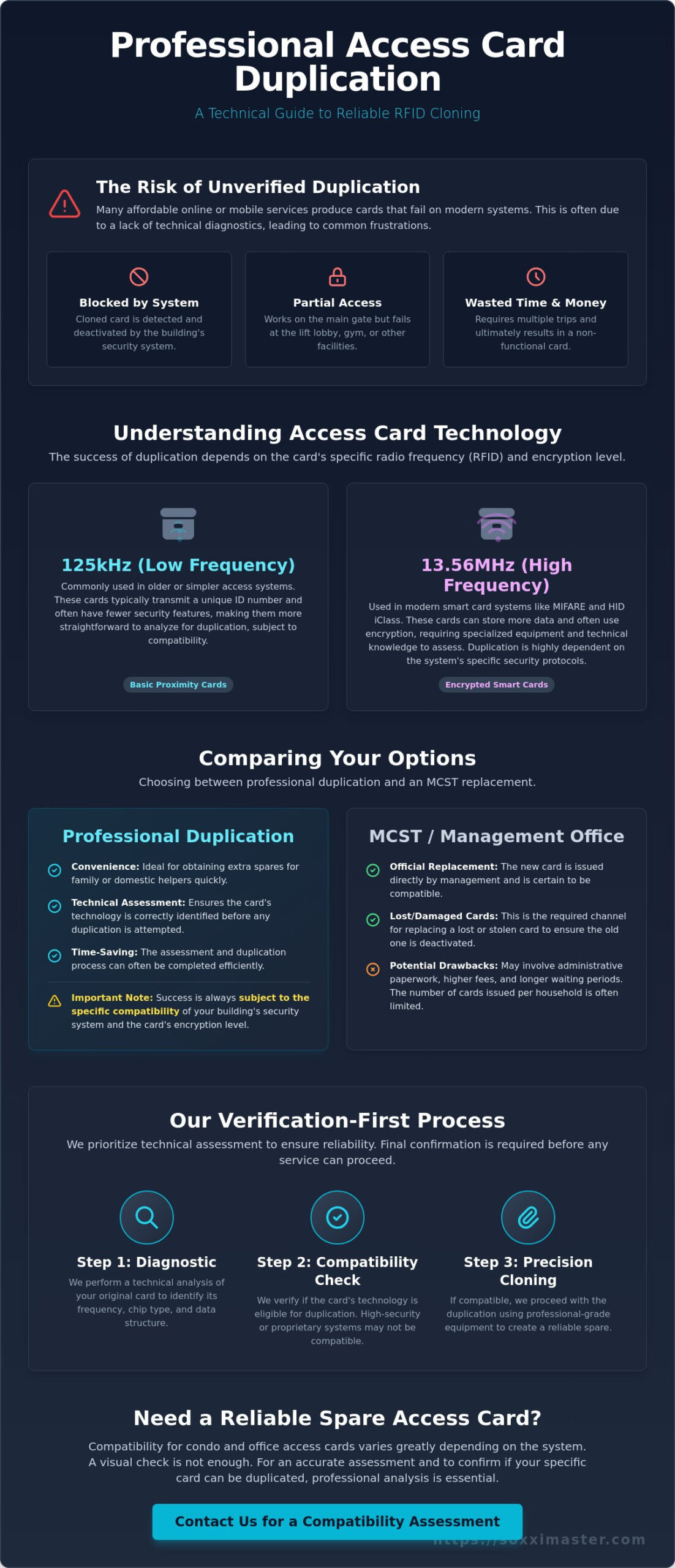
The first step in a professional evaluation is determining the card’s operating frequency. Low-frequency cards, typically operating at 125kHz, were the standard for many years. You’ll often find these in older Clementi estates or simple gate-only access systems. These cards are usually thicker and have a shorter reading range. In contrast, high-frequency cards operating at 13.56MHz have become the benchmark for modern integrated developments. This frequency supports Mifare and NFC technology, allowing the card to store more data and handle the multi-tier security found in newer condominiums. Because each frequency requires different hardware, identifying the correct one is essential before any RFID access card cloning can be attempted.
Encryption and Proprietary Systems
Beyond frequency, the level of encryption determines the feasibility of duplication. Singaporean developments use various systems, including HID, IC, and ID card variations. Some older systems transmit an unencrypted serial number, while newer, high-security systems use cryptographic keys to protect data. Encrypted systems require specialized diagnostic tools to assess whether the data can be safely and accurately duplicated. Proprietary systems, such as certain HID iClass or DESFire configurations, are designed to be resistant to cloning. This is why compatibility is never assumed; every card must undergo a technical evaluation. If you’re unsure about your card’s technology, you can contact Soxxi Master for an accurate assessment and confirmation of your specific needs.
Comparing Professional Card Cloning with Management Office Replacements
Residents seeking access card duplication clementi often weigh the benefits of visiting a specialist against the traditional route of requesting a replacement from their Management Corporation Strata Title (MCST). Both options serve a purpose, but the right choice depends on your specific needs, such as urgency and administrative convenience. While a specialist focuses on creating a technical replica of your existing card, the management office provides an officially registered credential. Understanding these differences helps you decide which path is most efficient for your household or office requirements.
It’s important to note that duplication is only possible when you have at least one functioning card. If you find yourself in an “All Keys Lost” scenario, duplication is no longer an option. In such cases, you must contact your building management to issue a new master credential. For those who still have their original card and simply need a spare, a specialist service provides a streamlined alternative that avoids the complexities of official channels.
The Process of Official Card Replacement
The official route typically involves several administrative hurdles. Residents usually need to fill out specific application forms and provide proof of residence, such as a tenancy agreement or utility bill. Lead times for official cards vary by development; some offices may take several business days to process a request and issue the new hardware. Cost considerations also play a role, as management fees for replacement cards are determined by individual building by-laws rather than market competition. A significant advantage of the official channel is security. If you’ve lost your original card, the MCST can deactivate the lost credential in the system database to prevent unauthorized entry.
The Specialist Duplication Advantage
Specialist services offer a clear advantage for those who need a spare for a family member or helper without the wait. One major benefit is the speed of service. For compatible card models, a technical assessment and duplication can often be completed on the same day. There’s no administrative paperwork required for creating a spare card, making it a convenient option for busy individuals. This efficiency is a hallmark of a Professional Key Duplication Service in Singapore. Specialist centers also provide a technical evaluation of your card’s frequency and chip type, which helps verify if a clone will function correctly with your specific readers.
Every card brought in for service undergoes a diagnostic check to ensure compatibility. Final confirmation is required before any service can proceed, as the ability to copy a card varies by system and encryption level. If you’re looking for an efficient way to manage your household access, contact Soxxi Master for an accurate assessment and confirmation of your specific needs.
How to Verify Your Access Card Compatibility Before Your Visit
A common misconception among residents is that a simple photograph of a card is enough to determine if it can be copied. While a clear image helps identify the physical form factor, it cannot reveal the internal chip logic or encryption protocols. For those seeking access card duplication clementi, a visual check is merely the starting point. Professional verification requires specialized diagnostic equipment to interact with the card’s antenna and read its response. This process ensures that the duplicate isn’t just a physical copy but a technically compatible credential that will work with your building’s specific reader hardware.
Preparing for a technical evaluation helps streamline the process. Before visiting a specialist center, it’s helpful to note the brand of the card, such as HID, Mifare, or Indala, and the name of your residential estate. You should also identify any current usage issues, such as the card failing at specific readers or requiring multiple taps to register. This information provides valuable context for the technician during the diagnostic phase. Physical testing remains the only way to confirm if a card is eligible for Duplicate Door Access Card Services, as the internal technology varies significantly between different developments.
Visual Cues vs. Technical Reality
Card markings can offer clues to a trained specialist. For example, specific serial numbers or logo placements might suggest a certain frequency range. However, two cards that look identical on the outside often use completely different technology on the inside. One might be a standard 125kHz proximity card, while the other could be a high-security 13.56MHz smart card with multi-layer encryption. Because you cannot see the internal antenna configuration or the microchip’s programming, a technical assessment is required to avoid wasting time on incompatible clones. Verification is always performed before any work begins to ensure accuracy.
The Professional Verification Workflow
A specialist follows a methodical workflow to determine compatibility. This structured approach eliminates guesswork and prioritizes the reliability of the final product. The process typically includes:
- Step 1: Frequency Detection. Using specialized RFID scanners, the technician identifies the card’s operating frequency to ensure the correct hardware is used for the duplication.
- Step 2: Data Structure Analysis. The technician checks for encryption layers and proprietary data formats that might affect the cloning process.
- Step 3: Compatibility Confirmation. Based on the specific reader system used in your Clementi estate, the specialist confirms if a functional duplicate can be created.
Final confirmation is always required before any service can proceed, as the ability to duplicate a card varies by system and model. To ensure you receive a functioning spare that meets your needs, contact Soxxi Master for an accurate assessment and confirmation of your specific requirements.
Soxxi Master: Precision RFID Duplication and Technical Assessment
Soxxi Master stands as a pioneer in the Singaporean security landscape. Since 2007, we’ve specialized in the technical evolution of modern electronic access, moving beyond traditional locksmithing into the specialized domain of RFID and automotive transponder technology. For those requiring access card duplication clementi, we provide a centralized hub for technical mastery. Our approach is built on a commitment to accuracy. We prioritize thorough verification over marketing hyperbole, ensuring that every assessment is based on the specific data integrity of your original credential.
We provide a comprehensive suite of solutions for residents and businesses in the West. This includes everything from standard condominium RFID access card cloning to complex auto gate remote duplication. By housing these diverse technical services under one roof, we offer a complete, all-in-one solution for your modern security needs. Visiting our specialized center allows for a definitive assessment using industry-leading diagnostic equipment that isn’t available through mobile or unverified vendors.
A Conservative Approach to Technical Services
Our methodology is intentionally conservative. We require a physical assessment of every card before confirming compatibility because we recognize that security technology is constantly evolving. This helps residents avoid the common pitfalls of “cheap” clones found online, which often fail after building management updates their system readers. A professional diagnostic check ensures that the duplication process respects the original card’s frequency and encryption parameters. If you’re looking for guidance on choosing the right provider, our guide on Finding Reliable Key Duplication Near Me offers further insights into what to expect from a specialist service.
Next Steps for Clementi Residents and Businesses
Reaching our specialized center from the Clementi area is a straightforward process. Residents can easily access our consolidated location at 37 Jalan Pemimpin #07-16 Mapex via the PIE or Lornie Highway. By centralizing our expertise at this single location, we ensure that every client has direct access to our most advanced diagnostic tools and experienced technicians. We don’t operate franchise shops, which allows us to maintain strict quality control over every technical task we perform.
We encourage a professional consultation for an accurate assessment of your specific needs. Compatibility is never assumed and must be verified against your building’s specific reader requirements. Final confirmation is required before any service can proceed to ensure a functional outcome for your household or office. For more information or to begin your technical evaluation, please contact Soxxi Master for a professional assessment of your access card.
Securing Your Access with Professional Verification
Mastering the complexities of RFID technology ensures your household remains accessible without the administrative delays often associated with official channels. By prioritizing a technical diagnostic process over simple visual inspection, you ensure that your spare card functions reliably across all building readers. Residents seeking access card duplication clementi can benefit from an expert assessment that identifies specific frequencies and encryption layers before any work begins. This methodical approach eliminates the risk of using non-functional clones that may fail after system updates.
As a pioneer in automotive and RFID key technology in Singapore, Soxxi Master utilizes professional diagnostic equipment for precise frequency verification. Our conveniently located specialist center at Jalan Pemimpin is equipped to handle a wide range of modern security systems, from condo tags to auto gate remotes. Compatibility is always subject to the specific hardware used in your development; final confirmation is required before any service proceeds. We encourage you to seek a professional consultation to verify your card’s specific requirements and ensure long-term reliability.
Contact Soxxi Master for an accurate assessment of your access card compatibility. We look forward to providing you with a reliable and efficient solution for your access needs.
Frequently Asked Questions
Can all condo access cards in Clementi be duplicated?
Not all cards are eligible for duplication. Success depends entirely on the specific frequency and chip technology used by your residential development. While many systems allow for professional cloning, newer proprietary formats are intentionally designed to be resistant to duplication. A physical assessment using diagnostic equipment is always necessary to confirm if your specific card model can be duplicated successfully.
Will duplicating my access card cause the original to stop working?
Duplicating a card typically doesn’t deactivate the original credential. Most duplication processes create a technical replica that shares the same digital identity as the original. You should be aware that certain advanced security systems with anti-passback logic might detect multiple uses of the same ID. It’s important to understand your building’s reader logic, as this varies by system and installation type.
How long does the professional card duplication process take?
The process is designed to be efficient and straightforward. For compatible models, a technical assessment and duplication usually take approximately 15 minutes to complete. This allows residents seeking access card duplication clementi to receive their spare credential without the long waiting periods or administrative hurdles often associated with official management office requests. Final confirmation is required before the process begins.
Do I need to bring my tenancy agreement to duplicate a card?
You don’t usually need to provide a tenancy agreement or proof of residence for professional duplication services. Since the specialist is creating a technical copy of a card you already possess, the process focuses on hardware compatibility and data integrity. While no paperwork is required by the specialist, it’s still your responsibility to ensure you comply with your building’s specific MCST by-laws.
What is the difference between a cloned card and an official replacement?
A cloned card is an electronic copy of your current card’s internal data. An official replacement involves the building management issuing a completely new card and updating their central database. While cloning is often faster and avoids administrative forms, an official replacement allows management to deactivate lost cards. The choice between the two depends on your specific needs for speed and security registration.
Can you duplicate the newer HID iClass or high-security encrypted cards?
Duplicating HID iClass or other high-security cards is subject to the specific encryption level and configuration used by your estate. Some versions allow for cloning using specialized diagnostic tools, while others use restricted protocols that prevent duplication. A professional evaluation at a specialist center is required to determine feasibility. We avoid absolute claims and prioritize a conservative technical assessment for these complex systems.
Is there a warranty provided for duplicated access cards?
Support for duplicated cards is typically provided to ensure they function reliably with your building’s readers. The duration and scope of this support vary by system and the type of RFID chip used during the duplication process. If a card fails to register at a gate or lift, a specialist can perform a re-diagnostic to identify the technical conflict and provide a solution.
Can I duplicate my office access card for use on my mobile phone?
Mobile phone duplication depends on your device’s NFC hardware and the card’s operating frequency. Many encrypted office systems use high-frequency protocols that standard mobile devices cannot emulate due to security restrictions. Furthermore, low-frequency cards are physically incompatible with mobile NFC antennas. A technical assessment is required to verify if your specific system and mobile device can support digital credential emulation.