

What if your car’s refusal to open isn’t just a dead battery, but a silent failure in the encrypted digital handshake between your remote and the vehicle’s security system? Standing in a humid carpark while repeatedly pressing a non-responsive button is a high-pressure experience that leaves many Singaporean drivers asking, “why is my key fob not unlocking doors?” It’s natural to feel anxious about being locked out or confused by the technical complexity of modern smart key systems, especially when dealership replacement costs can be significant.
We understand that you need a reliable, efficient way to regain access without incurring unnecessary expenses. This guide identifies the specific technical reasons behind key fob failure and outlines the professional steps to restore your vehicle access. We will examine how factors like radio frequency interference and immobilizer synchronization affect your remote’s performance. You will also learn why providing a chassis number is essential for a specialist to verify compatibility before any service begins. By the end of this article, you’ll have a clear path toward a verified solution for your specific vehicle model.
Key Takeaways
- Identify physical hardware failures such as depleted battery voltage or worn internal micro-switches that prevent your remote from functioning correctly.
- Understand why is my key fob not unlocking doors by examining how rolling code technology and external signal interference can cause digital desynchronization.
- Distinguish between remote failure and vehicle-side issues like blown central locking fuses or faulty door lock actuators.
- Learn why professional verification using your vehicle’s chassis number is essential for ensuring the accuracy of key repairs and replacements.
- Discover the methodical diagnostic process used by specialists to test radio frequencies and restore secure access to your vehicle.
Common Hardware Failures: Why Your Remote Stops Responding
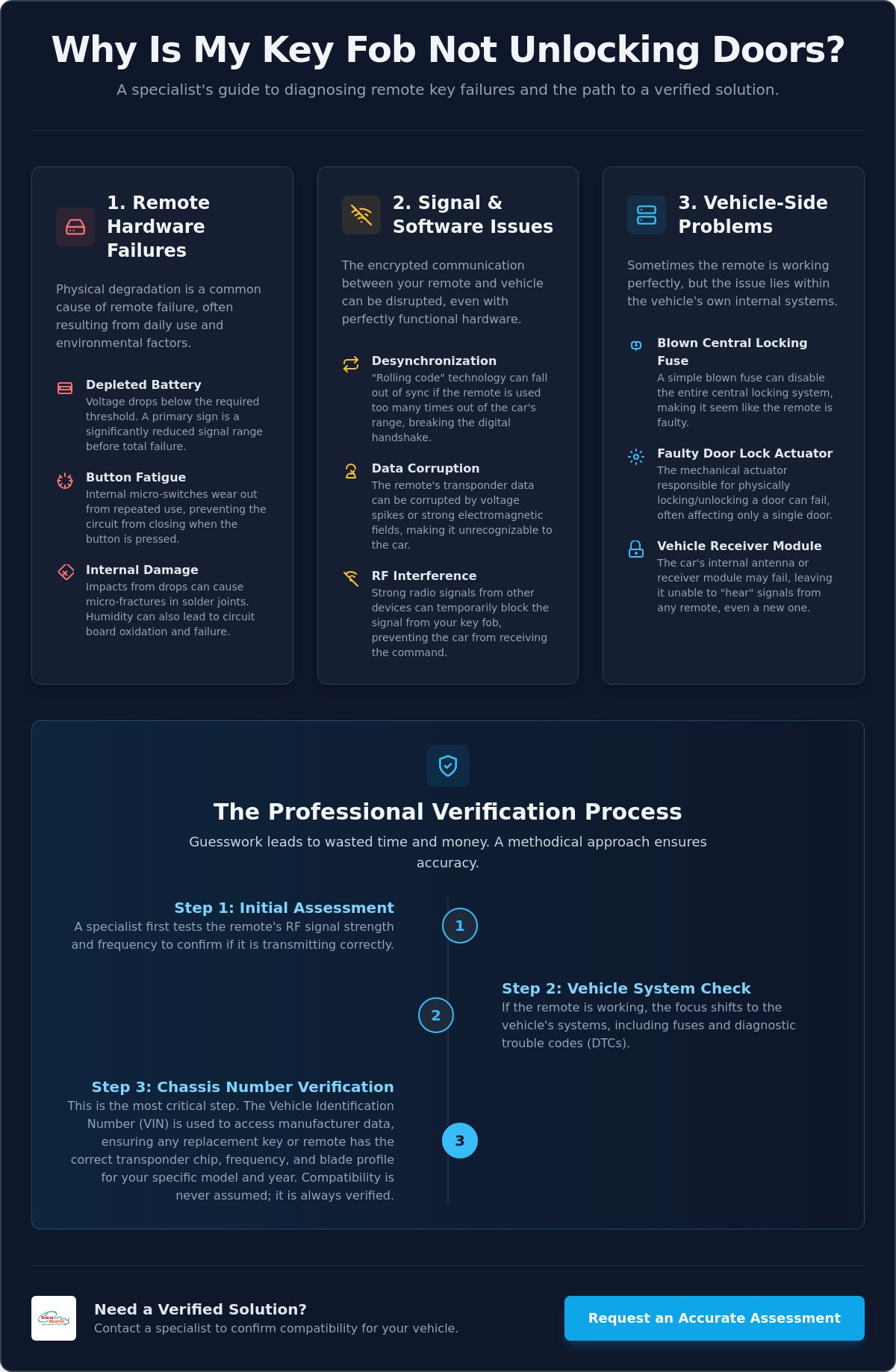
Most vehicle owners assume a software glitch is the culprit when their car remains locked, but physical hardware degradation is often the primary reason. Understanding why is my key fob not unlocking doors starts with an inspection of the internal components. Since these devices are used multiple times daily, they’re subject to constant mechanical stress and environmental exposure. In Singapore’s tropical climate, high humidity levels often lead to internal circuit board oxidation. This thin layer of corrosion acts as an insulator, preventing electrical signals from reaching the transmitter effectively.
Beyond environmental factors, physical impacts from accidental drops can cause microscopic fractures in the solder joints. These fractures may not be visible to the naked eye, yet they disrupt the flow of power from the battery to the integrated circuits. When these connections fail, the remote becomes unresponsive, regardless of how many times you press the buttons. It’s a frustrating situation that usually requires a specialist’s diagnostic tools to resolve.
The Role of the CMOS Battery
The Remote Keyless System (RKS) relies on a stable voltage to function. A common sign of a dying battery is a gradual reduction in signal range. You might find that the doors only unlock when you’re standing right next to the driver’s side window. Eventually, the voltage drops below the threshold required to send the encrypted unlock pulse, resulting in total failure. Choosing high-quality cells is vital because generic batteries often lack the peak current needed for modern transponders to communicate with the vehicle’s immobilizer system.
Internal Physical Damage and Button Fatigue
Tactile micro-switches under the rubber button pads have a finite lifespan. Over years of use, the internal spring mechanism can collapse or the conductive pad can wear away. This button fatigue means that even if the battery is full, the circuit never closes. If you’re still wondering why is my key fob not unlocking doors despite a new battery, the issue likely resides in these physical micro-switches. You might notice you have to press the button harder or at a specific angle to get a response.
In many cases, moisture ingress through worn rubber seals accelerates this internal damage. While a casing replacement might improve the aesthetics, it won’t fix a compromised circuit board. For complex issues involving electronic degradation, a professional assessment is necessary to determine if key duplication or a new original car remote key is the most reliable solution. Every vehicle system is different, and compatibility must be verified using your chassis number before proceeding with a replacement. For an accurate assessment and confirmation of your specific needs, please reach out to Soxxi Master to verify compatibility for your vehicle.
Signal and Programming Issues: When the Software Desyncs
While physical damage is a frequent culprit, software desynchronization is a more subtle reason why is my key fob not unlocking doors. Modern vehicle security doesn’t rely on a static signal. Instead, it uses Rolling Code technology. This system ensures that every time you press a button, both the remote and the car’s Engine Control Unit (ECU) generate a new, matching code for the next interaction. If the remote is activated many times while out of range, the sequence can fall out of sync. This leaves the hardware perfectly intact but the digital conversation broken. It’s a common scenario where the remote is transmitting, but the car refuses to acknowledge the command because the code doesn’t match the expected sequence.
In some cases, the synchronization loss is more severe, involving a total corruption of the transponder data. This can happen due to sudden voltage spikes or electromagnetic interference. When this occurs, the vehicle’s security system treats the remote as an unauthorized device. This isn’t a problem you can solve with a simple battery change. It requires specialized diagnostic tools to re-pair the remote to the vehicle’s computer system. The process varies by system and depends on the specific vehicle model, making professional verification essential.
What is a Transponder Key Handshake?
The security process is essentially a rapid, encrypted signal exchange between the key and the vehicle. This handshake verifies the identity of the key before the doors unlock or the engine starts. Occasionally, a key might have the correct data to bypass the immobiliser but fail to trigger the central locking. This happens when specific sectors of the transponder data become corrupted. To understand the underlying technology, you can read more about What is a Transponder Key? in our detailed guide. Restoring this connection requires precision and an understanding of the vehicle’s specific encryption protocols.
Signal Interference and Frequency Blocking
Singapore’s dense urban landscape is filled with radio frequency (RF) activity. High-voltage lines, mobile signal towers, and even certain electronic devices can create noise that drowns out your remote’s transmission. Research into spurious emissions from car key fobs shows how external factors can compromise signal integrity. If you’re in a crowded car park and find your remote unresponsive, try moving closer to the vehicle or testing it in a different location to rule out environmental interference. Signal jamming, whether accidental or intentional, is a reality in high-traffic areas.
Corrupted data or a complete loss of synchronization often requires a professional reset. If you suspect a software mismatch, seeking professional key remote programming is the most efficient way to restore function. Our specialists use diagnostic equipment to re-establish the link between your hardware and the vehicle’s computer. Final confirmation of compatibility is always required, and we use your vehicle’s chassis number to ensure the correct protocols are applied. For an accurate assessment of your specific needs, please contact Soxxi Master for a consultation.
Vehicle-Side Problems: Is It the Fob or the Car?
When you’ve ruled out battery failure and signal interference, the focus shifts from the remote to the vehicle itself. It’s a common misconception that the remote is always at fault. In reality, the car’s internal hardware can also be the reason why is my key fob not unlocking doors. Modern vehicles rely on a complex network involving a receiver antenna, the Body Control Module (BCM), and mechanical actuators. If any part of this chain breaks, the digital command sent by your key will never result in a physical unlock. For instance, a blown fuse in the central locking circuit can instantly disable the entire system, leaving the car unresponsive to even a perfectly functioning remote.
The security system uses either a hopping code or a rolling code to ensure that the car’s receiver only reacts to your specific key. However, electrical surges or a failing car battery can sometimes reset the memory of the vehicle’s remote receiver. When this happens, the car “forgets” the authorized keys, requiring a professional diagnostic tool to re-establish the link. Additionally, physical damage to the wiring harness located within the door hinge area is a frequent issue. Because this harness flexes every time the door opens, the copper strands inside can eventually fracture, cutting off the power to the lock motor.
Testing with a Spare Key
Isolation is the first step in professional troubleshooting. If you have a second remote, testing it immediately tells you if the problem lies with the primary fob or the vehicle. If neither remote works, the issue is almost certainly vehicle-side, such as a faulty BCM or a central locking relay. This diagnostic step highlights the importance of maintaining a duplicate car key. Having a spare doesn’t just prevent lockouts; it serves as a vital tool for identifying whether your security system’s hardware or software has failed. Without a secondary key, diagnosing a “no-response” situation becomes significantly more complex and time-consuming.
Mechanical Lock vs. Electronic Remote Failure
You can often distinguish between mechanical and electronic failures by observing how the car reacts. If you hear a clicking sound inside the door but the lock doesn’t move, the electronic signal is being received, but the door lock actuator has failed. These actuators are small motors that physically pull the locking pin. Over time, the plastic gears inside can strip or the motor can burn out. Conversely, if there is no sound at all and the hazard lights don’t flash, the car isn’t receiving the signal. This suggests a problem with the receiver antenna or the BCM. Final confirmation of these issues requires specialized equipment to test the circuit integrity. For a verified assessment and to confirm the specific needs of your vehicle, please contact Soxxi Master for professional assistance.
The Professional Verification Process for Key Repairs
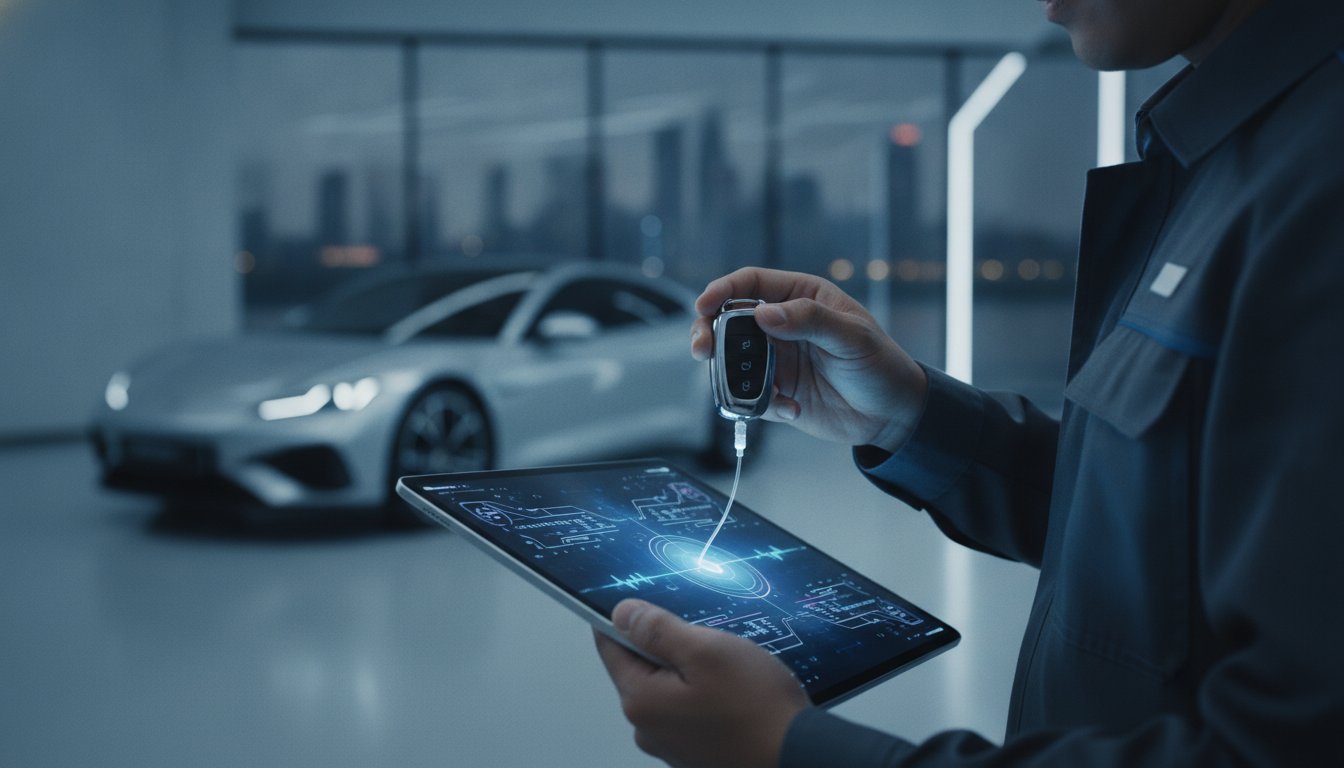
The professional restoration of access starts with a methodical diagnostic sequence. While a driver might wonder why is my key fob not unlocking doors, a specialist begins by confirming whether the remote is emitting a signal at all. Using a Radio Frequency (RF) tester, we can immediately verify the output strength and frequency of the transmitter. This step is crucial. It differentiates between a completely dead circuit and one that’s transmitting but is no longer recognized by the car’s computer. Without this initial test, you’re just guessing at the cause of failure.
Once transmission is confirmed, the next phase involves a deep-level diagnostic scan of the vehicle’s immobiliser system. We connect specialized data-link tools to the car’s OBD-II port to read the real-time status of the security modules. This allows us to see if the car is actively rejecting the key or if there’s a fault in the receiver’s authorization logic. Professional reprogramming is often required to resync the digital handshake between the hardware and the software. This process varies by system and depends on the specific vehicle model.
Why DIY Programming is Risky
Many online guides suggest manual “pedal-and-key” sequences to resync remotes. These methods are often outdated or inapplicable to modern encrypted systems. Attempting these DIY steps carries a significant risk. In some security architectures, entering a manual programming mode can accidentally erase all currently programmed keys from the vehicle’s memory. This turns a simple remote issue into an expensive “all keys lost” situation. Additionally, aftermarket fobs purchased online without verification often lack the correct transponder chip generation. Reliable key repair services ensure that the replacement hardware is electronically compatible with your vehicle’s specific encryption before any work begins.
Data Accuracy and Chassis Verification
Precision is the foundation of automotive security. This is why specialists require your 17-digit chassis number before proceeding with any service. This number allows us to identify the exact factory-installed security configuration. We don’t assume compatibility; we verify it.
- Frequency Identification: Most Asian and European vehicles in Singapore utilize 433MHz, while certain imports may use 315MHz. Using the wrong frequency results in a total failure to communicate.
- Encryption Generation: The chassis number reveals the specific generation of the immobiliser chip. This ensures the replacement remote can perform the necessary digital handshake.
- Software Compatibility: Specialized diagnostic software uses this data to select the correct communication protocol for the data-link tool.
Final confirmation of compatibility is always required before any programming proceeds. if you’re facing technical confusion regarding why is my key fob not unlocking doors, a professional assessment is the safest way to avoid unnecessary complications. For a verified solution tailored to your vehicle, contact Soxxi Master to confirm your specific requirements and receive an accurate assessment.
Specialist Solutions at Soxxi Master Singapore
Soxxi Master provides specialized support for drivers facing technical access issues in Singapore. Identifying why is my key fob not unlocking doors requires more than just a battery swap; it demands a systematic evaluation of the entire security chain. Our specialists offer expert diagnosis for both genuine and third-party remote systems, focusing on restoring functionality through verified methods. We provide a range of services from precision key duplication to advanced fabrication. This methodical approach ensures that every client receives a solution that is technically sound and reliable.
In cases of total system failure, we provide comprehensive all keys lost solutions. This is a complex security process that involves accessing the vehicle’s computer to reset the immobiliser system and program new keys from scratch. This service is significantly more technical than a standard duplication and varies by system. We prioritize professional accuracy and pricing transparency throughout the process. By focusing on verified data rather than assumptions, we ensure that the new hardware is perfectly synced with the vehicle’s ECU. Final confirmation of compatibility is always required before any programming proceeds.
Restoring Your Original Remote
Component-level repair is often a viable alternative to full replacement. Our technicians can address damaged circuit boards, fixing fractured solder joints or cleaning oxidation caused by Singapore’s high humidity. We also source original car remote keys for specific makes and models. These offerings are subject to compatibility and require final confirmation before the service proceeds. This ensures that the replacement remote is not only a physical match but also an electronic one. Depending on the model, we can often restore the tactile response of worn buttons through precise micro-switch replacement.
Contact a Specialist for Assessment
To receive an accurate assessment, it’s essential to provide specific vehicle details, such as the 17-digit chassis number. This information allows us to identify the exact security system and radio frequency installed in your vehicle at the factory. Visiting our facility at Jalan Pemimpin provides access to specialized diagnostic tools that can isolate whether the fault lies in the fob or the car’s receiver. This expert check-up eliminates the technical confusion often associated with smart key systems. We don’t recommend DIY attempts for complex electronic repairs, as these can lead to unintended system lockouts. Please contact us to confirm your specific needs and ensure your vehicle access is restored by a seasoned professional.
Restoring Secure Access to Your Vehicle
Understanding why is my key fob not unlocking doors involves more than a simple battery change. It requires a methodical evaluation of physical hardware, signal frequencies, and digital synchronization. Whether the issue stems from internal circuit oxidation or a rolling code desync, professional diagnosis is the most reliable path to restore secure access. Specialists use your vehicle’s unique chassis number to verify exact system specifications, ensuring that every repair or duplication is technically accurate and safe for your car’s security computer.
As a pioneer in automotive key replacement in Singapore, Soxxi Master utilizes specialized diagnostic tools for all major vehicle makes. Our conveniently located facility at 37 Jalan Pemimpin is equipped to handle complex smart key systems and precision transponder repairs. Because every vehicle’s security architecture is unique, final confirmation of compatibility is always required before any service proceeds. We invite you to Contact Soxxi Master for a Professional Key Assessment to verify your specific needs and receive an expert evaluation. Regaining entry to your vehicle is straightforward and manageable with the right technical support.
Frequently Asked Questions
Why does my key fob only work when I am standing right next to the car?
Reduced signal range is typically caused by low battery voltage. As the coin cell battery depletes, the transmitter lacks the power to send a strong signal over long distances. Environmental interference or a failing receiver antenna in the vehicle can also contribute to this issue. Replacing the battery with a high-quality cell is a common first step, though final results vary by system and model.
Can a key fob lose its programming if the battery dies?
Most modern key fobs retain their programming even when the battery is completely flat. The security data is stored in non-volatile memory that doesn’t require constant power. However, if the remote is pressed repeatedly while the battery is low or out of range, it can desync from the rolling code sequence. This is a primary reason why is my key fob not unlocking doors even after a battery change.
Is it possible to reprogram a used key fob from another car?
Reprogramming a used remote is generally not possible for most modern vehicle makes. Many transponder chips are locked to the original vehicle’s chassis number once they’ve been programmed. While some older systems might allow for re-pairing, success is rare and subject to strict compatibility. It’s usually more efficient to use a new, unprogrammed remote that matches your vehicle’s specific frequency and encryption generation.
Will a new battery fix my key fob if the buttons are physically damaged?
A new battery won’t resolve issues caused by physical button failure. If the tactile micro-switches on the circuit board are broken or the conductive pads are worn, the circuit cannot close to transmit a signal. In these cases, component-level repair or a full casing replacement is required. Professional assessment is necessary to determine if the internal electronics are still viable or if a full replacement is needed.
How do I know if the problem is my key fob or the car battery?
If your spare key works perfectly, the issue is likely with the primary key fob. If neither remote works and the car’s interior lights are dim or the engine won’t crank, the vehicle’s battery or central locking fuse is the probable cause. Isolating the fault using a secondary remote is the most efficient way to diagnose why is my key fob not unlocking doors before seeking professional repairs.
What should I do if my key fob is not unlocking the doors but the car starts?
This situation suggests that the transponder chip is functioning, but the remote’s transmitter or the car’s central locking receiver is not. The handshake for the immobiliser often uses a different protocol or frequency sector than the door locks. You should have the remote’s radio frequency output tested by a specialist to see if it’s transmitting the correct unlock pulse for your specific vehicle model.
Can humidity in Singapore cause my car remote to fail?
Singapore’s high humidity often leads to internal circuit board oxidation. Moisture can seep into the remote’s casing, causing corrosion on the copper traces and solder joints. This oxidation disrupts the electrical flow and can lead to intermittent failure or total unresponsiveness. Keeping your remote in a dry environment and replacing worn rubber seals can help prevent this type of degradation, depending on the age of the remote.
How much does it cost to replace a lost or broken key fob?
The cost of replacement varies significantly depending on the vehicle’s make, model, and the complexity of the security system. Smart proximity keys and European luxury models typically require more advanced diagnostic programming than standard transponder keys. For an accurate assessment, you must provide your vehicle’s chassis number to a specialist who can verify the correct parts and procedures required for your specific vehicle. Final confirmation is required before any service proceeds.