

When you need reliable access card cloning in Kallang, success depends heavily on the card’s underlying technology and encryption. While certain systems like KABA cards use advanced MIFARE DESFire technology that can be difficult to copy, compatibility varies widely by building security setup. Identifying your specific card type is always the essential starting point for determining what is possible in the Kallang area.
Property managers and residents alike want a dependable duplicate without risking damage to their original credentials. At Soxxi Master, this guide explains how professional card reading, data processing, writing, and testing work, along with the factors that affect duplication outcomes. You will learn important considerations before arranging a spare and how our Kallang specialists can help you secure seamless access.
Key Takeaways
- Card technology and encryption affect whether a duplicate can be made; KABA cards using MIFARE DESFire can be difficult to copy.
- Learn how reading, processing, writing and testing help assess whether a duplicate works with the access system.
- For vehicle-key work, compatibility is verified using vehicle details such as the chassis number, and final confirmation is required before service proceeds.
- When a card may be compatible, a specialist can assess the duplication process and explain the next step.
Access card duplication services and supported card types
Access-card duplication in Singapore depends on the card’s technology and the building’s rules. KABA cards using MIFARE DESFire can be difficult to copy, and other cards may also use encryption that affects compatibility. A card’s appearance alone won’t reveal its data type. Assessment starts by identifying the card and its system.
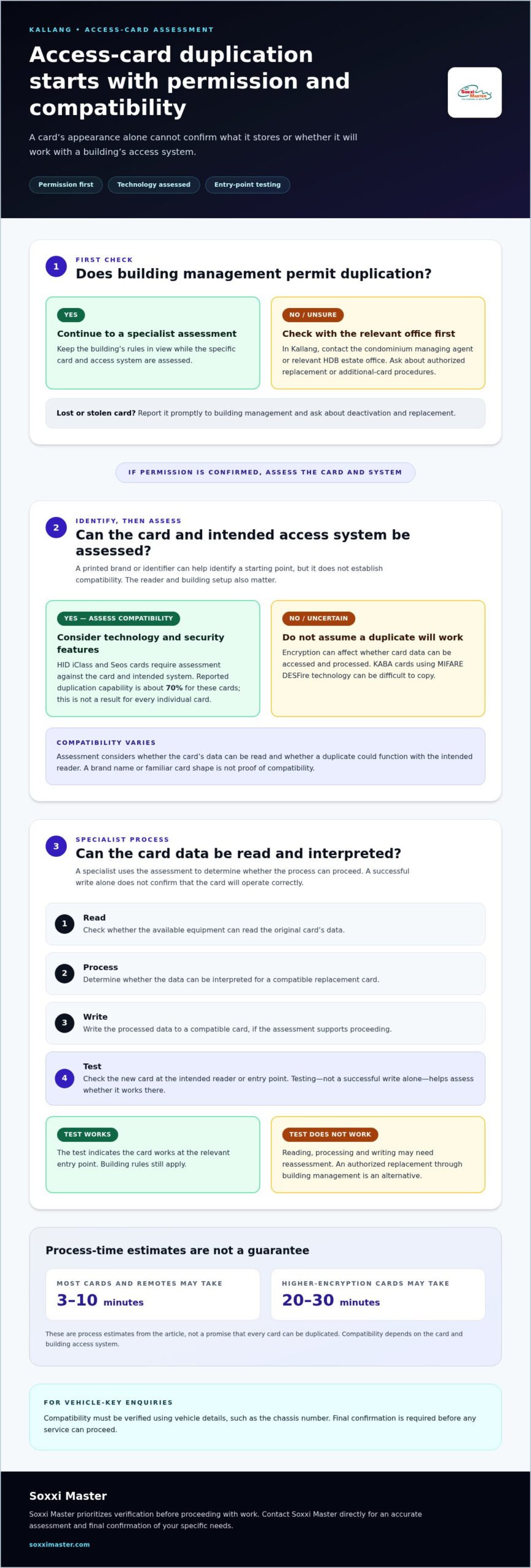
Most cards and remotes may take 3 to 10 minutes to copy. Higher-encryption cards may take 20 to 30 minutes. These are process estimates, not a promise that every card can be duplicated. For details about the service and its steps, see RFID access-card duplication.
For HDB access card replacement, contact the relevant estate or building management office. Ask about replacement procedures and any rules for additional cards. Singapore building or company rules may restrict duplication, even though no specific law against access-card duplication is identified here. Get permission before arranging a duplicate.
An authorised replacement or additional card through building management is a practical alternative that keeps access in line with the property’s procedures. A duplicate might not work with the system or could breach building rules. Handle card data carefully, and don’t arrange duplication without permission.
In Kallang, start with your condominium’s managing agent or the relevant HDB estate office. An access-card specialist can assess whether the card’s technology is compatible. If a card is lost or stolen, report it promptly to building management. Ask them about deactivation and replacement to address the missing card.
Why Choose Us to Duplicate Your Access Card?
For access card cloning, compatibility depends on the card and its access system. Card technology, security features and the reader all matter. Start by identifying any printed brand or card identifier, then assess the specific card rather than relying on its appearance. This provides a clearer basis for deciding what to examine next.
Card Type and RFID Compatibility
RFID cards store data that compatible readers use to grant entry. The card’s label can offer a useful starting point, but it doesn’t establish compatibility by itself. HID iClass and Seos cards require assessment against the card and intended system. Reported duplication capability covers about 70% of HID iClass and Seos cards, so that figure shouldn’t be treated as a result for every card. For Kallang access-card cloning, identifying the precise card type helps set realistic expectations.
Encrypted Card Compatibility
Encryption affects how card data can be accessed and processed. A familiar brand or card shape can’t show whether its security features allow duplication. MIFARE DESFire, for example, is a higher-encryption card type that can be difficult to copy. Assessment should consider its security features alongside the access system, rather than treating the card’s name as proof of compatibility.
A careful assessment separates identification from compatibility. It considers whether the card’s data can be read and whether a duplicate can function with the intended reader. Testing helps assess whether the result works at the relevant entry point. For an assessment, contact an access-card specialist.
Card reading, data processing, writing, and testing
Duplication follows a sequence: read the original, process its data, write to a compatible card, then test it. Each step helps assess whether the new card works with the intended access system.
Reading Card Data
First, a reader scans the original card’s data to determine whether the available equipment can read it. Visible markings alone don’t establish what data the card stores. The read results guide the next step: processing the data or stopping if it can’t be handled. The original card remains the reference for assessing compatibility.
Writing Card Data
After reading, the data is processed for a compatible replacement card and written to it. This depends on whether the original data can be interpreted and the destination card supports the required format. The original card can be read and copied without damage in the described duplication process. However, writing data doesn’t prove that the new card will operate correctly.
Testing the Finished Card
Testing checks the new card against the intended reader or access point. Present it at the same entry point used by the original and confirm that the reader responds as expected. Don’t rely only on a successful write operation. If the card doesn’t work, the reading, processing and writing steps may need reassessment. Testing distinguishes a usable duplicate from one that only contains written data.
Request an access-card assessment
Provider states it reads the original and writes a new card without damaging it. An iPhone or Android phone can identify almost 90% of access-card technologies. Some Android phones’ NFC chips enable emulation of access and other cards.
Soxxi Master: Car & Motorcycle Key Duplication
Soxxi Master provides RFID access card duplication for customers seeking a spare or replacement card. The service covers cards used for entry to condominiums, lifts and digital locks. Compatibility and building rules are important considerations. For vehicle-key enquiries, compatibility is assessed using details such as the chassis number, and final confirmation is required before service proceeds.
Share the card or vehicle details relevant to your request so the service can be assessed accurately. If the card’s technology or encryption affects duplication, that assessment helps clarify the appropriate next step. Contact Soxxi Master directly for an accurate assessment and final confirmation of your needs.
Take the Next Step with Confidence
Before arranging access card cloning, consider how the duplicate will be used and whether building rules allow it. That context helps make your enquiry clear and the next step practical. Soxxi Master also provides Car & Motorcycle Key Duplication and All Keys Lost Solution services, alongside RFID access card duplication.
For vehicle-key work, compatibility must be verified using vehicle details such as the chassis number, with final confirmation required before service proceeds. Share the details relevant to your request so Soxxi Master can assess your needs accurately.
A clear assessment is a good starting point. Take the next step when you’re ready.
Frequently Asked Questions
Can you duplicate HID iClass or Seos cards?
Some HID iClass or Seos cards may be duplicable, but compatibility depends on the individual card and access system. The card family alone can’t establish whether duplication will work. Two cards bearing the same brand may have different security features or system configurations. A proper assessment considers the specific card and its intended reader before proceeding.
What Happens During the Duplication Process?
The process typically involves assessing the original card, reading its data, preparing a compatible card, and checking that it works. Assessment also helps identify whether the card’s technology can be handled. Whether a reader accepts a card depends on the access system, not just the written data. Keep your authorised card until the replacement is confirmed to work.
Is cloning an access card legal in Singapore?
There is no specific law against access-card duplication in Singapore, but building or company rules may restrict it. So permission matters: a resident’s or employee’s access doesn’t automatically mean they may make extra cards. Before arranging a duplicate, review the property’s access-card policy and follow its approval process. This is especially relevant for shared offices and condominiums.
Can a locksmith legally duplicate a condo or office access card?
Whether a service provider can duplicate a condo or office card depends on card compatibility and the premises’ rules. Singapore has no specific law against duplication, but building or company policies may restrict it. A provider’s technical ability doesn’t override those rules. For a workplace, follow the employer’s access-card procedure; for a condominium, follow its management’s requirements.
Which building management offices or locksmiths in Kallang handle access cards?
Start with your condominium’s managing agent or the relevant HDB estate office. An access-card specialist can assess whether your card is compatible.