

A card’s appearance doesn’t show whether it can be copied safely. To decide where to copy an access card safely in Singapore, first check your property’s rules with the management office, then choose a specialist who can assess the card’s technology and compatibility.
It’s reasonable to want a spare without risking reader problems or breaching your building’s rules. This guide explains how card compatibility is assessed and what to know about RFID, NFC, Mifare and HID cards. You’ll learn why frequency or card type alone may not determine compatibility, what to consider before duplication, and how to approach the process responsibly.
Key Takeaways
- Before making a spare, review your property’s rules and get any required approval from its management office.
- Identify the card’s technology and frequency, since matching those details alone may not establish compatibility.
- Understand how RFID and NFC differ, and why phone-based emulation depends on both card support and phone capability.
- For access-card cloning, contact Soxxi Master for an assessment focused on your card and its compatibility.
Is it safe to duplicate my access card?
Making a spare can be appropriate when you’re authorized and the card technology is compatible. In Singapore, check your property’s rules or ask the management office before copying. A duplicate may not work if the access system rejects its format, so test it at an authorized reader before relying on it.
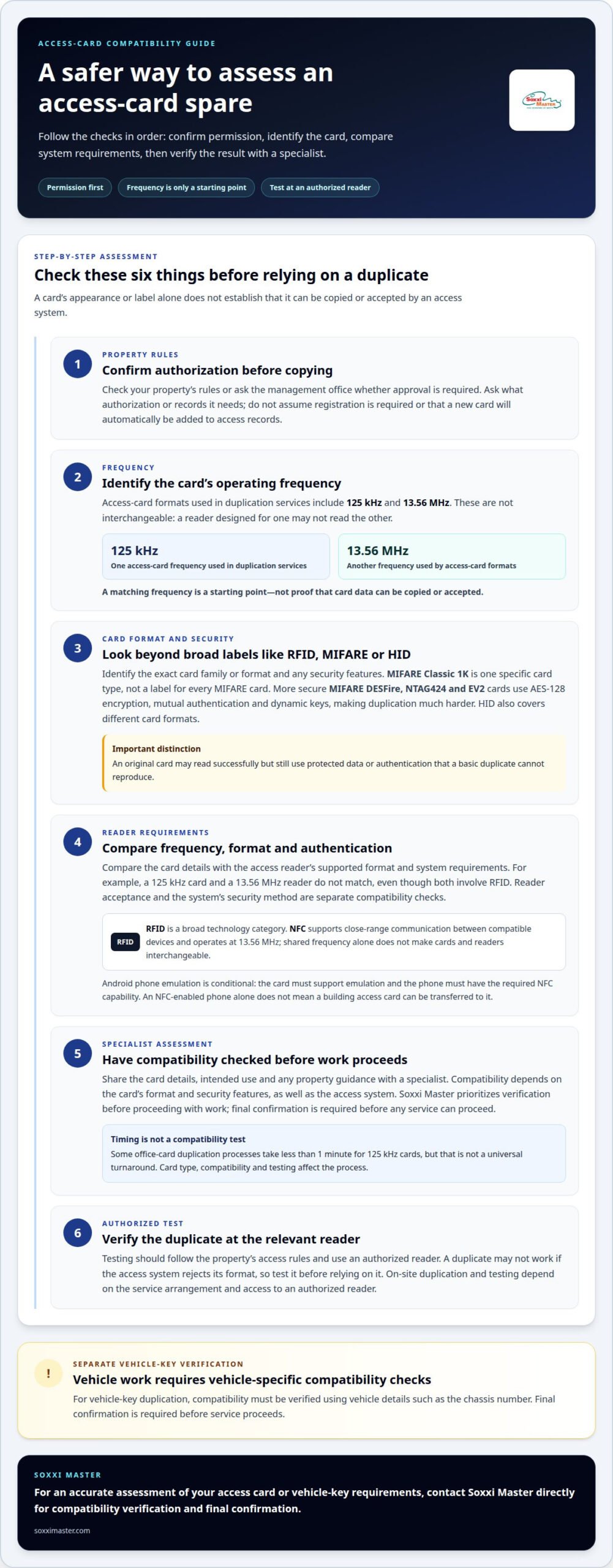
Does copying a condo or office access card require management approval in Singapore? Check the property’s rules and obtain any required approval before duplication. Don’t assume registration is required or that a new card will automatically be added to the property’s access records. Ask management what authorization or records it needs, and keep those instructions with your request.
Some office-card duplication processes take less than 1 minute for 125 kHz cards. That timing isn’t a universal turnaround: card type, compatibility, and testing affect the process. On-site duplication and testing depend on the service arrangement and access to an authorized reader. Bring the original card, explain the intended use, and test the duplicate before depending on it.
Which locksmiths or access-control providers in Singapore duplicate access cards? Look for a locksmith or specialist that explicitly handles RFID cards, and ensure the property permits the work. The key checks are the card’s format, authorization, and whether the duplicate works at the relevant reader. Singapore residents can review the access-card duplication service details for local context.
RFID, Mifare and HID card compatibility
Card compatibility depends on more than its label. Check the frequency, format and security features to assess whether an original can be duplicated.
RFID Technology Compatibility
RFID cards communicate with readers using radio signals, but frequency matters. Access-card formats used in duplication services include 125 kHz and 13.56 MHz. These frequencies aren’t interchangeable: a reader designed for one may not read the other. Check the card or system documentation for its frequency, then compare that detail with the reader’s supported format. A matching frequency is a starting point, not proof that the card’s data can be copied or accepted.
Card Type Matching
MIFARE Classic 1K is one specific card type, not a label for every MIFARE card. More secure MIFARE DESFire, NTAG424 and EV2 cards use AES-128 encryption, mutual authentication and dynamic keys, making duplication much harder. HID also covers different card formats; typical HID cards are described as operating at 13.56 MHz. Check the exact card type and system requirements, rather than relying on “MIFARE” or “HID” alone.
Use this practical sequence: identify the frequency, find the card family or format, then compare it with the access reader’s requirements. For example, a 125 kHz card and a 13.56 MHz reader don’t match, even if both are RFID. An original card that reads successfully still may use protected data or authentication that a basic duplicate can’t reproduce. Treat the reader’s acceptance and the system’s security method as separate compatibility checks. Testing should use an authorized reader and follow the property’s access rules.
RFID and NFC access-card technologies
RFID is a broad technology category, while NFC supports close-range communication between compatible devices. Access cards may use different frequencies and communication methods, so the label “RFID” alone doesn’t identify how a card behaves. For example, 125 kHz EM4100 cards are used for access control. NFC operates at 13.56 MHz, but sharing a frequency doesn’t make every card or reader interchangeable.
This distinction matters when assessing a spare. The reader must support the card’s format and the system’s authentication method. A card that responds to a reader may still contain protected data that a simple copy cannot reproduce. Check the card information or system documentation, then compare it with the reader’s requirements. Don’t assume a phone, card and reader are compatible just because they use contactless technology.
Android phone emulation is conditional. An Android phone can emulate an NFC card only if the card supports emulation and the phone has the required NFC capability. An NFC-enabled phone alone doesn’t mean a building access card can be transferred to it. Both the card technology and the phone’s supported functions matter. Confirm these details through the access-system information before relying on mobile access.
Use a practical check: identify whether the card uses RFID or NFC, establish its frequency and format, and confirm the reader’s requirements. Then distinguish ordinary communication from secure authentication. This explains why access cards that look alike may work differently. It also helps you describe the card accurately when arranging a professional compatibility assessment in Singapore.
Soxxi Master: Car & Motorcycle Key Duplication
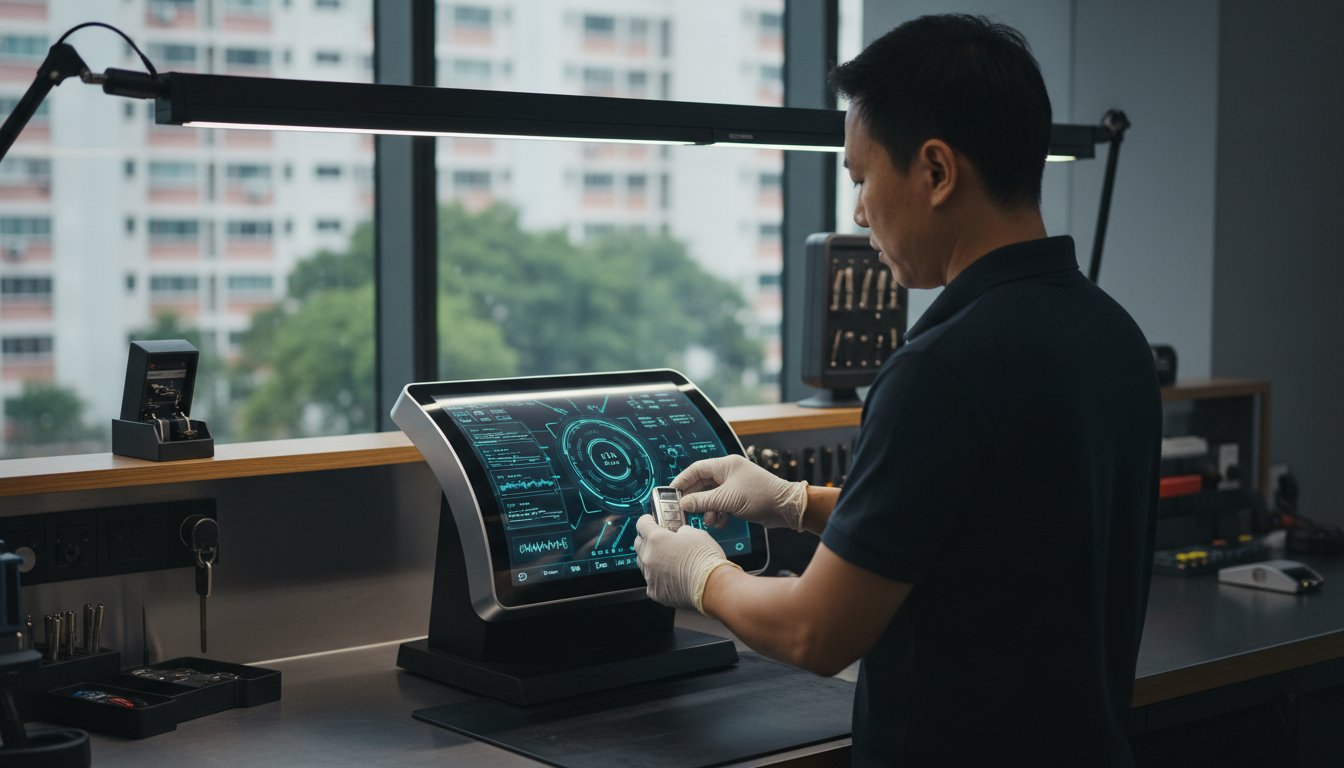
Soxxi Master provides RFID access-card cloning for people who need an authorized spare after checking their property’s requirements. The service takes card compatibility into account, since the access system’s format and security features affect whether a duplicate will work. Share the card details and intended use for an assessment before proceeding.
For vehicle-key duplication, compatibility is verified using vehicle details such as the chassis number. Final confirmation is required before service proceeds. This verification-first approach helps match the requested work to the specific vehicle or access card.
Make your next step a clear assessment
If you’re deciding where to copy an access card safely, describe the card, its intended use and any management approval. An assessment can clarify whether its format fits the access system before you rely on a spare. Keep relevant card information and written property guidance handy, and explain who will use the duplicate.
Soxxi Master offers RFID Access Card Cloning, Car & Motorcycle Key Duplication and an All Keys Lost Solution. For vehicle-key work, compatibility is verified using vehicle details such as the chassis number. Final confirmation is required before service proceeds.
A clear description of your needs helps the specialist assess the request and discuss next steps.
Frequently Asked Questions
How can you copy access cards?
A specialist assesses the original card and, when compatible, copies its data to a new card. Keep the original available and explain whether you need a spare or replacement. If it’s a replacement, tell the property manager too, so they can advise how to handle the old credential and its access.
What if the duplicated card doesn’t work?
Describe exactly what happens, such as whether the reader shows an error or gives no response. Note which door or lift is affected and whether the original card still works there. These details can help distinguish a card issue from an access-permission issue. Share them with the property manager and the service provider before requesting further work.
How do I proceed with the duplication?
Explain the purpose of your request first: a spare for another authorized user or a replacement for a missing card. If the original is lost, tell the property manager promptly and ask how to handle its access privileges. This addresses the missing credential separately from arranging a replacement.
Where can I safely copy an access card in Singapore?
If you’re looking for where to copy an access card safely in Singapore, contact Soxxi Master for an assessment of your needs. Share the card’s intended use and any instructions from the property manager. This gives the specialist useful context to discuss your request and next steps, without assuming every access system handles cards alike.
How can I tell whether an access card can be legally and technically duplicated?
When deciding where to copy an access card safely, separate permission from technical suitability. Ask the card issuer or property manager what authorization applies, and keep their response with your request. Then describe the card and its intended use to Soxxi Master. Possessing a card alone should not be treated as permission to reproduce it.