

In Singapore, duplicating your own access card for personal use is generally legal, but building or workplace rules may restrict it. Office access card duplication in Singapore isn’t a blanket permission to enter anywhere: using a copy to access areas you’re not authorised to enter can be unlawful. Check the rules that apply to your building or workplace before making a duplicate.
It’s sensible to want a spare card, especially when losing access could disrupt your workday. The important questions are whether the card type can be copied and whether you’re authorised to do so. This guide explains supported card types, how duplication works, what Singapore law and management rules mean for your own card, and when a specialist service may help.
Key Takeaways
- Card technology and encryption affect whether a duplicate can be made; some common card families are more compatible than others.
- Understand how access-card technology influences the duplication process and the result you can expect.
- Building management rules, workplace policies and lease terms can affect whether copying a card is permitted in your situation.
- Learn what to consider when choosing a duplication service and when specialist RFID access card cloning may be useful.
Why Choose Us to Duplicate Your Access Card?
Card technology affects compatibility, pricing, and reported success rates. Understand these factors before requesting a copy.
Standard and Encrypted Card Pricing
Standard, unencrypted cards and encrypted cards involve different duplication requirements. The price depends on card technology, encryption, and the work involved, and is given after a quote request. To request a copy, provide the existing card and identify its workplace or building. Explain that you’re authorised to request it; management approval may apply. A specialist can assess the card before proceeding. Learn about door access card duplication and the factors that shape the assessment.
Duplication Success Rates
Reported figures list a 100% success rate for standard unencrypted cards and 95% for high-encryption cards. These figures differ because card systems use different data and security protections. Card family and encryption level affect whether copying is technically supported. A percentage shouldn’t be treated as a promise for every card. The relevant question is whether the specific card can be read and duplicated compatibly.
Lost, Damaged, or Unauthorised Cards
If your card is lost, damaged, or copied without permission, notify your workplace or building management promptly. They can advise on access controls, cancellation, and replacement procedures. A damaged card may not provide readable data, while a lost card creates an access-security concern. If you suspect an unauthorised copy, report when and where you noticed the issue. Don’t request another copy until you have permission and management guidance.
Bulk pricing is available. The vendor claims 99% success for compatible cards; EM4100 and HID Proximity duplication is 99%.
Supported access card brands and types
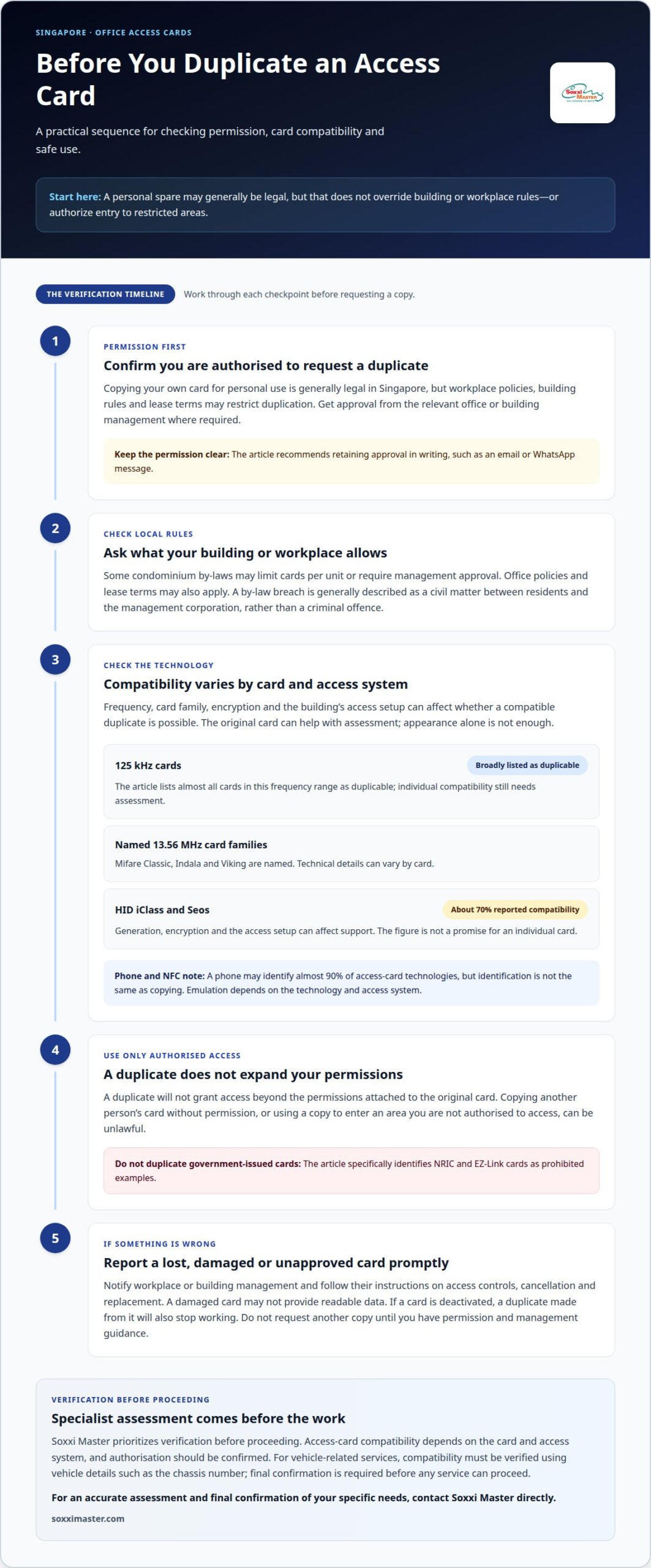
Office access card duplication in Singapore may be possible for common 125 kHz cards. Almost all cards in this frequency range are listed as duplicable. Mifare Classic, Indala, and Viking cards are also recognised types. Their technical details can vary by card. Compatibility depends on the card and the access system.
HID iClass and Seos cards have more limited support. About 70% of these cards are listed as duplicable. The brand name alone doesn’t establish compatibility. Card generation, encryption, and the building’s access setup can affect whether a copy works. These factors matter in office access card duplication in Singapore.
- 125 kHz: almost all cards in this frequency range are listed as duplicable.
- 13.56 MHz: Mifare Classic, Indala, and Viking are named card families.
- HID iClass and Seos: reported compatibility is about 70%.
Not every Singapore office access card can be duplicated. Common 125 kHz types and named 13.56 MHz families may be compatible, while some HID iClass and Seos cards are supported. Some cards cannot be copied because their technology or encryption prevents compatible duplication.
The original card helps identify its technology during assessment. Appearance alone isn’t enough: similar-looking cards may use different systems. Frequency, card type, and encryption affect compatibility, while building rules determine whether a copy is authorised. A duplicate also won’t grant access beyond the permissions attached to the original card.
For a card-specific assessment, review the details of door access card duplication.
Legality of duplicating your own access card in Singapore
Singapore has no specific law directly governing access-card duplication. The Computer Misuse Act and general property laws may be relevant. Copying your own card for personal use is generally legal, but that doesn’t override building or workplace rules.
Can a phone or NFC app copy a Singapore office access card? A phone may identify almost 90% of access-card technologies, but identification isn’t the same as copying. Whether a phone can emulate a card depends on its technology and the access system.
Permission and intended use matter. Copying another person’s card without permission, or using a duplicate to enter an area you’re not authorised to access, is illegal. Duplicating government-issued cards, including NRIC and EZ-Link cards, is also illegal. A personal spare for an authorised office door is different from copying someone else’s credentials.
Building rules can add another layer. Some condominium by-laws limit cards per unit or require management approval for duplicates. Office policies, lease terms, and management requirements may also restrict copies. A by-law breach is generally a civil matter between residents and the management corporation, rather than a criminal offence.
Before requesting a copy, confirm permission with the relevant office or building management. If a card is deactivated, a duplicate made from it will also stop working. For a lost or unapproved card, report the issue promptly and follow management’s instructions. Keep any approval in writing, such as an email or WhatsApp message, so the authorised request is clear.
Soxxi Master
Soxxi Master provides RFID access card cloning for readers who need an authorised spare. The card’s technology and the building’s rules shape whether duplication is suitable. If a card is lost, damaged, or no longer works, consider its status and access permissions before requesting a copy.
For vehicle-related services, compatibility is verified using vehicle details such as the chassis number. Final confirmation is required before service proceeds. This verification-first approach helps establish the right next step for your request.
Choose a Clear Next Step
For office access card duplication in Singapore, have your access permissions and card details ready. Soxxi Master offers RFID Access Card Cloning, Car & Motorcycle Key Duplication, and an All Keys Lost Solution. Each service addresses a different access or key need, so describe your situation accurately when getting in touch. For vehicle key work, compatibility must be verified using vehicle details such as the chassis number, and final confirmation is required before service proceeds.
A considered assessment helps you move forward with clarity. Contact Soxxi Master to discuss your access card and the appropriate next step.
Frequently Asked Questions
How can I know whether my access cards can be duplicated?
Card identification and a compatibility assessment can indicate whether duplication is possible. The card’s technology, frequency, and encryption affect the result. For example, two cards with similar designs may use different systems. Have the original card assessed rather than relying on its appearance or a printed brand name alone.
Can you duplicate HID iClass or Seos cards?
Some HID iClass and Seos cards can be duplicated, but compatibility varies by card. Reported support is about 70% for these card types. A card’s specific technology and security configuration affect suitability. The card needs individual assessment, so the brand name alone cannot establish whether a copy will work.
How Does This Compare to Going Through Management?
Management can issue an authorised replacement and handle its access permissions, but replacement through a condo or HDB management office typically takes 1-7 working days. Duplication can be another option when permitted by workplace or building rules. Management remains the right contact for lost-card deactivation, approval requirements, and changes to access permissions.
How long does it take?
Access-card duplication generally takes 5-45 minutes, depending on the card system. Simpler cards may take less time, while higher-encryption cards can require more detailed work. This is the duplication time, not a management-issued replacement timeframe. The card’s technology and whether it can be read affect the process.
Is it legal to duplicate an office access card in Singapore?
Copying your own office access card for personal use is generally legal in Singapore, but workplace policies may restrict duplicates. Copying or using an access card without permission may breach workplace or building rules. Get the necessary workplace approval first, and don’t confuse permission to copy with permission to access every area.