

Why should securing a simple spare key for your own home involve weeks of waiting and administrative hurdles that feel more like a penalty than a service? Most Singapore residents find themselves caught between the high administrative fees of their MCST and the urgent need for a reliable backup. Obtaining a condo management approved access card copy often feels unnecessarily complex, especially with the 2026 shift toward advanced ISO/IEC security standards and AES-128 encryption. You need a solution that works, but you’re likely concerned about whether a third-party card will actually trigger the reader when you arrive home.
We understand the frustration of dealing with proprietary systems and the confusion surrounding different RFID or Mifare technologies. This guide provides a clear path to understanding the technical requirements and policy limitations of your specific access system. You’ll learn how professional verification ensures your spare card remains functional, the impact of new high-security standards on cloning, and how to identify a specialist who prioritizes technical precision. Success depends on compatibility, and understanding these variables is the first step toward a seamless entry experience.
Key Takeaways
- Identify the technical distinctions between Low Frequency RFID and High Frequency Mifare systems to determine your card’s specific duplication requirements.
- Learn what defines a condo management approved access card copy and how modern security protocols might impact the functionality of duplicated IDs.
- Understand the importance of professional verification for encrypted systems, as compatibility varies depending on the specific model and security version used in your building.
- Find out why an expert approach involving technical precision is necessary to navigate the policy and technical limitations of contemporary access control.
The Search for a Condo Management Approved Access Card Copy
Residents in Singapore often find themselves searching for a condo management approved access card copy when their household needs change. Whether it is for a new tenant, a visiting family member, or simply a backup for a misplaced original, the term “approved” usually carries two distinct meanings. Technically, an approved card is one issued and registered by the Management Corporation Strata Title (MCST). However, for many residents, “approved” simply means a card that functions reliably across all building readers without causing technical errors. Understanding this distinction is the first step in resolving access issues efficiently.
The MCST plays a central role in maintaining the security of the estate. They oversee the installation and maintenance of the specific access control systems used at guardhouses, lift lobbies, and side gates. Because every condominium development selects its own hardware and encryption protocols, functional compatibility is never a given. A copy that works at one development might fail at another because of the specific frequency or security handshake required by the reader. This technical variety is why a professional assessment is necessary before any duplication is attempted.
Official Issuance vs. Third-Party Duplication
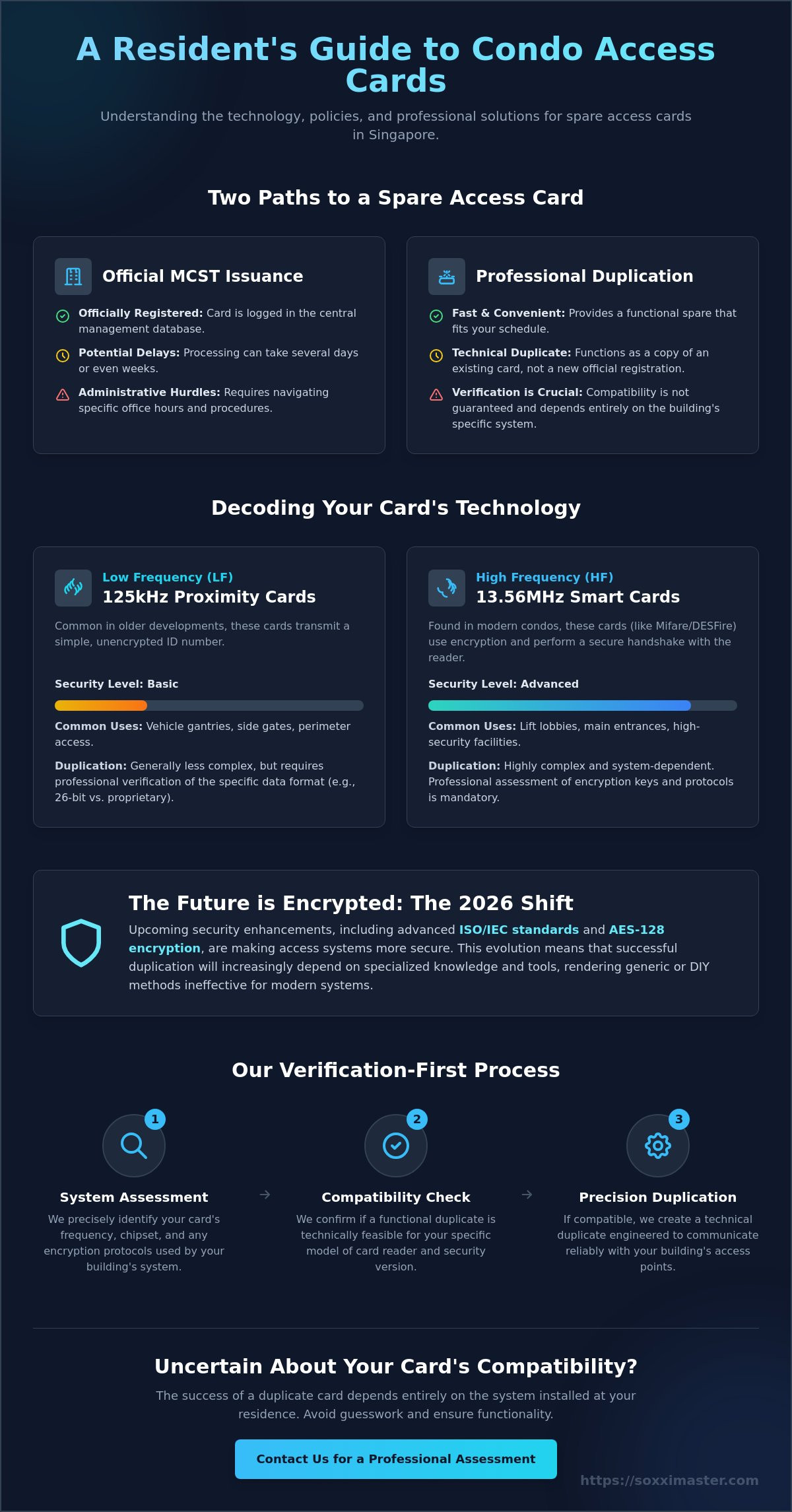
Obtaining a card through the management office follows a set administrative procedure. This path ensures the card is registered in the central database, but it often requires residents to navigate specific office operating hours and lengthy processing times. Many residents explore professional RFID access card cloning services because they need a solution that fits their schedule. Before proceeding, it’s prudent to review your specific condo by-laws. Some estates have clear guidelines regarding the maximum number of active cards permitted per unit, and staying informed helps you manage your access needs responsibly.
The Resident’s Dilemma: Cost and Convenience
Waiting for an official management request to be processed can take days or even weeks in some developments. This delay creates a significant inconvenience, especially if you have lost your only means of entry. A spare card serves as a vital safety net, ensuring you aren’t locked out of your own home due to a simple accident or a damaged original. It’s vital to remember that while a specialist can provide a functional copy, this card exists as a technical duplicate of your original ID. It allows for seamless entry based on the permissions already granted to your unit, providing the convenience you need without the administrative wait. Final confirmation of compatibility is always required, as the success of the duplication depends entirely on the specific system installed at your residence.
Understanding Modern Condo Access Technology (RFID vs. Mifare)
Understanding the hardware behind your entry system is essential for any resident. In Singapore, condo security has evolved from simple proximity sensors to complex, encrypted smart systems. While you might seek a condo management approved access card copy for convenience, the feasibility depends on the technical architecture of your building. Every system has its own “language.” If the duplicate doesn’t speak it perfectly, the reader will simply ignore it. Compatibility is never assumed; it must be verified against the specific encryption protocols of your estate’s management system.
125kHz Proximity Cards: The Traditional Standard
Many older developments still utilize 125kHz proximity technology. These cards are frequently used for vehicle gantry access and general perimeter gates. Brands like HID or EM-style cards are common in this category. These systems function by broadcasting a simple, unencrypted identification number when they enter the reader’s magnetic field. Because these signals are straightforward, they are generally easier to duplicate compared to modern smart cards. However, a specialist must still identify whether your card uses a standard 26-bit format or a proprietary structure. This level of detail ensures that your spare card functions exactly like the original, providing the reliability you expect from a professional service.
13.56MHz Smart Cards: Advanced Security Layers
Modern Singapore condos have increasingly adopted 13.56MHz smart cards, primarily Mifare and DESFire technologies. These systems offer significantly higher protection by utilizing encrypted data sectors. Unlike traditional RFID, these cards perform a mutual authentication process with the reader. This means the card and the reader must both “prove” their identity before access is granted. This is the primary reason why some residents find that cheaply made clones fail at the lift lobby even if they work at the side gate.
If your system uses the latest security protocols, such as AES-128 encryption, the reader may even flag and block unauthorized IDs. Professional verification is the only way to determine if your card can be successfully duplicated without compromising the system’s integrity. For residents who want to understand the nuances of these systems, our Access Card Duplication Guide provides a comprehensive breakdown of these security tiers. If you are unsure which technology your building uses, you can contact a specialist for a technical assessment to ensure your spare card remains fully functional across all access points.
Management Policies vs. Technical Functionality: What Approved Means
Residents often assume that every plastic card or fob is inherently duplicable. This is a common misconception. In reality, the “approved” status of a credential is tied to both the building’s administrative records and the technical capabilities of the hardware. When you look for a condo management approved access card copy, you are balancing the need for convenience with the rules of your residence. Professional service providers prioritize the integrity of the existing access system, ensuring that any work performed does not compromise the security of the building or the functionality of the original card.
Ethical considerations are just as important as technical ones. A professional specialist acts as a technical consultant rather than just a service provider. This means prioritizing the long term stability of your access credentials. If a system is designed with specific security flags that block duplicated IDs, a responsible expert will inform you of these risks. This transparency ensures you don’t invest in a solution that could be deactivated by a future system audit or software update conducted by the MCST.
Compliance and System Integrity
Technical experts refuse to bypass high-level security encryptions because doing so can lead to system instability. A professional RFID access card cloning service focuses on creating a reliable technical replica that mirrors the original’s permissions without triggering security alerts. Residents should understand that a professional duplicate is designed to work in harmony with the reader. It doesn’t interfere with the original card’s operation or overwrite existing data. This conservative approach is necessary because modern readers are increasingly sophisticated. They can often detect if a card’s internal signature has been improperly replicated, which could lead to the card being blacklisted by the management software.
When Duplication May Not Be Possible
Not every access credential can be copied. Some modern systems utilize proprietary locks or “rolling codes” that change every time the card is used. In these instances, a third-party copy will fail immediately or after a single use. As of May 2026, new ISO/IEC security standards have introduced even more robust cryptographic suites, such as SIMON and SPECK, which are specifically designed to prevent unauthorized cloning. While a condo management approved access card copy is the goal for many, technical barriers sometimes exist that prioritize building safety over duplication convenience.
An honest assessment is far more valuable than a sale that results in a non-functional product. If a card features advanced anti-cloning mechanisms or AES-128 encryption that is tied to a specific building controller, duplication may not be technically feasible. Residents should look for specialists who provide clear, transparent communication regarding these limitations. Final confirmation is always subject to a physical verification of the card’s specific security version to ensure the outcome meets professional standards.
The Professional Duplication Process: Verification and Precision
Many services suggest that a simple photo sent via messaging apps is enough to assess compatibility. This approach is often technically insufficient for modern high-frequency cards. A truly reliable condo management approved access card copy requires a hands-on technical assessment using specialized diagnostic equipment. This process ensures that the duplicate not only contains the correct identification data but also broadcasts a signal strong enough to be recognized by your building’s specific readers across all entry points.
Precision is the difference between a card that works every time and one that leaves you stranded at the lift lobby. Every condominium uses a unique combination of hardware and software. Professional duplication focuses on replicating the electronic signature of your original credential with absolute accuracy. This methodical approach respects the security parameters of the MCST while providing you with the convenience of a functional spare.
Step 1: Technical Assessment and Identification
The process begins by using high-precision readers to identify the exact chip type and operating frequency of your original card. It isn’t enough to simply categorize it as a “smart card.” A specialist must determine if the system utilizes Mifare DESFire, Classic, or more advanced Ultralight protocols. We check for open sectors and specific encryption locks that might prevent a successful duplicate. This thorough Duplicate Door Access Card Service approach helps identify potential blocks before any data is written, ensuring that the final product is compatible with your estate’s specific readers.
Step 2: Signal Accuracy and Testing
Once the technical profile is established, the data is written to a high-quality replacement chip. Signal accuracy is paramount during this stage. If the internal antenna in the copy is poorly tuned, a car park gantry reader may fail to pick up the signal through a windshield. We verify that the signal strength and response time of the copy match the original’s specifications. After the duplication is complete, we always recommend that you test the card at your specific lift or gate. Because system software varies by estate, this final real-world test is the only way to confirm total compatibility with the building’s infrastructure.
Versatile Form Factors for Daily Use
Residents aren’t always limited to the standard credit-card size for their spare. Depending on the system frequency and chip type, you can often choose a form factor that better suits your lifestyle:
- Compact Key Fobs: Durable, water-resistant, and easy to attach to your existing key ring.
- Adhesive Stickers: These can be placed on the back of a mobile phone for tap-and-go convenience at side gates.
- Standard ISO Cards: The traditional choice, ideal for keeping in a wallet or a dedicated lanyard.
If you need a reliable assessment of your current credential, contact our team for a professional verification to ensure your spare card remains fully functional.
Choosing a Specialist for Your Access Card Needs
Selecting the right service provider for electronic access duplication is a matter of building security and technical reliability. While many local shops might offer basic key cutting, duplicating a modern condo management approved access card copy requires a deep understanding of electronic communication protocols. A specialist with a background in automotive and electronic keys is uniquely equipped for this task. They understand the nuances of transponder signals and encryption, which are the same principles that govern secure building access today.
Expertise in this field isn’t just about owning the right tools. It’s about having the diagnostic experience to identify why a card might fail and the integrity to explain when a system cannot be duplicated. Transparent communication regarding compatibility is a hallmark of a professional service. You should expect a clear assessment of whether your specific card type is supported, as every estate utilizes different security layers that vary by system. Final confirmation of functionality is always subject to an on-site technical evaluation of the original credential.
The Soxxi Master Advantage
Our approach combines traditional technical mastery with contemporary electronic expertise. Having worked with a wide range of Singapore condo systems over several years, we recognize that every development presents its own set of technical challenges. We maintain a conservative approach, prioritizing accuracy over speed. We don’t overpromise on highly encrypted cards; instead, we provide a professional environment where residents can receive a factual assessment of their access needs. This focus on precision ensures that the final product functions as intended without interfering with the integrity of the building’s security infrastructure.
How to Consult with Our Specialists
To ensure the most accurate results, we require a physical assessment of your current credential at our service center. Residents seeking a functional access solution can follow these simple steps to begin the process:
- Bring your original card: We need the primary credential to perform a diagnostic scan of the frequency and chip type.
- Identify the system: Providing the name of your condominium or the brand printed on the card reader helps our specialists prepare the necessary equipment for your inquiry.
- Receive a verification: Our team will confirm if your card can be successfully duplicated based on its specific encryption and security version.
Technical requirements vary depending on the model and system version installed at your residence. If you are ready for a reliable assessment, contact Soxxi Master for a professional assessment and confirmation of your specific access card needs.
Secure Your Building Access with Technical Precision
Navigating the complexities of modern security requires more than just a simple duplicate. Understanding the technical distinction between unencrypted RFID and advanced Mifare systems is essential for every resident. A functional condo management approved access card copy is the result of careful verification and precise data replication. By prioritizing system integrity, you ensure that your spare card works in harmony with the building’s readers without triggering security blocks or deactivation. Accuracy in the duplication process is what maintains the reliability of your daily entry.
As a pioneer in Singapore’s automotive and electronic key services, we provide the technical expertise needed for these sophisticated systems. Our service center at 37 Jalan Pemimpin is equipped with specialized RFID and Mifare diagnostic equipment to analyze your specific credential. Compatibility varies by system and estate, so a physical assessment is always the most reliable path forward. You can consult a specialist for your condo access card assessment to verify your card’s requirements and receive a functional solution. We look forward to helping you secure a dependable backup for your home.
Frequently Asked Questions
Is it illegal to duplicate my own condo access card in Singapore?
Duplicating an access card is not a criminal offense in Singapore, but residents should review their specific MCST by-laws or tenancy agreements. These private contracts often contain clauses regarding unauthorized duplication for security purposes. While a specialist can provide a technical copy, the resident remains responsible for adhering to the governing rules of their estate to ensure they remain in compliance with their building’s management policies regarding a condo management approved access card copy.
Can every type of condo access card be copied?
Not every access card is subject to duplication. While many standard 125kHz RFID and certain Mifare 13.56MHz cards can be replicated, modern systems utilizing advanced encryption like DESFire EV3 or proprietary rolling codes are designed to prevent unauthorized cloning. Technical feasibility depends entirely on the specific hardware and software version used by your building. A professional diagnostic assessment is required to determine if your particular credential can be successfully copied.
Will my condo management know if I am using a duplicated card?
Most traditional readers cannot distinguish a high-quality technical duplicate from the original card. However, some sophisticated modern systems feature anti-cloning protocols that monitor for duplicate ID signatures or unusual access patterns. If a reader detects a cloned chip signature, it may flag the entry in the management software. This is why professional verification is necessary to ensure the duplicate functions correctly without triggering system alerts or security flags during daily use.
What is the difference between an RFID card and a Mifare card?
The primary difference lies in operating frequency and security protocols. Standard RFID cards usually operate at a Low Frequency of 125kHz and broadcast an unencrypted ID number. In contrast, Mifare cards utilize a High Frequency of 13.56MHz and include encrypted data sectors for enhanced security. Obtaining a condo management approved access card copy for a Mifare system is more complex, requiring specialized equipment to navigate the encryption layers used by modern condominiums.
Can you duplicate the access card into a smaller sticker or key fob?
Duplication into alternative form factors like compact fobs or adhesive stickers is often possible, subject to technical compatibility. These options provide residents with added convenience, such as attaching a fob to a key ring or placing a sticker on a mobile device. However, the success of this conversion depends on the specific chip type and frequency of your original card. A specialist must verify that the new form factor can house the required technology for your specific readers.
What should I do if my duplicated card stops working after a system update?
If a duplicate stops functioning after a management system update, it may be due to new security patches or changes in the building’s encryption protocols. Some advanced readers are updated to block specific chip types used in duplication. In these cases, you should consult with your service provider for a re-assessment. They can determine if the system has shifted to a new security standard that no longer supports the existing duplicate’s technology or if a different chip is required.
Do I need to bring my original card to your shop for duplication?
Physical access to the original card is essential for a successful duplication. A specialist must use diagnostic readers to identify the chip’s frequency, protocol, and any existing encryption locks. This hands-on assessment ensures that the data is read accurately and that the replacement chip is correctly configured. Without the original card, it is impossible to verify the technical requirements necessary to create a functional and reliable copy for your specific building infrastructure.
Can you duplicate cards that have lift level restrictions?
Lift level restrictions are typically managed by the building’s central database rather than the card itself. Because a technical duplicate replicates the exact ID number of your original credential, the system should recognize it and grant the same access permissions. However, success varies by system, especially if the estate uses advanced read-write protocols that update data on the card itself. Final confirmation is always required after a professional evaluation of your specific card’s architecture.