


A “Do Not Duplicate” stamp doesn’t stop an ordinary key from being copied. It has no built-in legal or technical control, and a locksmith may duplicate the key if the person requesting it signs a form confirming they’re authorised. A guarantee for duplicated keys concerns whether the copy works, not whether the stamp prevents copying.
It’s understandable to expect the wording to restrict access to your key, but the stamp alone can’t enforce that restriction. This article explains what it can and can’t do, how key-control processes differ from a stamped warning, and what to consider when you need a duplicate. You’ll also learn what a duplication guarantee may cover, so you can make a clearer decision about your key security.
Key Takeaways
- Treat a stamp as a warning, not a reliable way to control who can obtain a copy.
- Key-control processes rely on recorded authorisation, which is different from stamping an ordinary key.
- Understand what a duplication refund covers: whether the copy works is separate from whether copying was restricted.
- For vehicle-key services, provide vehicle details such as the chassis number; compatibility must be verified and final confirmation is required before work proceeds.
What a Do Not Duplicate stamp does and does not prevent
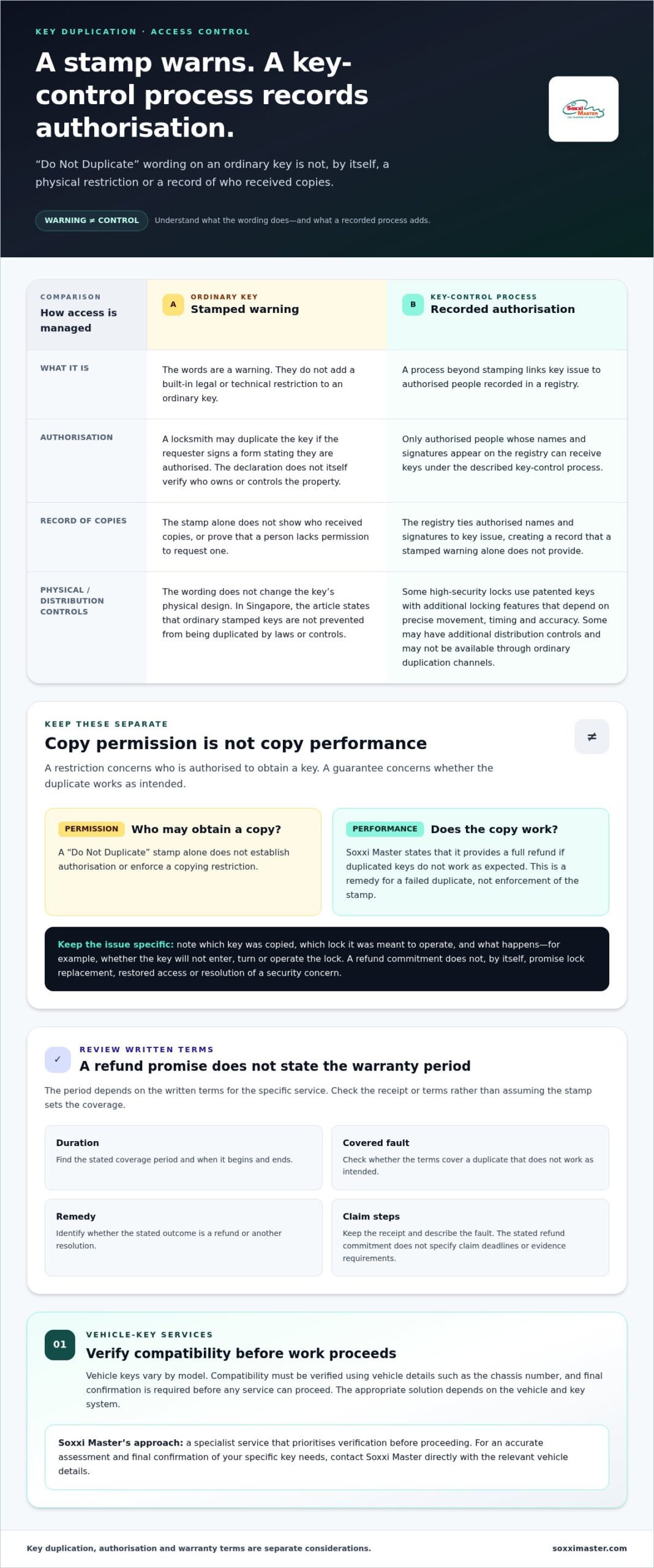
A “Do Not Duplicate” stamp on an ordinary key does not stop someone from copying it. The words are a warning, not a physical restriction built into the key. In Singapore, no laws or controls prevent an ordinary stamped key from being duplicated. A locksmith may make a copy when the person requesting it signs a form stating they’re authorised.
The stamp also doesn’t prove that a person lacks permission to copy the key. For example, a tenant or staff member might present a stamped key and sign an authority form. The wording alone doesn’t verify who owns the property or controls access. The form records a declaration; it doesn’t change the key’s physical design.
Damaged or worn keys raise a separate issue. A stamp doesn’t itself establish exclusions for damaged, worn, or restricted keys, nor does it set guarantee terms. The key’s condition can affect whether a duplicate works, while a restriction relates to who is authorised to obtain it. Those are distinct considerations.
Actual control requires a process beyond stamping. In a key-control system, only authorised people whose names and signatures appear on the registry can receive keys. High-security locks may also use patented keys with additional locking features that depend on precise movement, timing, and accuracy. Some high-security keys may be subject to additional distribution controls and may not be available through ordinary key-duplication channels.
For example, a property manager relying only on a stamped common-door key has a warning, not a record of who received copies. That’s different from a registry that ties authorised names and signatures to key issue. A stamp on an ordinary door key also doesn’t describe the functions of car remote keys, a separate key category.
What does a guarantee for duplicated keys cover?
A guarantee for duplicated keys addresses the copy’s performance, not permission to copy it. Soxxi Master states that it provides a full refund if duplicated keys don’t work as expected. This sets out the remedy if a duplicate fails its intended function. It doesn’t mean the key’s “Do Not Duplicate” stamp has been enforced.
Consider a simple example: a copied door key won’t turn the lock, even though the original does. That is a functional problem with the duplicate. A refund commitment should not be read as a promise to replace a lock, restore lost access, or resolve a security concern. Those are different outcomes from refunding the cost of an unsuccessful duplicate.
Keep the issue specific. Note which key was copied, which lock it was meant to operate, and what happens when you use it. For example, describe whether the key won’t enter, turn, or operate the lock. This makes the problem easier to explain without assuming the cause. Don’t treat damage to the original key or a change to the lock as proof that the copy itself is defective.
The stated refund commitment does not provide details about a claim deadline, evidence requirements, or how a refund is requested. Don’t assume those terms. If a duplicate fails, explain the exact problem and ask about the applicable refund process. For a clear assessment of a key-copy issue, contact the specialist directly with the key and the problem you’re experiencing.
Soxxi Master states that it provides a full refund if duplicated keys do not work as expected. This identifies the remedy for a copy that fails its intended use, while leaving any other remedy or process unspecified.
When describing a failure, focus on what the duplicate does or does not do. Contact Soxxi Master and ask how the refund applies to that specific issue.
How long is the warranty on duplicated keys in Singapore?
A key’s warranty period can’t be worked out from the word “duplicated” alone. In Singapore, look for the duration in the written terms for that specific service. The period and the remedy are separate details: a refund promise, for example, explains what may happen if a copy fails, but doesn’t by itself establish how long the coverage lasts.
Before relying on a warranty, check the receipt or written terms for its start date and end point. Also note what the coverage applies to. A duplicate that won’t operate the intended lock is a different issue from a damaged original key or a lock that has changed. Clear wording helps distinguish a problem with the copy from other causes.
Use this checklist when reviewing the terms:
- Duration: Find the stated coverage period and when it begins.
- Covered fault: Check whether the terms address a duplicate that doesn’t work as intended.
- Remedy: Identify whether the stated outcome is a refund or another resolution.
- Claim steps: Keep the receipt and note the fault, such as a key that won’t turn the lock.
For example, if a copied key fails soon after duplication, the date of service and the written coverage terms help establish whether the issue falls within the stated period. Don’t assume that a stamp on the original sets the warranty duration. It concerns copying restrictions, not the timeframe for a claim.
Read the applicable terms before relying on a guarantee for duplicated keys. If the wording is unclear, ask Soxxi Master to explain the duration and remedy before proceeding.
The warranty period depends on the written terms for the specific service. Check those terms for the coverage duration and when it begins and ends.
Soxxi Master: Car & Motorcycle Key Duplication
Soxxi Master provides car and motorcycle key duplication for drivers who need a working spare or replacement. Vehicle keys can vary by model, so compatibility must be verified using vehicle details such as the chassis number. Final confirmation is required before any service can proceed.
This verification-first approach helps establish whether the requested key service matches the vehicle. Share the relevant vehicle information and describe your need, such as duplicating an existing key or seeking help after losing all keys. The appropriate solution depends on the vehicle and key system.
Choose the next step that fits your access needs
Before arranging a key service, identify the problem you need solved: an additional vehicle key, a replacement after losing every key, or access through an RFID card. That distinction helps you describe your situation clearly and focus on the right solution. A guarantee for duplicated keys is only one part of the decision; consider whether the service addresses your actual access need.
Soxxi Master offers Car & Motorcycle Key Duplication, RFID Access Card Cloning, and an All Keys Lost Solution. Share the relevant details for an accurate assessment, then review the final confirmation before proceeding. A clear starting point makes the next step easier.
With the right service in view, you can move forward with greater clarity and confidence.
Frequently Asked Questions
Do the words Do Not Duplicate stamped on a key prevent someone from copying my key?
No. On an ordinary key in Singapore, the stamp doesn’t stop duplication; a locksmith may copy it if the requester signs a form confirming their authority. For a shared key, such as one held by a tenant, the wording is only a warning. It doesn’t verify who has permission or prevent someone from asking for a copy.