

If you have ever thought, “I need to get a second key for my motorcycle,” you are already prioritizing your vehicle’s security. Holding only one key means you aren’t just one step away from a ride; you are one mishap away from being stranded. Many owners realize they need a spare only after the original is lost or damaged, leading to unnecessary stress and high recovery costs. It is a common concern, especially with the complexity of modern transponder systems that have become standard on most bikes registered since 2015.
We recognize the confusion between traditional mechanical blades and electronic smart keys. This guide provides a professional overview of the technical requirements and verification steps needed to secure a reliable spare. You will learn about the importance of precise calibration and why certain systems require the bike’s presence for successful synchronization. We’ll also explain how a specialist ensures your new key integrates perfectly with your bike’s immobiliser, subject to system compatibility.
You can expect a clear breakdown of the verification process, which uses specific vehicle details like your chassis number to ensure accuracy. We will also discuss the differences between standard duplication and complex electronic programming, helping you understand what is required for your specific model. By the end, you’ll have a clear path toward securing a functional, high-quality spare key without the uncertainty of unverified methods.
Key Takeaways
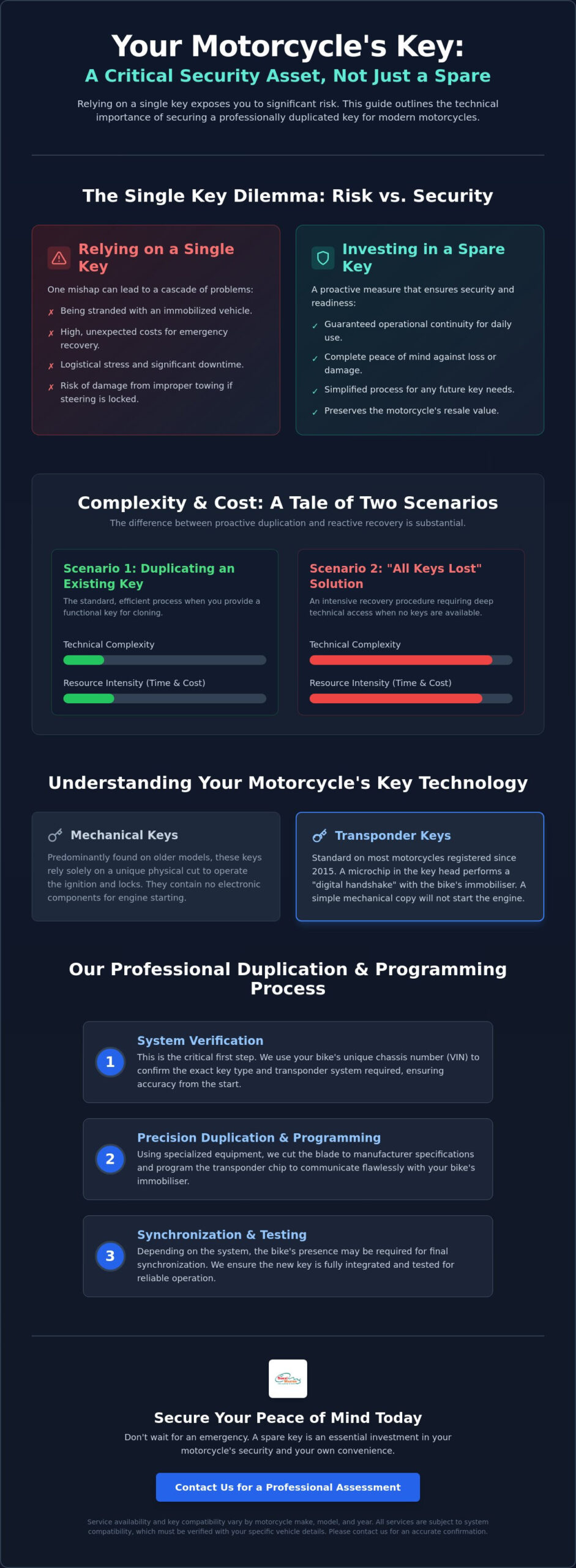
- Understand the operational risks of relying on a single key and why the “All Keys Lost” scenario is significantly more complex and resource-intensive to resolve.
- Identify the technical requirements for your specific bike, whether you need a traditional mechanical blade or a programmed transponder to get a second key for my motorcycle.
- Learn why security verification using the motorcycle chassis number is a critical step in ensuring the accuracy and reliability of your new spare key.
- Evaluate the benefits of using a specialist service provider, including potentially shorter lead times compared to manufacturer orders, subject to system compatibility.
- Gain insight into the professional synchronization process needed to ensure your new key communicates correctly with your motorcycle’s immobiliser system.
The Importance of Securing a Second Key for Your Motorcycle
Owning a motorcycle in Singapore represents a significant financial and personal investment, especially considering current COE values and the technical sophistication of modern machines. Relying on a single key is a calculated risk that many riders overlook until a crisis occurs. When you choose to get a second key for my motorcycle, you aren’t just buying a piece of metal or plastic; you’re investing in a security asset that ensures operational continuity. A spare key serves as a primary fail-safe against the logistical nightmare of a misplaced or broken original.
The technical landscape of motorcycle security has shifted toward complex electronic systems. Most motorcycles registered after 2015 utilize Transponder Keys that communicate with an onboard immobiliser. This means that a simple mechanical copy won’t start the engine. If that single electronic key fails, the bike remains immobilized, turning a high-performance machine into an immovable object. Proactive duplication is a standard part of responsible ownership that mitigates these technical vulnerabilities before they become emergencies.
Risk Management for Daily Riders
For daily commuters, a spare key prevents unexpected downtime that can disrupt work schedules and personal commitments. If your only key snaps in the ignition or disappears during a busy day, the recovery process is grueling. Most motorcycles are equipped with steering column locks. If the key is lost while the column is locked, moving the bike requires specialized towing equipment to avoid damaging the frame or suspension. Beyond daily utility, maintaining a complete set of keys preserves the resale value of your motorcycle. Potential buyers and dealers often view a missing spare as a sign of lax maintenance, which can complicate the valuation process during a sale or trade-in.
Avoiding the Complexity of Total Key Loss
The technical difference between duplicating an existing key and creating one from scratch is substantial. Duplicating a functional key allows a specialist to read the existing data and mirror it onto a new chip. However, if all keys are missing, the process shifts to a more intensive all keys lost solution. This often involves decoding the physical lock wafers and accessing the bike’s Electronic Control Unit (ECU) to reset the security handshakes.
Having a spare key simplifies the verification process for any future needs. It provides a baseline for technical assessment, ensuring that any new key is calibrated precisely to the manufacturer’s specifications. While recovery is possible in total loss situations, it is a far more involved procedure that requires deep technical expertise. Securing a second key now is a logical step that prioritizes accuracy and peace of mind, subject to your specific bike’s system compatibility. We encourage riders to contact Soxxi Master for an accurate assessment and confirmation of their specific security needs.
Understanding Motorcycle Key Technology: Mechanical vs. Transponder Systems
Motorcycle security has evolved significantly from the basic metal blades used decades ago. In the past, a key’s only job was to physically move the lock wafers. Today, security is multi-layered, combining physical precision with electronic encryption. If you intend to get a second key for my motorcycle, you must first identify which generation of technology your bike utilizes. Modern systems are designed to prevent “hot-wiring” by requiring a digital handshake between the key and the engine control unit.
Most motorcycles produced in the last decade feature an immobiliser system. This system relies on a low-frequency radio signal to communicate with a chip hidden inside the key head. The Motorcycle Industry Council and other global bodies have seen these standards become nearly universal to combat rising theft rates. When you insert the key, an induction coil around the ignition barrel powers the chip, which then sends a unique code to the bike. If the codes don’t match, the fuel pump or ignition circuit remains disabled. This is why a simple hardware store copy might turn the lock but will never start the engine.
Identifying your system is the first step toward a functional spare. Many manufacturers use distinct branding for their security tech. For example, Honda utilizes the Honda Ignition Security System (HISS), while Yamaha and various European brands have their own proprietary immobiliser platforms. You can often tell if your bike has this technology by looking for a “security” light on the dashboard or a specific logo on the key itself. If you’re unsure of your system’s requirements, you can consult a specialist for a technical assessment based on your chassis number.
What is a Transponder Key?
A transponder key contains a passive electronic chip that requires no internal battery to function. It is powered by the electromagnetic field of the ignition barrel. Because these chips are encrypted, duplicating them requires specialized diagnostic tools that can read and mirror the specific data packets. For a deeper look at how these components protect your vehicle, refer to our detailed transponder guide. Accuracy during this process is vital; even a minor data mismatch can lead to intermittent starting issues.
Smart Key and Remote Systems
Higher-end models and modern scooters often use proximity-based smart keys. These systems allow for keyless ignition, where the bike detects the fob within a certain radius. To get a second key for my motorcycle when using a smart system, the new fob must be paired directly to the bike’s computer. This often requires the physical presence of the motorcycle. It’s also important to maintain the fob’s battery; a weak cell can lead to communication errors that mimic a system failure. Final confirmation of compatibility for these complex remotes is always required before service begins.
The Professional Duplication Process: Precision and Verification
When you decide to get a second key for my motorcycle, the service moves through a sequence of technical milestones designed to ensure both physical and electronic accuracy. This isn’t a casual procedure. It’s a methodical restoration of your vehicle’s access system. A professional specialist treats each key as a unique security component rather than a generic commodity, prioritizing verification at every stage to maintain the integrity of your motorcycle’s anti-theft systems.
The workflow typically involves five critical steps to ensure a high-quality result:
- Initial Assessment: A technical review of your existing key and vehicle model to identify the specific transponder or smart system requirements.
- Security Verification: Confirming ownership and technical specifications using the motorcycle chassis number.
- Mechanical Cutting: Utilizing high-precision equipment to replicate the physical blade profile.
- Electronic Programming: Synchronizing the new transponder chip or remote with the motorcycle’s onboard immobiliser unit.
- Final Testing: Verifying the new key’s performance across all lock cylinders, including the ignition, fuel cap, and seat lock, subject to the bike’s configuration.
The Role of the Chassis Number
Professional specialists require your vehicle’s chassis number to ensure technical accuracy and security. This data allows the technician to identify the exact key blank and software profile required for your specific production year and region. Beyond technical specs, this step is a core part of responsible Vehicle Theft Prevention standards. By verifying these details, a specialist ensures that duplication is only performed for authorized owners, preventing unauthorized access. This verification process is mandatory, and final confirmation of compatibility is required before any technical work begins.
High-Precision Key Fabrication
The physical cutting of a motorcycle key requires extreme tolerances to prevent long-term damage to your lock cylinders. While traditional manual machines rely on a technician’s steady hand, professional services utilize automated key fabrication. These CNC-driven machines cut the blade according to original manufacturer specifications rather than just tracing a worn original. This precision is vital because a poorly cut key can cause internal friction, leading to premature wear of the delicate wafers inside your ignition barrel. To get a second key for my motorcycle that lasts as long as the original, using manufacturer-grade cutting technology is a technical necessity. We encourage you to contact Soxxi Master for an accurate assessment and confirmation of your specific key fabrication needs.
Evaluating Your Options: Specialist Services vs. Authorised Dealers
Deciding where to get a second key for my motorcycle involves a choice between manufacturer protocols and specialist efficiency. While authorised dealers are the standard for many, their operational structures often result in extended wait times. A specialist provides a technical alternative that prioritizes rapid turnaround without compromising security standards. This path is often preferred by riders who can’t afford to wait for international shipping cycles.
Specialists utilize on-site equipment to perform both the mechanical fabrication and the electronic synchronization in a single session. This eliminates the need for multiple appointments or the risk of shipping sensitive security components. Every professional assessment begins with a verification of your vehicle’s chassis number to ensure the software profile matches your specific model. This level of precision is vital for maintaining the integrity of your bike’s immobiliser system.
Manufacturer Lead Times and Logistics
Ordering through a dealer often triggers an international request to an overseas factory. This logistical chain can lead to weeks of waiting as the key blank or encrypted data is processed and shipped. Local specialists utilize in-house technology to bypass these delays. They maintain a comprehensive inventory of blanks and programming software, allowing for much faster service once technical compatibility is verified.
Specialist Expertise in Complex Systems
Executing professional key duplication requires advanced diagnostic tools that interface directly with various security protocols. Specialists manage a wide array of systems from global manufacturers, often supporting legacy models that dealers may no longer service. This expertise ensures a tailored approach based on the specific electronic architecture of your motorcycle, whether it’s a Japanese commuter or a European performance bike.
Compatibility is never assumed; it depends on the model, year, and the existing security system’s state. Final confirmation of the service requirements is always necessary before any programming begins. If you’re ready to get a second key for my motorcycle, don’t leave it to chance with unverified methods. To ensure your spare is functional and reliable, consult with a professional specialist for an accurate compatibility check and expert assessment of your security needs.
Securing Your Spare Key with Soxxi Master in Singapore
Choosing to get a second key for my motorcycle at Soxxi Master means choosing a process rooted in technical discipline. Our specialist centre at Jalan Pemimpin is equipped with the necessary diagnostic tools to handle both mechanical and electronic requirements. We focus on providing a complete solution that maintains the security standards set by your vehicle’s manufacturer. This professional environment ensures that every step, from initial reading to final synchronization, is performed with precision.
We support a wide range of motorcycle brands and security systems, including those from Japanese, European, and American manufacturers. However, technical support is always subject to compatibility and the specific electronic architecture of your machine. By prioritizing accuracy over speed, we ensure that your spare key functions as reliably as the original, preventing the intermittent starting issues often associated with unverified duplication methods.
Our Approach to Security and Accuracy
We do not treat key duplication as a simple retail transaction. Every request undergoes a rigorous verification process where we check vehicle ownership and chassis details. This ensures that the technical profile we use is the correct match for your bike’s production specifications. This methodical approach is what differentiates professional service from unverified methods. DIY attempts on modern immobiliser systems often result in permanent lockouts or corrupted ECU data, which is why we maintain a focus on controlled, specialist-led procedures.
- Advanced Diagnostics: Using verified software to ensure error-free transponder programming.
- Ownership Verification: Protecting your vehicle’s security through chassis number and documentation checks.
- Long-term Reliability: Focusing on manufacturer-grade components to prevent premature wear or failure.
Steps to Get Your Accurate Assessment
To ensure a smooth experience, we recommend providing your vehicle details for a preliminary compatibility check before visiting our centre. This allows our technicians to verify if your specific model and year are supported by our current diagnostic tools. When you arrive for your appointment, please bring your existing functional keys and relevant vehicle documentation to facilitate the verification process. Having these items ready ensures we can proceed with the technical assessment without delay.
You can initiate this process by submitting your details through our enquiry form. By providing your motorcycle’s make, model, and chassis number, you allow our specialists to conduct a professional consultation tailored to your needs. Final confirmation is always required before any technical work begins. We encourage you to contact Soxxi Master for an accurate assessment and confirmation of your specific motorcycle key requirements.
Securing Your Ride with Technical Precision
Proactive key duplication is more than a convenience; it’s a critical part of vehicle risk management. By understanding the technical distinction between simple mechanical blades and complex transponder systems, you can make informed decisions about your bike’s security. Professional duplication ensures that your spare key is synchronized correctly with the immobiliser, maintaining the integrity of the original anti-theft protocols. This precision prevents the common pitfalls of unverified copies that can lead to intermittent starting issues.
When you decide to get a second key for my motorcycle, working with an experienced specialist provides the accuracy required for modern electronics. Soxxi Master has served as a pioneer in automotive key replacement since 2007, offering deep expertise in transponder and immobiliser technology. Our centre is conveniently located at 37 Jalan Pemimpin, where we prioritize verification and technical precision. Every service is subject to compatibility and varies by system, so final confirmation is required before we begin.
We invite you to contact Soxxi Master for a professional assessment of your motorcycle key needs. Taking this small step today ensures your machine remains ready for the road ahead and protects you from unexpected downtime.
Frequently Asked Questions
Can I duplicate a motorcycle key if I have lost the original?
Yes, it’s possible to generate a new key even if the original is missing by using an all keys lost solution. This technical process involves decoding the physical lock wafers or accessing the vehicle’s electronic control unit to reset security data. While more complex than simple duplication, specialists can often restore access, subject to the specific make and model of the motorcycle. Final confirmation of the method required is necessary before service.
Is it possible to copy a motorcycle key with a chip at a regular locksmith?
Most regular locksmiths can cut the mechanical blade but lack the specialized diagnostic tools required to program the electronic chip. Modern motorcycles use transponder technology that requires a digital handshake with the engine control unit. Without this synchronization, the bike won’t start. A specialist service provider is typically required to ensure the new chip is correctly calibrated to your bike’s specific security protocols.
How long does it take to get a second key for my motorcycle?
The time required to get a second key for my motorcycle typically ranges from 30 to 60 minutes for transponder systems. Simple mechanical keys may take less time, while complex smart keys or proximity fobs often require more extensive synchronization. These durations are estimates and can vary depending on the specific model and the complexity of the security system being programmed. Precision and verification are prioritized over speed to ensure reliability.
Do I need to bring my motorcycle to the shop for key duplication?
You generally need to bring the motorcycle to the specialist centre if your key includes a transponder or smart system. The vehicle’s presence is required so the technician can interface with the onboard computer to synchronize the new key. While mechanical blades can sometimes be copied from the original alone, the electronic handshake can’t be verified without the bike. This ensures the new key is fully functional and secure.
What information do I need to provide to get a spare key made?
When you prepare to get a second key for my motorcycle, you must provide the make, model, and production year along with the chassis number. This information allows the specialist to identify the correct key blank and software profile for your vehicle. Additionally, valid proof of ownership and identification are required to comply with security verification standards. This process ensures that duplication services are provided only to authorized owners.
Can a second key be programmed for a keyless ignition motorcycle?
Yes, a second key can be programmed for keyless ignition motorcycles, subject to system compatibility. These proximity fobs require a specific pairing process with the motorcycle’s electronic control unit. The technician uses specialized diagnostic equipment to register the new fob into the bike’s memory. Because these systems are highly sophisticated, final confirmation of the specific software requirements for your model is necessary before the programming process can begin.
What should I do if my only motorcycle key is bent or damaged?
If your only key is bent or damaged, you should avoid using it to prevent internal damage to the ignition cylinder. A specialist can often use the damaged key to decode the original manufacturer specifications and perform a high-precision key fabrication. This creates a new, structurally sound key rather than just a copy of the damaged one. Addressing this early prevents the key from snapping inside the lock, which would require a more complex extraction.
Why is a chassis number required for motorcycle key duplication?
The chassis number is required to identify the exact technical profile and security protocols associated with your specific motorcycle. It ensures the specialist uses the correct transponder chip and mechanical blank for your bike’s production region and year. This data is also a critical part of the security verification process. It helps confirm that the duplication is authorized and matches the manufacturer’s records, providing a reliable and accurate spare key.