

A duplicated card that opens a door isn’t necessarily secure. Knowing how to verify a duplicated access card is safe starts with identifying the card technology and understanding what its credential protects. EM4100 cards operate at 125 kHz and store information openly, without encryption or authentication, so copying one may reproduce a credential that a compatible reader accepts.
It’s reasonable to want a clear answer before relying on a duplicate. This guide explains how copied credentials may unlock doors, why EM4100 vulnerabilities matter, and what a professional can assess to help determine the risks. You’ll also learn why the card alone may not tell the whole story: reader compatibility and the access system’s security features affect how a credential is handled.
This guide explains how to verify a duplicated access card is safe and what to discuss when arranging a professional assessment in Singapore.
Key Takeaways
- A copied credential may unlock a door when the reader accepts it, so successful access alone doesn’t establish that the system is secure.
- Assessing compatibility involves considering the card and its authorized reader together; the access system affects what a duplication test can show.
- Card data and building access records are not necessarily the same thing. Understanding what the credential contains helps clarify what information could be exposed.
- For RFID access card cloning, a professional assessment can help clarify compatibility and door-access risks before you rely on a duplicate.
How copied credentials can be used to unlock doors
A reader may unlock a door when it accepts a copied credential. A professional assessment considers the card technology and the authorized reader together.
-
How a professional identifies the access credential type
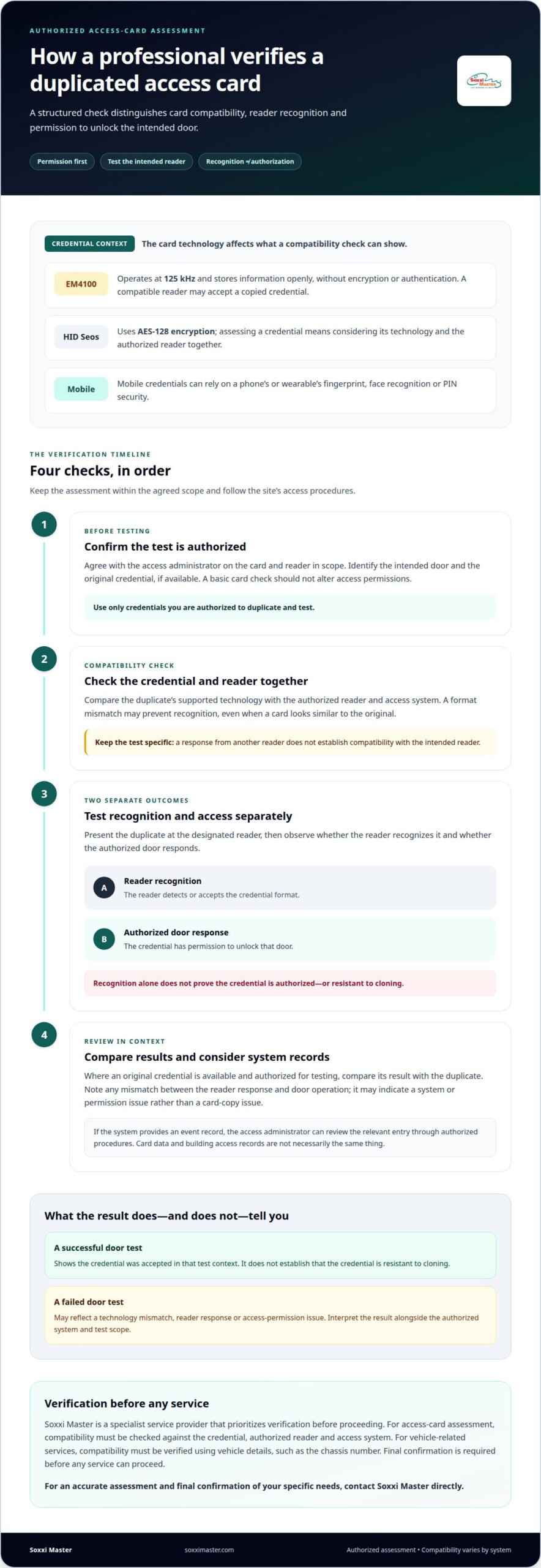
Identify the credential format before assessing what a duplicate can do. An EM4100 is a 125 kHz card with openly stored information and no encryption or authentication, so a compatible reader may accept a copied credential. HID Seos credentials use AES-128 encryption. Mobile credentials can instead rely on a phone’s or wearable’s fingerprint, face recognition, or PIN security. In Singapore, use only credentials you’re authorised to duplicate; technical ability alone doesn’t establish permission.
-
How a professional evaluates anti-clone credentials
Assess whether the credential uses encryption, not just whether its copy appears to work. AES or a comparable strong encryption method is a useful anti-clone feature to evaluate. By contrast, an EM4100’s openly stored data lacks encryption and authentication, leaving the credential exposed to copying. The security risk is unauthorised entry if a copied credential is accepted. A successful door test does not prove the credential is resistant to cloning.
-
How a professional checks compatibility with the authorized reader
Test the duplicate only with the authorized reader and with permission from the system administrator. A card and reader must support compatible credential technology; a mismatch may cause a valid card to fail. If a card may have been copied without permission, notify the access administrator promptly and ask them to review the credential’s access. For professional help with an authorized duplicate, see door-access card duplication.
How a professional verifies a duplicated access card works with the authorized reader
Have the duplicate tested with the intended reader and access system. The test should distinguish whether the reader recognises the card from whether the credential is authorised to unlock the door.
- Confirm the test is authorized. Establish which card and reader are in scope, and confirm permission with the access administrator. Identify the intended door and the original credential, if available. This prevents a test on an unrelated reader from being mistaken for compatibility. The professional should not alter access permissions as part of a basic card check.
- Check the credential and reader together. Compare the duplicate’s supported technology with the authorized reader and system. A card that uses an incompatible format may not be recognized, even if it looks similar to the original. Keep the test within the access system being assessed; a response from a different reader doesn’t establish that the intended reader accepts the duplicate.
- Test recognition and access separately. Present the duplicate at the designated reader, then observe whether the reader recognizes it and whether the authorized door responds. These are different outcomes: recognition alone doesn’t show that the credential has permission to unlock that door. The professional should follow the site’s access procedures and avoid testing doors outside the agreed scope.
- Review the result in context. Compare the duplicate’s outcome with the original credential, where one is available and authorized for testing. If the system provides an event record, the access administrator can review the relevant entry. Note any mismatch between the reader response and door operation; it can point to a system or permission issue rather than a card-copy issue.
For a card-specific assessment, discuss your access-card requirements with a specialist.
Can a duplicated access card expose personal or building access data?
A copied card may reproduce credential information, but that does not mean it contains a person’s name or the building’s access history. Distinguish data stored on the card from access records held by the system.
- Identify what the credential stores. Assess the credential format and the information it presents to a compatible reader. For a MIFARE NFC card, sector 0 contains the UID and manufacturer’s data. That identifier is not, by itself, a person’s name or a record of doors entered. Avoid assuming every card stores the same fields or that a readable identifier reveals the system’s full data.
- Separate card data from access records. Determine whether information is on the card or held by the access-control system. A card may provide a credential that the reader checks, while entry records are maintained separately by the system. The card’s contents alone therefore don’t establish which doors were used or when. The system administrator can assess relevant access records through authorised procedures.
- Assess the exposure if a copy is unauthorised. Consider whether another person could present the copied credential to a compatible reader. With an EM4100, information is stored openly without encryption or authentication, so a copied credential may be accepted by a compatible system. This creates a possible unauthorised-entry risk, not proof that personal details or access logs were copied.
- Limit further risk through the system administrator. If a card may have been copied without permission, report it to the administrator. They can review access records and determine whether the credential should remain active. For a mobile credential, also consider the phone’s or wearable’s native fingerprint, face-recognition, or PIN protection.
Soxxi Master: RFID Access Card Cloning
Soxxi Master provides RFID access card duplication for customers who need a spare or replacement card. The service can help prepare a duplicate for assessment against its intended access system. However, a card’s ability to operate a reader does not by itself show that the credential technology is secure.
The assessment should consider the original card and the reader it is intended to work with. Share the relevant access-card details and explain which authorized reader the duplicate needs to work with. This helps focus the service on the credential and intended use, rather than assuming every card system works alike. Soxxi Master verifies the card’s compatibility with the intended access system and obtains final confirmation before proceeding with duplication or other service. For vehicle-related services, compatibility is verified using vehicle details such as a chassis number, and final confirmation is required before service proceeds.
If you’d like an assessment of an access-card duplication request, contact Soxxi Master.
Make your next access-card decision with confidence
Before relying on a duplicate, consider both the credential and its intended use. Knowing how to verify whether a duplicated access card is safe helps you explain your needs and decide whether professional RFID access card duplication is appropriate. Permission to duplicate the credential and compatibility with the access system are also essential.
Soxxi Master also offers Car & Motorcycle Key Duplication and an All Keys Lost Solution. For vehicle services, compatibility must be verified using vehicle details such as the chassis number, and final confirmation is required before any service can proceed.
Share the details of your access-card request with Soxxi Master for an assessment and guidance on the next step.
A clear assessment is a practical starting point for moving forward.
Frequently Asked Questions
How can a professional assess whether an access card may have been duplicated?
The building administrator can compare the card’s status with authorised issuance records and review relevant access events. This can help assess whether a duplicated card is safe without treating unusual activity as proof of copying. For example, an entry the cardholder does not recognise may warrant investigation, but records alone may not identify who made a copy.
How can a professional assess an access card for signs of unauthorised copying or cloning?
To assess a duplicated access card, examine the card and compare its behaviour with issuer records. There may be no visible mark that proves cloning. Unexplained entries or inventory discrepancies can prompt further review, but they are not proof of copying. Keep relevant details for the building administrator.
How can I have a professional test a duplicate access card without compromising building security?
Arrange testing with the building administrator, who can define the permitted card, reader and access area. Keep the assessment supervised and within the agreed scope. Do not test the duplicate on unapproved doors or try to change access settings. Recording the test conditions and outcome helps the administrator interpret the results without disrupting normal access.
Should a building manager or card issuer approve an access card duplicate?
Yes. Obtain approval from the building manager or card issuer before arranging a duplicate. They can confirm who is authorised to request one and whether the credential suits the building’s access arrangements. This helps prevent an unrecognised card from being treated as approved. If you are unsure who manages access, ask the property’s designated contact.