

Your automobile key is no longer just a piece of cut metal; it is a sophisticated endpoint in a global cybersecurity network. In 2026, vehicle access relies on complex standards like UN R155 and Ultra-Wideband technology, making a simple replacement feel like a high-tech hurdle. It’s common to feel overwhelmed by the steep costs of a dealership or the fear of being stranded when a remote fails. You might also find it difficult to distinguish between a standard remote and a high-security smart key system.
We understand that you need clear answers and a reliable way back on the road without unnecessary delays. This guide will help you master the intricacies of modern automotive security and explain how to secure a precise replacement for your vehicle in Singapore. We’ll explore the technical requirements of modern transponders and why professional verification using your chassis number is essential for accuracy. You’ll learn how a specialist approach provides the precision your vehicle’s immobiliser demands, ensuring your new key works seamlessly with your car’s specific software, subject to system compatibility.
Key Takeaways
- Understand the impact of global cybersecurity standards like UN R155 on vehicle access and why modern keys require sophisticated electronic encryption.
- Learn the critical technical distinction between simple key cloning and professional programming into your car’s immobiliser system.
- Discover why providing your vehicle’s chassis number is the essential first step to ensuring a compatible and precise automobile key replacement.
- Evaluate the advantages of choosing a specialist for faster lead times and technical flexibility, subject to model compatibility.
- Gain insights into the “All Keys Lost” process and contact Soxxi Master for an accurate assessment and final confirmation of your specific needs.
What is a Modern Automobile Key? Understanding Today’s Technology
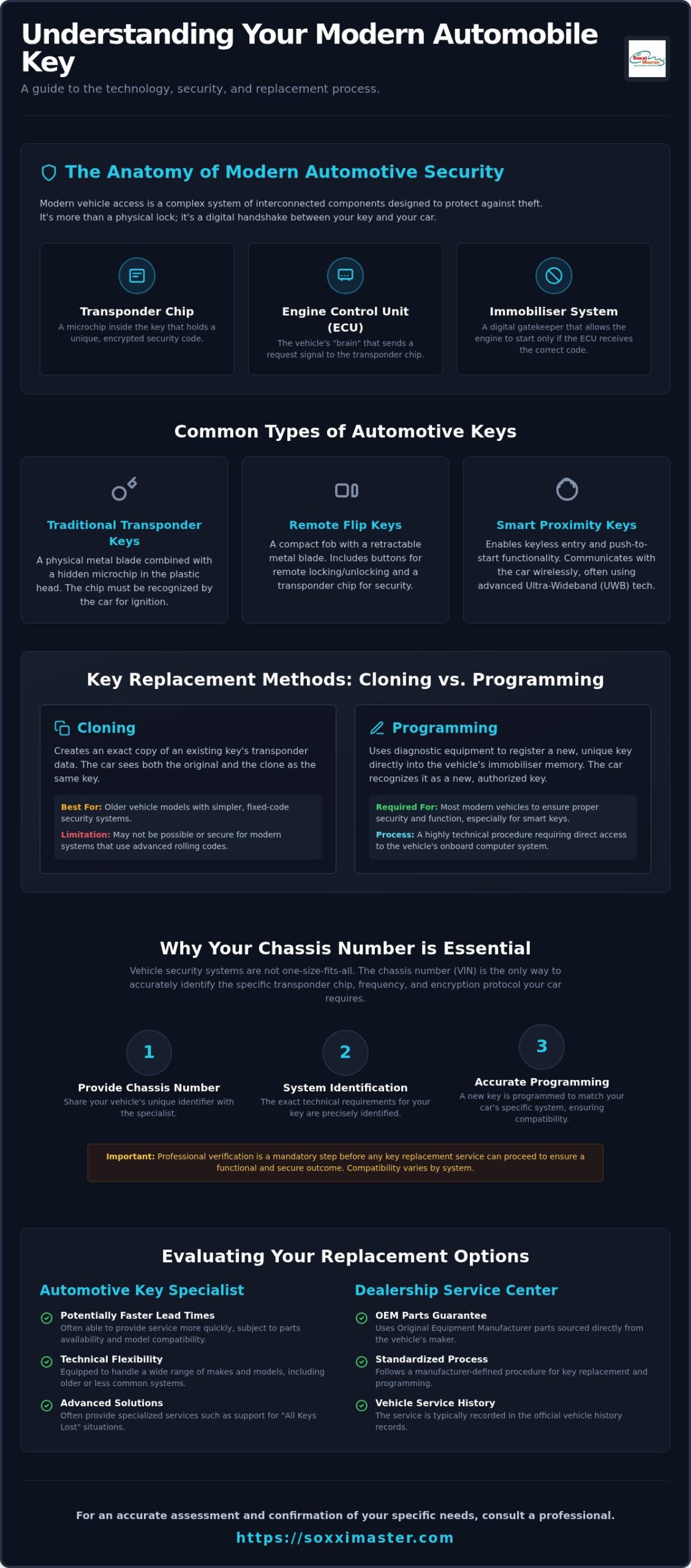
A modern automobile key is far more than a simple metal tool used to turn a lock. It is a sophisticated security device. These units integrate mechanical precision with advanced electronic encryption to protect your vehicle from theft. The evolution of the car key has moved away from basic physical blades toward proximity-based smart systems that rely on digital handshakes. This transition means your key is essentially a dedicated computer designed specifically for your vehicle’s immobiliser system.
Security in 2026 depends on the perfect alignment of hardware and software. Every automobile key must match the specific frequency and transponder chip type required by the manufacturer. Even a slight mismatch in these technical specifications will result in a key that fails to communicate with the vehicle. Because these systems vary by model, professional verification is the only way to ensure a replacement will function correctly. Specialists use your chassis number to identify the exact technical requirements before any programming begins.
Common Types of Automotive Keys in Singapore
The variety of keys found on Singapore’s roads reflects decades of technological progress. Most vehicles currently utilize one of three main systems, depending on the model and year of manufacture:
- Traditional Transponder Keys: These feature a visible metal blade but contain a hidden microchip within the plastic head. The car’s ignition will not turn over unless the chip is recognized.
- Remote Flip Keys: These combine convenience with security. The mechanical blade retracts into a compact fob that also houses buttons for keyless locking and unlocking.
- Smart Proximity Keys: These represent the current standard for many new vehicles. They allow for “push-to-start” functionality and keyless entry, often using Ultra-Wideband (UWB) technology to prevent signal relay attacks.
The Role of the Transponder Chip
The transponder chip is the critical link between your key and the Engine Control Unit (ECU). When you attempt to start the engine, the ECU sends a radio frequency signal to the chip. The chip must then respond with a unique, encrypted code. If the code is missing or incorrect, the immobiliser system will keep the engine disabled. This is why a physical copy of a key blade is insufficient for modern cars; the electronic “password” is just as vital as the mechanical cut. You can find more detailed information in our professional guide to transponder keys. Each system is unique, and final confirmation of the chip type is always required before service can proceed.
The Anatomy of Automotive Security: Beyond the Blade
Modern vehicle security is an invisible layer of protection that goes far beyond a simple metal lock. The immobiliser system acts as a digital gatekeeper for your car. When you insert an automobile key or bring a smart fob into range, the vehicle’s Engine Control Unit (ECU) performs an immediate security check. If the transponder signal is missing or the encrypted code is incorrect, the fuel pump and ignition system remain disabled. This prevents the engine from starting even if the mechanical lock is physically bypassed.
It’s essential to understand how a new key is added to your vehicle’s memory. “Cloning” involves copying the data from an existing key onto a blank one. While this works for some older models, modern security often requires “programming.” This process involves using diagnostic equipment to introduce the new key’s unique identity to the car’s computer. Because this requires direct access to the onboard system, the process is subject to compatibility and varies by system. For consumers seeking reliable help, following general FTC Auto Repair Advice regarding choosing experienced specialists can help you find providers with the correct diagnostic tools for these advanced tasks.
Security standards have evolved from fixed codes to rolling codes. Fixed codes send the same signal every time, making them vulnerable to signal interception. In contrast, rolling code systems generate a new, unique encrypted value for every use. This ensures that even if a signal is captured by a third party, it can’t be reused to gain access. These technical layers are complex, which is why professional verification using your chassis number is required to ensure the correct encryption protocol is used for your replacement.
High-Security Laser Cut Keys
Many modern vehicles use internal cut keys, often called laser-cut keys. Unlike traditional keys with ridges on the edges, these have a winding groove cut into the center of the blade. This design offers higher resistance to picking and makes unauthorized duplication difficult without specialized machinery. The fabrication process requires extreme precision to ensure the blade slides smoothly into the ignition. Even a microscopic deviation can cause the lock to jam, which is why professional mechanical cutting is vital for long-term functionality.
Remote and Fob Synchronisation
The electronic remote must be paired specifically to your car’s receiver. This synchronisation ensures that only your specific fob can operate the locks or trunk. While various options exist, original car remote keys typically provide the most reliable performance and software stability. If you’re unsure which system your vehicle uses, you can contact a specialist for an assessment to verify compatibility. Final confirmation is always required before any synchronisation service can proceed.
Specialist vs. Dealer: Evaluating Your Replacement Options
When you need a replacement automobile key, the choice between a car dealership and a professional specialist involves more than just a transaction. It’s a choice between rigid corporate processes and technical agility. Dealerships often operate on long lead times. They frequently need to order specific fobs or blanks from overseas manufacturing hubs, which can leave you waiting for weeks. A specialist typically maintains a local inventory of high-quality components, allowing for a much faster response to your needs. This efficiency is vital when you’re facing a situation where you can’t access your vehicle.
Accuracy in automotive security begins with data. A professional service provider will always require your vehicle’s chassis number before starting any work. This information is essential for an accurate assessment of the hardware and software versions used in your specific production year. You should be cautious of any service that makes “one size fits all” claims. Automotive systems are highly fragmented; what works for one model year might be incompatible with the next. Final confirmation is always required to ensure the replacement key will synchronise perfectly with your engine control unit. For a professional evaluation of your needs, you can reach out through our contact page.
Quality of Materials and Mastery
The durability of your new key is just as important as its programming. There’s a significant difference between a specialist’s precision and the output of a generic key cutter. High-quality casings and resilient buttons are necessary for a key to survive years of daily use. A specialist ensures that the internal circuit board is securely seated and that the mechanical blade is fabricated to exact tolerances. This attention to detail prevents common issues like cracked shells or buttons that become unresponsive over time. Choosing a provider who understands both the traditional craft of key fabrication and the complexities of modern encryption provides the most reliable long-term outcome for your vehicle.
The Professional Key Duplication and Programming Process
The process of creating a new automobile key is a methodical sequence that combines mechanical engineering with digital security. It begins long before any metal is cut. A professional approach ensures that every step is verified against the vehicle’s specific manufacturer data. This structured workflow is designed to eliminate errors and ensure that the replacement functions exactly like the original, subject to system compatibility. By following a clear, multi-step procedure, specialists provide a reliable solution that maintains the integrity of your vehicle’s security system.
Step 1: Technical Assessment
Before any work starts, a specialist performs a comprehensive assessment of the vehicle’s current security state. This involves using the chassis number to verify the exact software version and hardware requirements. You can read more about this in our Professional Key Duplication Guide. During this stage, the specialist identifies the specific radio frequency and transponder chip type. They also check for existing faults in the locking system that might interfere with the new key’s performance. Final confirmation of these details is required to ensure that the replacement components are perfectly matched to your car’s model year.
Once the technical details are confirmed, the mechanical phase begins. Modern keys are cut using computer-controlled fabrication machines. These devices use the vehicle’s unique key code to carve the blade with microscopic precision. This automated process is far more accurate than traditional manual tracing. It ensures the blade operates smoothly within the ignition and door locks without causing wear to the internal tumblers. This level of precision is essential for maintaining the longevity of your vehicle’s mechanical locking components, especially for high-security internal cut designs.
Step 2: Programming and Synchronisation
The electronic phase is where the key is introduced to the vehicle’s computer. A specialist connects diagnostic tools to the car’s OBDII port to communicate directly with the security module. This process varies by system and is used to register the new transponder as an authorized device. It’s a critical security step; without this digital handshake, the immobiliser will not allow the engine to start. During this process, old or lost keys can be cleared from the system memory. This ensures that any missing keys can no longer be used to start the vehicle, providing an extra layer of security for the owner.
The final stage is a rigorous testing protocol. A specialist verifies every function of the new key to ensure total reliability. This includes testing the ignition, all physical door locks, and every remote feature such as trunk release or proximity-start buttons. This comprehensive check confirms that the automobile key is fully integrated with the vehicle’s electronics. If you need a reliable replacement, contact Soxxi Master for a technical assessment of your vehicle’s specific requirements.
Advanced Solutions: All Keys Lost and Emergency Repairs
Losing your only set of keys is a high-pressure situation. It’s often considered the ultimate challenge in automotive security. When no original is available for duplication, the process shifts from simple copying to advanced technical recovery. This critical last resort service involves recreating a working automobile key from the vehicle’s existing hardware and software. It requires a deep understanding of both mechanical lock structures and encrypted immobiliser data. Professional mastery ensures that even in a total loss scenario, your vehicle can be safely restored to operation without damaging the underlying security modules.
The complexity of this task has increased with the 2026 cybersecurity standards. Modern vehicles now use more robust encryption protocols, making the recovery process a precision science. A specialist must interface with the vehicle’s Engine Control Unit to reset the security parameters. This allows the system to accept new electronic signatures while revoking access for the lost keys. Because these systems are highly integrated, final confirmation of the vehicle’s software version is required before any emergency recovery can begin.
The ‘All Keys Lost’ Technical Solution
Creating a key from scratch requires a specialist to decode the vehicle’s lock. Instead of following a template, the technician uses specialized tools to read the internal wafer positions of the lock cylinder. This data allows for the fabrication of a new mechanical blade that matches the original factory specifications. Once the physical key is ready, the focus shifts to the electronic signature. Higher-security European and Japanese brands often have complex anti-theft modules that require re-flashing or resetting to accept new keys. This sophisticated All Keys Lost specialist solution ensures that the vehicle recognizes the new hardware as an authorized device. This process is always subject to compatibility and varies by system.
Key and Remote Repair
Sometimes a replacement isn’t necessary if the existing hardware can be salvaged. Key fobs are prone to physical wear, battery contact failure, or water damage. A specialist can often restore functionality by replacing worn casings or repairing internal circuitry. This extends the life of your current automobile key and prevents the need for a full system reset. Replacing a cracked shell or a failing micro-switch can save you from a future emergency where the key fails to start the car. Final confirmation of the damage level is required before a repair can proceed. Specialists prioritize precision in these delicate tasks to ensure the remote functions reliably under daily use. If you’re facing a total loss of access or a failing remote, you should contact Soxxi Master for a professional evaluation and confirmation of your specific needs.
Securing Your Vehicle with Precision and Expertise
Modern automotive security is a rapidly evolving field where technical mastery is the only way to ensure reliable access. This sophisticated technology requires precise synchronisation with your vehicle’s internal software. Choosing a specialist means you benefit from specialized diagnostic and fabrication equipment that often provides faster solutions than traditional dealerships. Whether you need a simple duplication or a complex “All Keys Lost” solution, professional verification using your chassis number remains the essential first step to accuracy.
Soxxi Master stands as Singapore’s pioneer in automotive key replacement, combining traditional craftsmanship with the latest electronic expertise. We focus on providing verified, technical solutions that prioritize your vehicle’s safety and functionality. Every service is subject to model compatibility, ensuring that the results meet the exact requirements of your car’s security system. Don’t leave your vehicle’s access to chance or unverified methods.
Contact Soxxi Master for a professional assessment of your automobile key needs and receive a final confirmation tailored to your specific vehicle details. We look forward to getting you back on the road with confidence.
Beyond maintaining your vehicle, ensuring your home runs smoothly is another priority for many Singaporean families; to explore options for reliable domestic support, find out more about professional helper placement services.
Frequently Asked Questions
Can any automobile key be duplicated by a specialist?
Most modern keys can be duplicated by a specialist, but success depends on model and system compatibility. Some high-security systems or newer models might have manufacturer-specific restrictions that prevent duplication outside of authorized channels. A professional assessment is always required to determine if your specific automobile key can be duplicated. Specialists use chassis number verification to check the technical requirements of your vehicle’s immobiliser and transponder chip before proceeding.
What information do I need to provide for a key replacement assessment?
To receive an accurate assessment, you must provide your vehicle’s make, model, and year of manufacture. The most critical piece of information is the chassis number. This unique identifier allows a specialist to verify the exact transponder frequency and software version required for your car. Final confirmation of these details is essential because even slight variations between production batches can affect the compatibility of a replacement key or remote.
Is it possible to program a car key without the original being present?
Yes, it’s possible to program a new key even if the original is lost or non-functional. This is known as an “All Keys Lost” solution. Specialists use diagnostic tools to interface with the vehicle’s computer via the OBDII port to register a new electronic signature. This process varies by system and requires professional mastery to ensure the vehicle’s immobiliser accepts the new key while revoking access for any missing originals.
What is the difference between a master key and a valet key?
A master key provides complete access to all vehicle functions, including the ignition, doors, trunk, and glove compartment. In contrast, a valet key is a restricted version designed for temporary use. It typically allows the engine to start and the doors to unlock but prevents access to secure storage areas like the trunk or glovebox. The technical capabilities of these keys depend on model specifications and the specific security configuration of your vehicle.
How long does the professional key programming process typically take?
The duration of the programming process varies by system and the complexity of the vehicle’s encryption. While some duplication tasks can be completed efficiently during a scheduled appointment, more complex “All Keys Lost” scenarios might require additional time for lock decoding and software synchronisation. Specialists often provide faster lead times than dealerships because they maintain local inventory and use specialized diagnostic equipment designed for quick, precise technical assessments of your vehicle’s needs.
Will getting a duplicate key from a specialist affect my vehicle’s security?
A professionally duplicated key won’t compromise your vehicle’s security. In fact, the programming process often enhances security by allowing a specialist to clear old or lost keys from the car’s memory. This ensures that only the keys currently in your possession are authorized to start the engine. Specialists prioritize precision and use verified hardware to ensure that the new key functions seamlessly with the existing immobiliser and encryption protocols.
Can a broken or snapped car key be repaired or replaced?
Yes, broken keys can often be repaired or replaced depending on the extent of the damage. If the internal transponder chip and circuit board are intact, a specialist can replace a snapped blade or a worn casing to restore functionality. If the electronic components are damaged, a full replacement and reprogramming may be necessary. A professional assessment is required to determine the most reliable course of action for your specific situation.
Why do some car keys require a chassis number for duplication?
The chassis number is essential for identifying the exact technical specifications of your vehicle’s security system. Manufacturers often change transponder frequencies or encryption types mid-year, meaning the model name alone isn’t enough for a precise match. By using the chassis number, a specialist ensures that the replacement key has the correct chip and software version. This verification process is critical for achieving a successful synchronisation with the vehicle’s engine control unit.