

Approximately 90% of condo access card systems in Singapore use technology that can be professionally duplicated, yet many residents believe their only choice is a long wait for an expensive MCST replacement. If you’ve misplaced your fob, the immediate panic of being locked out of the lift or lobby is overwhelming. Knowing exactly what to do if you lose your condo access card is essential for restoring your home’s security without unnecessary delays. It’s a high pressure situation, but a methodical approach ensures you aren’t left stranded while maintaining your property’s integrity.
We understand the frustration of navigating complex building by-laws and the anxiety of potential security breaches. This specialist-led guide provides a clear roadmap to secure your property and evaluate your replacement options effectively. You’ll learn the critical steps for deactivating lost credentials, the differences between official management channels and professional duplication, and how to verify if your specific card technology is compatible with modern cloning solutions. Since success depends on the specific model and frequency, we’ll help you move from a locked-out emergency to a verified, secure solution with professional precision.
Key Takeaways
- Learn the critical protocol for immediate deactivation with your MCST to prevent unauthorized building access.
- Understand exactly what to do if you lose your condo access card by identifying whether your system uses RFID or Mifare technology.
- Compare the administrative lead times of official management replacements against the technical efficiency of professional specialist services.
- Discover how specialist scanning can replicate access credentials, subject to specific system compatibility and encryption protocols.
- Implement proactive strategies for maintaining verified spares and protecting your cards from physical or electronic damage.
Immediate Steps to Take After Losing Your Condo Access Card
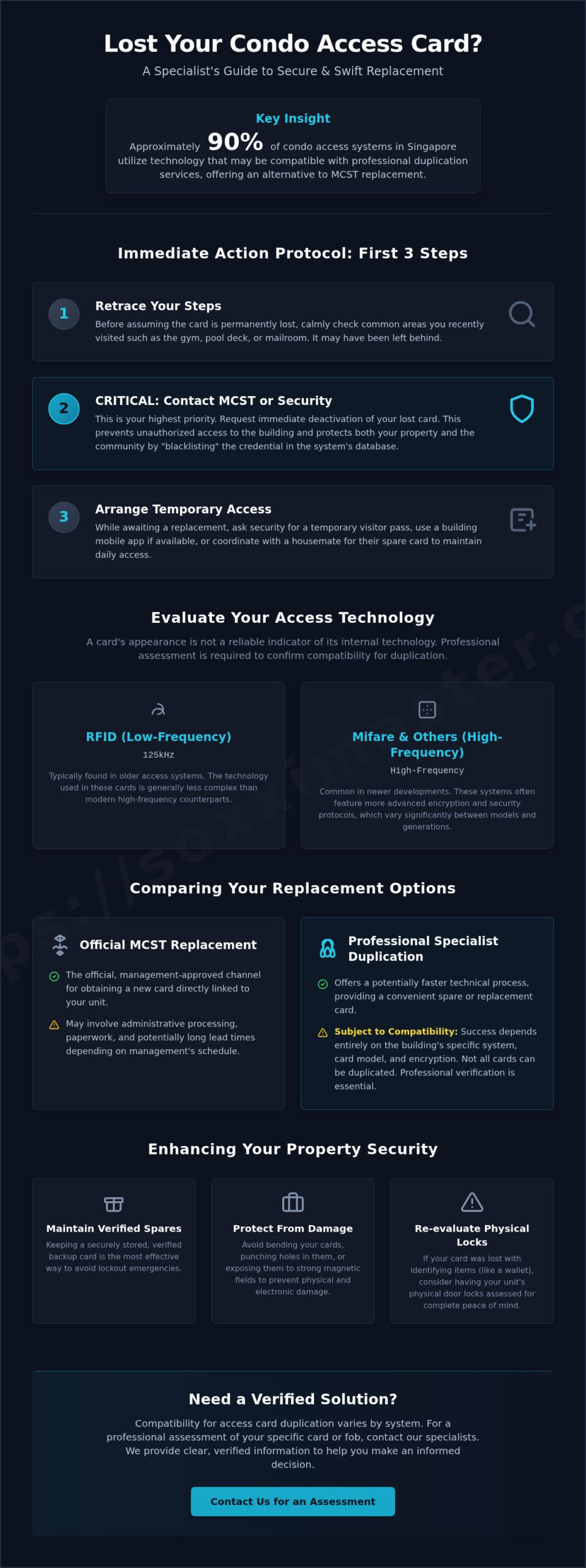
Losing your card is a high-pressure scenario that requires a calm, methodical response. Before assuming the worst, take a moment to retrace your steps through the common areas you recently visited. Check the gym, the pool deck, or the mailroom, as cards are often left behind on equipment or tables. If a quick search yields no results, you must transition into a security-first mindset. Knowing what to do if you lose your condo access card starts with securing your residence and the building’s perimeter. Speed is essential.
Your next move should be contacting your Management Corporation Strata Title (MCST) or the on-site security office. They manage the building’s electronic access control systems and have the authority to disable your specific card ID from the central database. This step is crucial because it prevents any unauthorized finders from gaining entry to your block, lift lobby, or basement carpark. It’s an efficient way to mitigate risk before you even begin the replacement process. Understanding what to do if you lose your condo access card involves more than just finding a replacement; it’s about immediate risk management.
Consider the specific facilities your card was programmed to access. Many modern condominiums link permissions to individual cards, including BBQ pit bookings or tennis court entries. If your card was lost alongside identifiable items like a wallet, driver’s license, or a phone that displays your home address, your personal unit security is compromised. In these specific situations, deactivating the card is only half the battle; you should also evaluate if your physical door locks need attention to ensure complete peace of mind.
Why Deactivation is Your First Priority
Modern digital access systems create a permanent log of every tap. If an unauthorized individual uses your lost card, those activity logs remain tied to your unit number. By reporting the loss immediately, you ensure the MCST updates the master database to “blacklist” the lost credential. This professional level of oversight is the only verified way to maintain the security of the entire residential community. It protects you from liability and ensures the building’s integrity remains intact.
Temporary Access Solutions
While you navigate the replacement process, you’ll need a way to move through the building. Most developments offer temporary workarounds to keep your daily routine manageable. You can inquire at the security post about obtaining a temporary visitor pass, though this often requires daily registration. Additionally, check if your condo utilizes a mobile app or an intercom system that allows you to unlock gates remotely via your smartphone. Coordinating with family members or housemates for a spare card is often the most efficient temporary solution. If you find that your household requires more flexible options, you may eventually want to explore a professional duplicate door access card service to ensure you always have a secure backup available.
Evaluating Your Condo Access Card Technology
Before deciding on a replacement path, you need to understand the hardware in your hand. Identifying the physical form is the simplest starting point. Most residents carry a standard ISO card, which is the size of a credit card, a compact teardrop keyfob, or even a small adhesive sticker. While the exterior might display brand names like HID, Indala, or Mifare, these labels are only indicators of the underlying technology. Knowing what to do if you lose your condo access card requires moving beyond visual identification to technical verification. A card’s appearance doesn’t always reveal its internal complexity.
Technical specifications vary widely between developments. Some cards feature visible long-range antennas, while others rely on proximity-based chips hidden within the plastic. Compatibility for duplication is never a given; it’s entirely dependent on the specific generation of technology your building uses. For instance, an older card might be easily identified, but a newer version from the same brand could feature updated security patches that change the duplication requirements. This is why professional assessment is a mandatory step in the process.
RFID vs. Mifare: What’s the Difference?
Access systems generally fall into two categories: low-frequency RFID and high-frequency Mifare. Standard RFID typically operates on a 125kHz frequency. These systems are common in older developments and often lack advanced encryption. In contrast, Mifare technology operates at 13.56MHz and frequently utilizes secure sector data to protect against unauthorized copying. As security standards evolve, many modern condos have transitioned to high-security protocols like Mifare DESFire to mitigate RFID security risks. Simple cloning tools found online often fail with these encrypted systems because they can’t bypass the security handshakes required to read the data structure.
The Importance of Technical Verification
Verification is a non-negotiable step in the professional duplication process. A physical inspection by a specialist is necessary because two cards that look identical may house completely different chipsets. Using specialized diagnostic equipment, experts can identify the exact frequency and encryption protocol of your token. This determines if the card is duplicatable or if it belongs to a high-security category that requires official management intervention. Final confirmation is always required before any service can proceed, as chipsets vary by system type.
It’s essential to recognize that duplicate door access card services are subject to compatibility. For example, some high-security HID iClass or Seos cards may require advanced decryption that standard services can’t provide. If you’re unsure about your card’s technology, you can contact Soxxi Master for a professional evaluation of your specific access token. Our team prioritizes accuracy and will provide a clear assessment based on your card’s technical profile.
Comparing Official MCST Replacement and Specialist Duplication
Choosing between the Management Corporation Strata Title (MCST) and a professional specialist is a common crossroad for residents. When considering what to do if you lose your condo access card, you must weigh the necessity of security deactivation against your need for immediate access. While the MCST provides the official record of your residency, their administrative workflows are often structured around building governance rather than individual urgency. This distinction is vital for residents who find themselves suddenly unable to access their home or parking facilities.
The primary advantage of the official route is the ability to maintain a secure master database. Following NIST access control guidelines, professional property management ensures that only authorized credentials remain active in the system. However, this level of oversight often comes with extended lead times. Depending on the building’s vendor agreement, residents may wait anywhere from several business days to over a week for a replacement. This delay can be particularly challenging for households with multiple occupants or those who rely on card-access parking for daily commuting.
When to Go Through the Management Office
Reporting a loss to the management office is the only verified way to deactivate a missing card. This is a critical security step if you believe your card could be used by an unauthorized person. Additionally, some newer developments utilize highly encrypted, proprietary systems that are currently non-duplicatable by third parties. In these instances, the MCST is your only option for a functional replacement. This process also allows the office to update your particulars in the resident directory, ensuring your building intercom and facility booking rights remain synced with your new credential.
The Role of a Professional Key Specialist
A professional specialist serves as an efficient alternative for those who need a spare card immediately. If you still have a working card in your possession, a specialist can provide rapid duplication to ensure you aren’t left without a backup. This service often includes the flexibility to change form factors, such as converting a bulky card into a compact keyfob for easier carrying. Professional key duplication requires specialized hardware to ensure data integrity during the transfer, providing a reliable solution that works seamlessly with your building’s readers, subject to system compatibility.
Determining the right path depends on your specific situation and the technology used in your building. While management handles the security database, specialists offer technical convenience for creating backups. If you’re unsure if your card type is compatible with our services, you can contact Soxxi Master for a professional assessment and confirmation of your needs.
The Technical Process of Professional RFID and Mifare Duplication
The technical workflow behind professional duplication is a precise science that ensures your replacement works exactly like the original. While your first priority is the deactivation of a lost token, understanding the duplication process is a key part of what to do if you lose your condo access card and need to restore access for other family members using a remaining working card. The procedure begins with a non-invasive scan. High-fidelity readers extract the unique identification data from your existing token without altering its original state or compromising its internal circuitry.
Specialized software then performs a deep analysis of the captured data structure. It identifies the specific frequency and encryption protocol, such as those found in complex Mifare or HID systems. Once the protocol is verified, the data is transferred to a high-quality, compatible blank token. The final phase involves a rigorous testing process. The duplicate is compared against the original data to ensure total integrity before it leaves the workshop. This methodical approach prevents the common errors associated with generic, low-grade cloning devices.
Ensuring Data Integrity and Compatibility
Long-term reliability depends heavily on the quality of the “blank” chip used. Using unverified or low-quality duplication tools carries a high risk of data corruption, which can lead to intermittent failures at your condo’s lift or gate. Professional specialists use verified hardware that maintains the specific encryption handshake required by modern security systems. We verify that the duplicate functions correctly across the intended readers, though final functionality is always subject to the specific encryption level and system type of your building.
Form Factors and Customization
Professional duplication also offers the opportunity to improve your daily convenience. You can choose from various form factors, including slimmer cards that fit easily in a wallet or durable, waterproof keyfobs. In some cases, it’s possible to integrate multiple access functions into a single remote or token, depending on model compatibility. If you’re managing complex multi-access needs, consulting a master key automotive key specialist can provide insights into consolidating your access credentials into a streamlined, high-performance solution.
Accuracy is our priority. To ensure your new access solution is a perfect technical match for your property, you should contact Soxxi Master for a professional assessment of your card’s duplication viability.
Enhancing Your Property Security and Access Management
Proactive security management is the final component of a professional access strategy. While earlier sections focused on the immediate response, long-term security requires a shift toward prevention. Understanding what to do if you lose your condo access card is just the first step; creating a robust redundancy plan ensures you aren’t caught off guard again. Maintaining a secure environment involves more than just having a functional card. It requires regular oversight of who holds active credentials to your unit.
Proper care for your RFID or Mifare cards extends their operational lifespan and prevents technical failure. These cards contain delicate internal antennas and microchips that can be damaged by physical stress or electromagnetic interference. Don’t bend your cards or store them near strong magnets. These can corrupt the data sectors and render the token unreadable. If you use a duplicate door access card, treat it with the same precision as the original to ensure consistent performance at every reader throughout the building.
Auditing access is essential, particularly for tenanted properties. When a tenancy agreement ends, it’s a professional best practice to verify that all issued cards are returned or deactivated. This prevents unauthorized entry by previous occupants and maintains the integrity of your unit’s security. Combining electronic access with high-quality physical locks provides a layered defense. This ensures your home remains secure even if a digital credential is compromised or lost in a common area.
Creating a Redundancy Plan
Having at least one spare card in a secure location can prevent high-pressure emergency lockouts. This redundancy is useful if your household relies on multiple access points. For residents who drive, having a backup gate remote duplication ensures you can always enter the carpark without relying on security assistance. We recommend storing these spares with a trusted family member or within a secure home safe. This ensures they’re available when needed most, subject to your specific system’s compatibility.
Physical Security Beyond the Access Card
Electronic cards manage building entry, but your unit’s main door lock is your primary line of defense. Integrating high-security mechanical solutions, such as ABUS locks, provides an additional layer of protection. These mechanical systems don’t rely on digital signals or battery power. In extreme cases where you face an all keys lost solution scenario involving both house and vehicle keys, a specialist assessment is required to restore access safely. You can contact Soxxi Master for an accurate assessment and confirmation of your specific needs.
Securing Your Home and Restoring Access
Managing your property’s entry points requires a balance of immediate security protocols and technical foresight. If you’ve misplaced your credential, knowing exactly what to do if you lose your condo access card ensures you navigate the path between official MCST deactivation and professional duplication with confidence. By identifying your card’s underlying technology and establishing a redundancy plan, you protect your household from the stress of future lockouts while maintaining the integrity of the building’s access control system.
As specialists in RFID and Mifare technology since 2008, we provide precision duplication using advanced diagnostic equipment to match your specific system requirements. Our methodical approach ensures every replacement token is technically verified, helping you avoid the risks associated with unverified cloning tools. You can find us at our convenient location at 37 Jalan Pemimpin, where our experts are ready to assist with your technical queries. Contact Soxxi Master for a Professional Access Card Compatibility Assessment to receive an accurate evaluation of your access credentials. Restoring your home access is straightforward when you have the right technical partner by your side.
Frequently Asked Questions
Can all condo access cards be duplicated by a specialist?
No, success depends entirely on the specific chipset and encryption protocol used by your building. While many common 125kHz and 13.56MHz cards are compatible with specialist equipment, high security systems like HID iClass or Seos often require official management intervention. Technical verification is always necessary before any service can proceed to ensure the hardware is compatible with modern duplication tools.
Is it illegal to clone a condo access card in Singapore?
As of June 2026, duplicating an access card is not a criminal offense under national law. However, it often constitutes a breach of your condominium’s private by-laws, which are governed by the Building Maintenance and Strata Management Act. You should consult your tenancy agreement or the building’s internal rules, as unauthorized duplication could lead to disputes with the MCST or your landlord.
Will my management office know if I am using a duplicated card?
Generally, a duplicated card presents the same identification data as the original, making it indistinguishable to most readers. However, if the MCST audits digital access logs and notices the same card ID being used at two different locations simultaneously, it could trigger a security investigation. Knowing what to do if you lose your condo access card starts with reporting the loss to prevent such complications.
How long does the professional duplication process take?
The technical scanning and data transfer are efficient, but the overall time varies based on the complexity of your card’s encryption. Professional specialists prioritize a thorough verification and testing phase to ensure data integrity. This process is typically much faster than the administrative lead times associated with official MCST replacements, which can range from several days to weeks depending on the vendor.
What should I do if my duplicated card stops working after a few months?
You should return to the specialist for a technical assessment of the hardware. Failure often results from physical damage to the internal antenna or exposure to electromagnetic interference. A specialist can verify if the data sectors are corrupted or if the chip itself has failed. Reliability is subject to the quality of the blank token used and the condition of the original data.
Does duplicating my card affect the security of the building?
Duplication itself does not weaken the building’s encryption, but it creates a credential that is not officially recorded in the management database. If you lose a duplicated card, the MCST cannot deactivate it because they have no record of its existence. This is why understanding what to do if you lose your condo access card involves balancing personal convenience with the building’s master security protocols.
Can I change my access card into a keyfob or a smaller sticker?
Yes, changing the form factor is often possible depending on system compatibility. Many residents prefer converting a standard ISO card into a compact keyfob or an adhesive sticker for better portability. This customization depends on whether the replacement chip can support the specific frequency and encryption handshake required by your building’s lift and lobby readers. A technical assessment is required for final confirmation.
What information do I need to provide for a compatibility check?
You must present the physical card or token for a non invasive diagnostic scan. While brand names like HID or Mifare provide a general starting point, they don’t reveal the specific encryption level or chipset version. Specialists use advanced diagnostic equipment to identify the exact technical profile of your token. Final confirmation of duplication viability is only possible after this physical inspection and verification process.