

What if the reason your spare access card failed at the gantry wasn’t a faulty chip, but an unverified encryption protocol? It’s a common frustration for many residents and professionals who seek mifare card duplication singapore services but worry about technical compatibility. You likely want the convenience of a spare card without the anxiety of it being rejected by your building’s reader or compromising your data security. Most people assume all RFID cards are the same. The reality involves complex layers of security that require expert handling.
We recognize that security systems have evolved significantly by 2026. This guide details the technical requirements and professional verification steps necessary for duplicating MIFARE access cards for condos and offices. We’ll examine the specific differences between legacy systems and modern, high-security options like MIFARE Plus EV2 or MIFARE DESFire. You’ll learn why a physical assessment is the only way to confirm if your specific card can be duplicated safely and effectively. Understanding these technical nuances ensures you get a working solution that respects the security protocols of your property management.
Key Takeaways
- Understand the technical differences between legacy MIFARE Classic chips and the high-security MIFARE DESFire systems used in modern Singaporean developments.
- Learn why professional diagnostic tools are required to assess encryption levels, as compatibility is never assumed and varies by specific reader systems.
- Discover the professional verification steps for mifare card duplication singapore that aim to ensure your spare card functions seamlessly with your building’s security protocols.
- Identify why a physical assessment by a specialist is necessary, as external card markings are rarely a definitive indicator of the internal chip technology.
- Recognize the importance of a methodical, expert-led approach to RFID cloning to maintain data security and ensure technical accuracy.
Understanding MIFARE Card Technology in Singapore Access Systems
MIFARE is a proprietary contactless smart card technology owned by NXP Semiconductors. In Singapore, it has become the foundational technology for most secure entry points. You’ll find these chips embedded in cards used for condominium lift access, office gantries, and even modern digital door locks. This MIFARE technology relies on a Radio Frequency Identification (RFID) system that operates primarily at the 13.56 MHz frequency. Unlike basic proximity cards that only transmit a simple ID number, MIFARE systems use unique identifiers (UID) and secure, encrypted sectors to store data. This multi-layered approach allows for complex interactions between the card and the reader, which is why a professional assessment is essential for any mifare card duplication singapore request.
Why MIFARE is the Standard for Condos and Offices
The widespread adoption of MIFARE in Singapore’s residential and commercial sectors stems from its balance of user convenience and robust security. Older magnetic stripe cards were prone to physical wear and data corruption, but MIFARE chips are contactless and durable, often lasting for years without degradation. Newer developments in Singapore have largely shifted toward highly encrypted smart cards to prevent unauthorized access. These systems aren’t just checking a number; they’re performing a cryptographic handshake. Because of this complexity, duplication is a technical process that depends on the specific chip generation and the security configuration of the building’s reader. It’s not a one-size-fits-all solution, as the specific security keys used by building management can vary significantly from one property to another.
The Role of Frequency in Card Duplication
Understanding frequency is critical for successful access card cloning. Most basic security systems use low-frequency (125kHz) signals, which have a long range but limited security features. MIFARE cards operate on the high-frequency (13.56MHz) band, which allows for faster data transmission and much stronger encryption. This distinction is why a standard cloner won’t work for most modern Singaporean condos. Specialized high-frequency equipment is required to interface with the chip’s encrypted sectors. However, the ability to create a working duplicate isn’t universal; it varies by system. Hardware compatibility must be verified at a technical level before any service can proceed. If you need a professional evaluation of your card’s technology, you can explore our duplicate door access card services for an accurate assessment. Final confirmation is always required after a physical inspection of the original card.
Common MIFARE Card Types and Encryption Levels
Identifying the specific chip inside your access card is the first step in any technical assessment. MIFARE technology isn’t a single product but a family of chips with varying memory capacities and security protocols. While many residents looking for mifare card duplication singapore services assume all cards are interchangeable, the internal architecture dictates whether a duplicate can be created. The most common varieties found in Singapore include the legacy Classic series, the limited-use Ultralight, and the high-security DESFire and Plus models. Each requires a different approach and specialized diagnostic equipment to verify compatibility.
MIFARE Classic 1K and 4K Explained
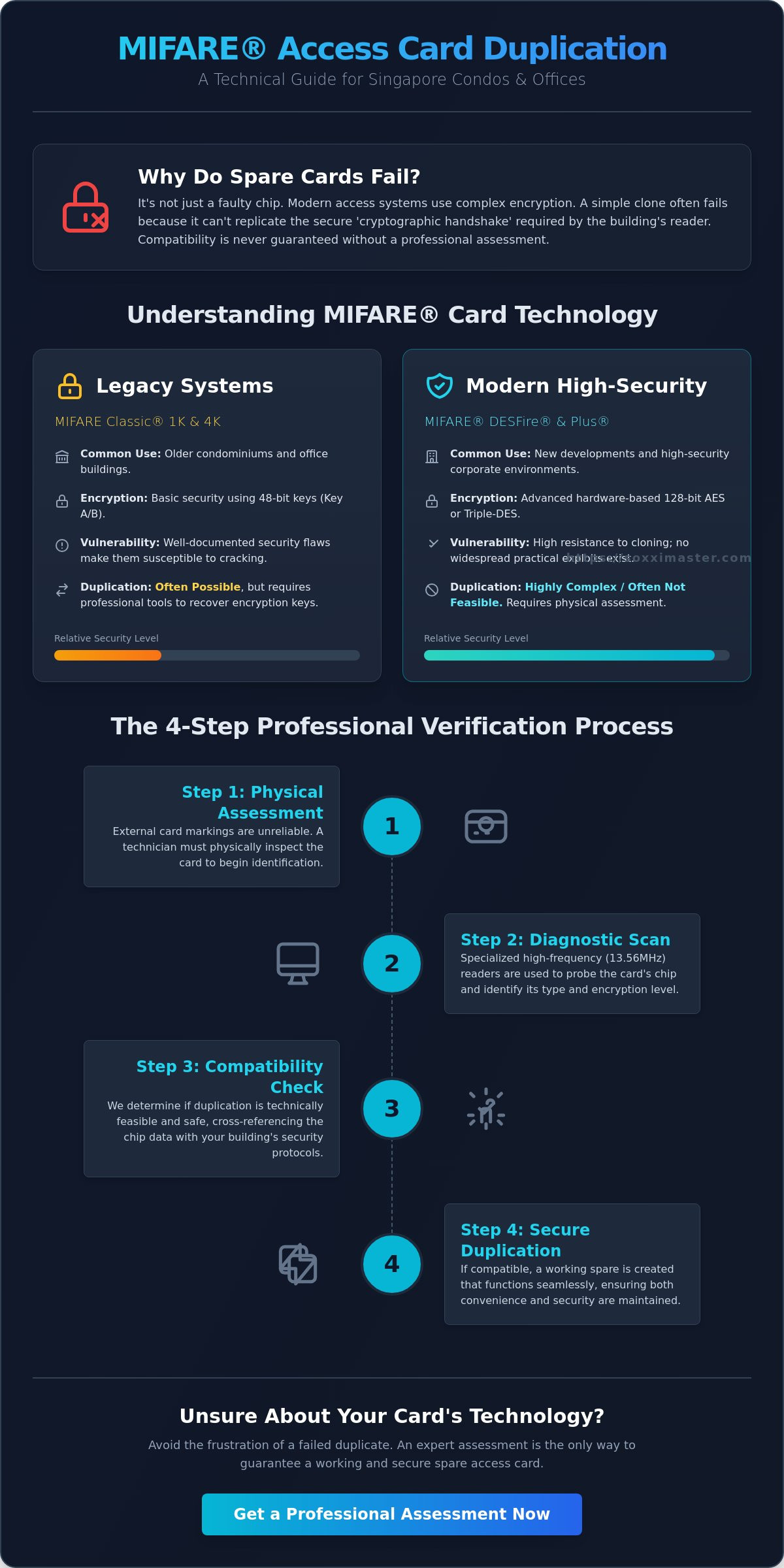
The MIFARE Classic family remains the most widespread technology for older condominium and office systems. These cards are divided into sectors and blocks; the 1K version offers 16 sectors, while the 4K version provides 40 sectors for more complex access rules. Data is protected by two different 48-bit keys, known as Key A and Key B. Despite their popularity, researchers have documented significant MIFARE Classic security vulnerabilities over the years. Because of these known flaws, duplication is often possible for this specific family, provided the specialist can successfully recover the necessary encryption keys. However, success is never guaranteed and depends entirely on the specific security configuration of your building’s reader system.
The Complexity of MIFARE DESFire and Plus
Modern developments in Singapore are increasingly adopting MIFARE DESFire and MIFARE Plus to address the weaknesses of older systems. These chips use advanced hardware-based encryption, such as Triple-DES or 128-bit AES, which provides a much higher level of data protection. MIFARE Plus was specifically designed as an evolutionary path, allowing buildings to upgrade from Classic security to AES encryption without replacing all their hardware. Duplication for these variants is significantly more complex and is highly subject to the specific system configuration chosen by the facility management. In many cases, these cards use “rolling codes” or proprietary handshakes that make standard cloning impossible.
Because these high-security systems are designed to be tamper-resistant, a technical assessment is mandatory. We don’t rely on guesswork or surface-level scans. Instead, we use precision diagnostic tools to determine the chip’s encryption status. If you’re unsure which technology your building uses, you can contact us for a professional assessment of your card type. Final confirmation of compatibility can only be provided after our specialists physically inspect the card and verify the encryption levels against our supported systems.
- MIFARE Ultralight: Often used for limited-use applications like event ticketing or transit; these have minimal security and no encryption.
- MIFARE Classic: The standard for many existing Singaporean condos, utilizing 48-bit security keys.
- MIFARE DESFire/Plus: The current high-security standard, utilizing AES encryption protocols that vary by system.
The Professional Verification Process for Card Duplication
Verification is the most critical step in ensuring a duplicate access card behaves exactly like the original when presented to a building’s reader. Many providers focus solely on the speed of the copy, but a professional process prioritizes technical accuracy and data integrity. When you seek mifare card duplication singapore services, the specialist must first identify the specific chip architecture and its current encryption status. This isn’t a simple “copy and paste” task; it involves a methodical diagnostic approach to confirm if the card uses static data or proprietary rolling codes. If a system uses rolling codes, a standard clone will stop working after the first use, which is why technical verification is mandatory before any service proceeds.
Diagnostic Testing and Data Integrity
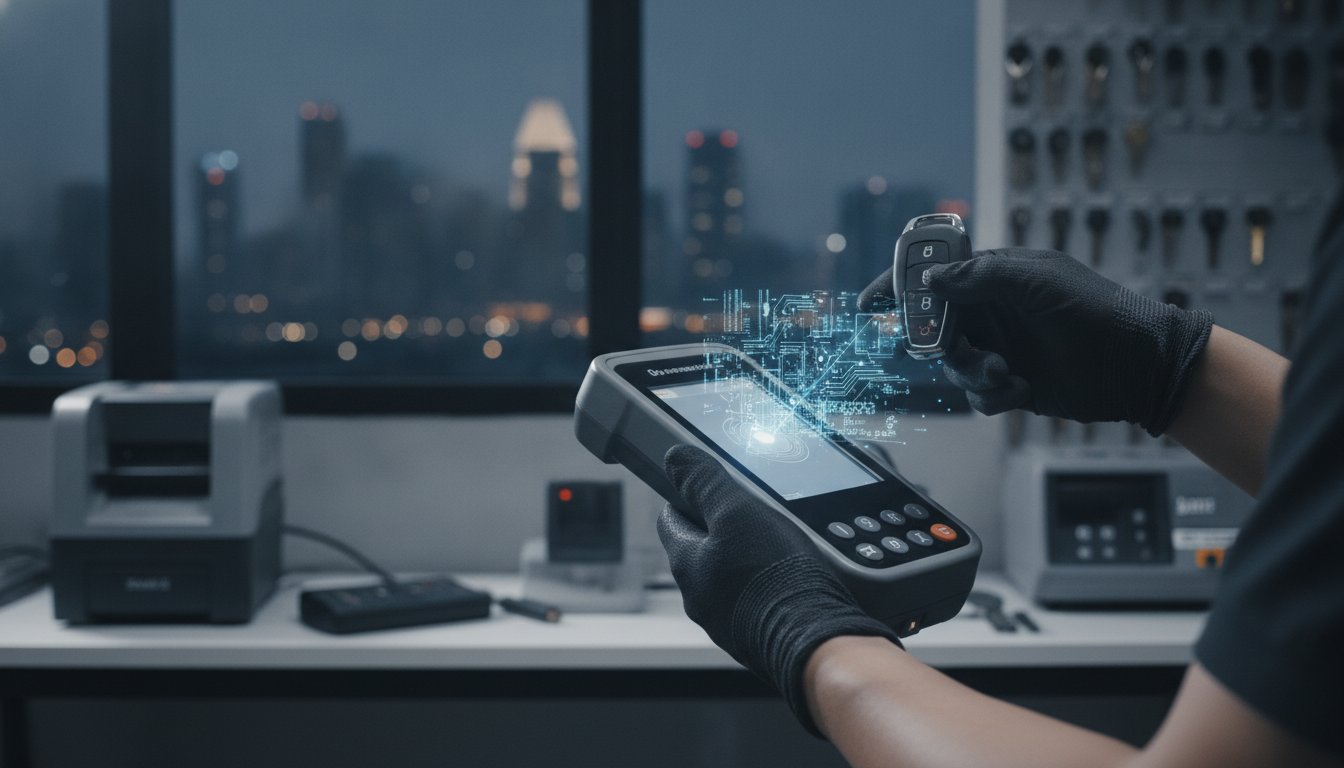
Specialists use high-precision RFID diagnostic tools to analyze the card’s internal memory sectors. This testing determines whether a card is “locked” or “unlocked” for reading. A locked card requires the recovery of specific security keys to access the data sectors. This is particularly relevant given documented MIFARE Classic NFC card vulnerabilities, which highlight how insecure data storage can lead to unauthorized reading if not handled by a professional. Once the data is successfully read, it must be written to a high-quality blank chip. We don’t use generic, low-grade blanks that often fail after a few months. Instead, we select chips that match the original’s frequency and protocol requirements to ensure long-term reliability at the condo or office gantry.
Security and Privacy Standards
Choosing a professional key duplication service means your data is handled with the highest level of confidentiality. Unlike unverified vendors or DIY kits, a specialist service provider follows strict protocols to protect your information. We don’t store your card’s data permanently; once the duplication process is verified and the transaction is complete, the sensitive information is purged from our diagnostic systems. This commitment to privacy is why residents and facility managers prefer working with a trusted specialist who understands the nuances of Singapore’s security landscape. We prioritize a secure, transparent process over marketing shortcuts. If you’re concerned about the security of your current access system, we recommend a physical inspection to provide a final confirmation of what’s possible for your specific card model.
- Technical diagnostics identify the chip type (Classic, DESFire, or Plus).
- Encryption key recovery ensures all data sectors are accurately mirrored.
- Rolling code detection prevents the creation of non-functional duplicates.
- Secure data handling protocols protect your building access information.
Assessing Compatibility for Your Access Card
Determining if your access card is compatible with duplication is a technical process that extends beyond a simple visual check. While many people searching for mifare card duplication singapore hope for an immediate answer, the internal chip and its encryption level are the true deciding factors. External markings, such as printed card numbers or brand logos, provide initial clues but aren’t definitive proof of compatibility. For instance, cards from brands like HID or Fermax might use different technologies depending on when the building’s system was installed or last upgraded. Success is never assumed; it’s always subject to the specific configuration of the reader system at your property.
Certain high-security systems, such as those utilizing HID iClass or Viking chips, vary significantly by model and firmware version. Some of these chips are designed with proprietary encryption that prevents unauthorized reading. Because these systems are constantly evolving, a physical assessment is the only reliable way to confirm if a working duplicate can be created. We prioritize technical accuracy over speed, ensuring that if a card is duplicated, it will function reliably at your specific gantry or lift. Final confirmation is mandatory before any service can proceed, as we don’t rely on guesswork for complex security hardware.
How to Provide Details for an Assessment
To begin a preliminary assessment, you should take clear, high-resolution photos of both sides of your card or key fob. Look for any embossed numbers or printed logos like Keri, HID, or Fermax. In some cases, your access system might even be integrated with your original car remote keys. If your condo access is built into your vehicle’s remote, we’ll need specific details about the remote’s make and model to determine the chip type inside. Providing these details upfront helps our specialists narrow down the likely technology, though a physical scan remains the definitive step in the verification process.
Why Some Cards Cannot Be Duplicated
It’s important to understand that not every card can be cloned. Modern security systems in some Singaporean developments now use cloud-based verification or “one-time use” tokens. These systems check the card’s data against a live database every time it’s tapped. If the system detects a duplicate or an inconsistent data string, it may block the card entirely. Proprietary encryption protocols are specifically designed to be tamper-resistant. If our diagnostic tools indicate that a system is not supported, we’ll provide a clear and professional explanation rather than attempting a service that won’t work. We maintain a conservative stance on all high-security cloning to ensure your original card’s integrity is never compromised.
To ensure you receive a working solution that fits your specific needs, we recommend contacting us for a professional assessment of your access card. Final confirmation of compatibility can only be provided after our specialists physically inspect and scan the original hardware.
Professional Access Solutions with Soxxi Master
Soxxi Master has established itself as a pioneer in Singapore’s security industry, evolving alongside the technology that keeps our homes and offices safe. Our expertise isn’t limited to a single type of entry system; it spans across traditional mechanical keys, complex automotive transponders, and the latest RFID protocols. When you require mifare card duplication singapore, you’re looking for more than just a copy. You’re looking for technical accuracy that ensures your building access remains seamless. Our expertise in mifare card duplication singapore is built on a foundation of technical verification, focusing on the specific data integrity of every chip we scan. If you need a professional assessment of your duplicate door access card needs, our team provides the technical depth required for modern encrypted systems.
The Soxxi Master Difference
With 18 years of experience as a trusted specialist, we’ve seen the transition from simple proximity cards to the highly encrypted MIFARE DESFire systems used in 2026. Based in Jalan Pemimpin, our workshop is equipped with the diagnostic tools necessary to handle a wide range of requests. This includes specialized services like auto gate remote duplication, where frequency alignment is just as critical as the chip data itself. We don’t believe in hidden complications or technical jargon. Instead, we offer clear, upfront advice based on the physical reality of your hardware. As “the master of key,” we provide an all-in-one solution for both mechanical and electronic access, ensuring that every duplicate we produce meets our rigorous standards for reliability.
Next Steps for Your Duplication Request
Getting started is a straightforward process designed for your convenience. You can reach out to us via WhatsApp with clear photos of your card or remote. While these images allow us to provide a preliminary check, it’s important to remember that final confirmation is required before any service can proceed. We must physically verify the encryption levels and chip type to ensure a working result. This methodical approach is why we don’t make absolute claims about supporting every system without an inspection. We’re here to help you understand the technical compatibility of your specific access card and provide a reliable solution.
Contact Soxxi Master today for an accurate assessment and confirmation of your specific access needs. Our specialists are ready to guide you through the technical requirements to ensure you receive a high-quality spare for your home or office.
Securing Your Access with Professional Expertise
Understanding the nuances between legacy MIFARE Classic and modern DESFire systems is the first step toward obtaining a reliable spare. Technical verification standards ensure that every duplicate mirrors the original’s data integrity. This methodical process prevents the common frustration of cards that fail at the gantry or lift. With 18 years of experience as a trusted specialist in Singapore, we’ve refined our methods to handle both automotive and RFID systems with precision. We focus on accuracy to ensure your building security remains uncompromised while providing the convenience you need.
Getting mifare card duplication singapore right requires a diagnostic approach that accounts for proprietary security protocols. Compatibility is never assumed; it’s verified through physical assessment to ensure the duplicate functions exactly like the original. We prioritize your data privacy and technical accuracy over quick, unverified clones. If you’re ready to secure a working spare for your home or office, we’re here to provide the expert guidance you need for a successful duplication.
Contact our specialists for a professional card assessment and receive a final confirmation of your specific access requirements. We look forward to providing you with a seamless and reliable service that gives you peace of mind.
Frequently Asked Questions
Is it legal to duplicate a condo access card in Singapore?
Singapore has no specific national law that prohibits the duplication of access cards, provided the technology isn’t patented and no intellectual property rights are infringed. However, individual building management (MCST) by-laws often have specific rules regarding card cloning. Violating these internal policies can lead to penalties like card confiscation or fines. It’s the user’s responsibility to check their building’s regulations before seeking mifare card duplication singapore services.
Can all MIFARE cards be duplicated?
Not all cards are compatible with duplication. Success depends on the chip generation and the specific encryption level chosen by the building’s security provider. While older systems like MIFARE Classic are often supported, modern high-security versions like MIFARE DESFire or Plus EV2 might use proprietary rolling codes that prevent cloning. A physical assessment at our workshop is necessary to confirm if your specific card model and system configuration allow for a working duplicate.
How long does the MIFARE card duplication process take?
The technical process typically takes between 10 and 15 minutes per card. This duration includes the initial diagnostic scan to identify the chip type, the recovery of necessary encryption keys, and the final writing of data to a high-quality blank chip. Some complex encryption levels might require a slightly longer assessment to ensure data integrity. We prioritize technical accuracy to ensure the new card functions reliably at your gantry or lift.
Will my original card be affected by the duplication process?
Your original access card remains completely unaffected and fully functional after the procedure. The duplication process is non-invasive; our diagnostic equipment simply reads the data from the card’s memory sectors without altering any of the original information. It’s a read-only interaction that doesn’t change the card’s internal state. You’ll receive your original card back in the exact same condition, along with the newly verified duplicate for your use.
What is the difference between an RFID card and a MIFARE card?
RFID is a general category of wireless technology, while MIFARE is a specific brand of high-frequency chips. Most basic RFID cards in Singapore operate at 125kHz with minimal security features. MIFARE cards operate at a higher 13.56MHz frequency, which allows for encrypted data storage and secure handshakes with readers. This technical distinction is why mifare card duplication singapore requires specialized high-frequency equipment rather than a standard low-frequency cloner.
Why does my duplicated card not work on some readers in the condo?
A duplicate might fail if the building uses an “anti-passback” system or proprietary rolling codes. Anti-passback protocols prevent a card from being used to enter twice without a corresponding exit. If the system detects two identical IDs within the gantry zone, it may block access for security reasons. These advanced features are why a professional technical assessment is mandatory to determine if a duplicate will remain functional within your specific building’s reader network.
Do I need to bring my original card to your service centre?
Yes, you must bring the original card to our service centre for a physical assessment. We cannot duplicate a card using just a photo or a serial number because our diagnostic tools must interact directly with the internal chip. This physical scan allows us to verify the exact frequency and encryption protocols used by your system. Final confirmation of compatibility is only possible after our specialists have physically inspected and scanned the original hardware.