

What if the primary risk to your building access isn’t duplicating your card, but relying on a single, aging piece of plastic? Many property owners frequently ask, is rfid cloning safe, fearing that a duplicate might trigger a system lockout or compromise their security. It’s normal to feel some anxiety when you’re faced with complex terms like Mifare or HID. You simply need a reliable backup that works every time without damaging your hardware.
This guide explains the technical realities of card duplication in 2026 to ensure your credentials stay secure. We’ll help you understand different systems and why professional verification is essential. Note that compatibility must be verified using system or vehicle details (e.g., chassis number), and final confirmation is required before any service can proceed at Soxxi Master. You’ll gain the clarity needed to manage your access needs professionally and securely.
Key Takeaways
- Understand how professional RFID duplication uses non-invasive electromagnetic induction to read data without damaging your original card’s internal circuitry.
- Learn the answer to the question, “is rfid cloning safe?” by distinguishing between professional duplication for convenience and malicious skimming practices.
- Discover why technical compatibility is subject to system verification and why providing credential details is a mandatory first step for a successful duplicate.
- See how choosing a specialist with calibrated equipment ensures your new access card functions reliably across various condominium and office readers.
Understanding RFID Technology and the Safety of Duplication
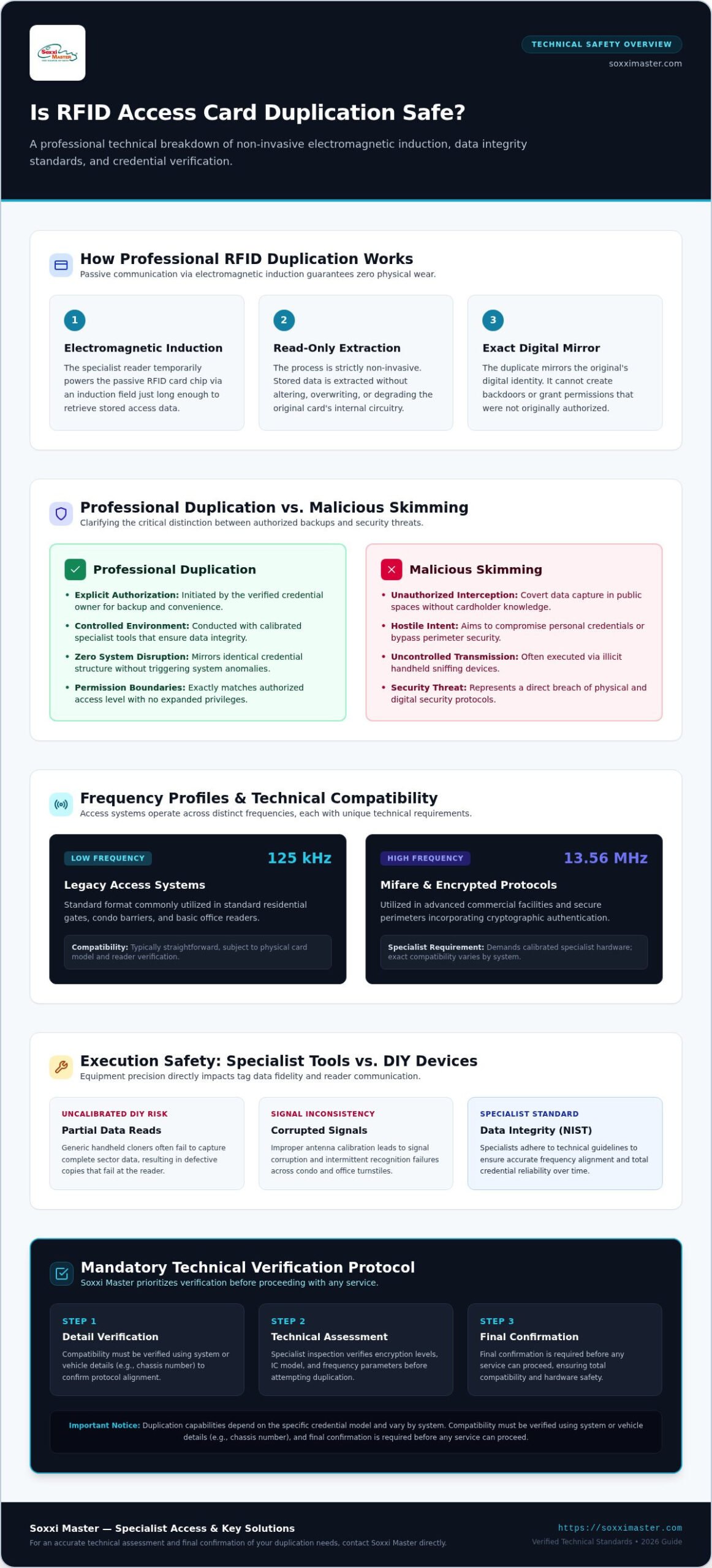
Modern access systems utilize radio-frequency identification technology to facilitate seamless, contactless entry. This passive communication method relies on electromagnetic induction to power the card’s chip and retrieve stored data. Because this process is read-only, professional duplication is technically non-invasive. When clients ask, is rfid cloning safe, they’re often concerned about hardware degradation. Expert tools extract information without altering the original card’s internal circuitry, maintaining the integrity of the source device.
We must distinguish between malicious skimming and intentional cloning for convenience. Skimming involves unauthorized data capture in public settings. In contrast, professional cloning is a controlled service where you provide your authorized card to create a backup. This process is safe for the hardware, provided it’s handled by a specialist. You can learn more about our duplicate door access card solutions to understand how we maintain these standards.
Common Security Misconceptions About RFID Cloning
A frequent myth suggests that a cloned card creates a “backdoor” into a security system. In reality, a clone acts as a digital mirror of your existing authorized access. It can’t grant permissions that weren’t already programmed into the original. The security of your premises depends on how you manage these duplicates. Physical security of the spare card remains the most critical factor for the user. While the technical process is rfid cloning safe, responsible ownership is key.
Technical success depends on the credential model and varies by system. Compatibility must be verified using system or vehicle details (e.g., chassis number), and final confirmation is required before any service can proceed. Reach out to Soxxi Master for an accurate assessment and final confirmation of your access duplication needs.
Technical Safety: Can Cloning Damage Your Original Card or System?
Professional duplication tools operate on a read-only basis, ensuring your original access card remains untouched. These tools use induction to power the chip just long enough to extract the digital identity. This non-invasive approach means your original hardware is never at risk of electronic degradation. When considering is rfid cloning safe, technical reliability is often the biggest concern. Modern readers generally cannot distinguish between an authorized original and a professional duplicate because the data structure is identical.
However, using unverified DIY tools introduces significant risks. Cheap handheld devices often lack the calibration needed for precise frequency transmission. This leads to partial data reads or corrupted signals that cause intermittent access failures. When you ask is rfid cloning safe, the answer depends heavily on the equipment used. Following NIST guidelines on securing RFID systems, specialists prioritize data integrity to prevent tag copying errors.
Encryption Levels and System Compatibility
Safety profiles vary significantly between legacy 125kHz low-frequency cards and 13.56MHz high-frequency systems like Mifare. While many standard cards are easily duplicated, success is always subject to compatibility. High-security systems using cryptographic authentication require specific specialist hardware to ensure a reliable clone. This is similar to what is a transponder key, where an embedded chip must communicate correctly with a vehicle’s immobilizer.
Every access system has unique requirements. Compatibility must be verified using your specific system details, and final technical confirmation is mandatory before any service begins. For a professional assessment, you should contact Soxxi Master to confirm your duplication needs.
Ensuring a Secure Duplication Process with a Specialist
Choosing a specialist ensures that your duplicate remains technically sound and reliable over time. While the fundamental question of is rfid cloning safe is answered by the non-destructive nature of the technology, the quality of the execution depends on calibrated equipment. A professional key duplication service prioritizes precision to avoid the common data errors found in consumer-grade tools. This methodical approach aligns with the MITRE CAPEC analysis on RFID cloning, which highlights the technical nuances of credential interrogation. Professional verification is a mandatory first step to ensure your duplicate works without triggering system exceptions.
The Professional Verification and Duplication Workflow
Specialists begin by identifying the specific frequency and chip architecture of your credential. This ensures the correct blank is selected for your access card clone. You’ll need to provide system details or the credential type for a final confirmation before any work proceeds. This structured process varies by system and is subject to card compatibility. Final testing protocols then verify that the new card matches the original parameters exactly, providing a seamless user experience across your building’s readers.
Once you have your duplicate, responsible management is essential. Store spare cards in a secure, dry location. If a duplicate is lost, you should treat it with the same urgency as a lost original. While the technical process is rfid cloning safe, maintaining the physical security of your backup is your primary responsibility. Compatibility must always be verified using system details, and final technical confirmation is mandatory before any service can proceed. Reach out to Soxxi Master for an accurate assessment and final confirmation of your specific needs.
Securing Your Access with Professional Precision
Understanding the technical realities of RFID technology helps you move past common security fears. We’ve seen that the answer to is rfid cloning safe is a clear yes when you prioritize professional execution over unverified DIY tools. By choosing a Singapore-based specialist who uses a verification-first approach, you ensure your system integrity remains intact across condominium, office, or gym readers. Soxxi Master provides a convenient all-in-one solution for your access cards and automotive remotes, focusing on precision and reliability. Technical compatibility always depends on your specific model and varies by system. Verification using your credential details is essential, and final technical confirmation is mandatory before any service can proceed.
You can now manage your backups with confidence and ease. Reach out today for an accurate assessment and final confirmation of your specific technical needs.
Frequently Asked Questions
Is it illegal to clone my own condo access card in Singapore?
Residents should consult their specific building management bylaws or tenancy agreements to understand the internal rules regarding property access credentials. Soxxi Master serves as a specialist provider for individuals requiring reliable backups for their personal use. Compatibility must be verified using system or vehicle details (e.g., chassis number), and final confirmation is required before any service can proceed.
Will my original card stop working if I make a duplicate?
The original card remains fully functional because professional duplication is a non-invasive, read-only procedure. Our calibrated equipment ensures that is rfid cloning safe for your hardware by mirroring data without altering the source chip. Compatibility must be verified using system or vehicle details (e.g., chassis number), and final confirmation is required before any service can proceed.
Can all types of RFID cards be cloned safely?
Success depends on the specific credential model and varies by system. While many standard 125kHz and 13.56MHz cards are supported, high-security systems with advanced encryption may not be compatible. To determine if your card is rfid cloning safe, a technical assessment is necessary. Compatibility must be verified using specific system details before any work begins to ensure a reliable outcome.
What happens if the cloned card doesn’t work with my lift or gate?
Our verification-first approach is designed to minimize the likelihood of technical errors. If a duplicate fails, it is usually due to proprietary encryption or frequency mismatches that require specialized hardware. We prioritize precision and technical confirmation to ensure reliability for every client. Contact Soxxi Master directly for an accurate assessment and final confirmation of your specific access duplication needs.