


A higher number alone doesn’t tell you whether your bike is secure enough. To understand what an ABUS security level rating means, start with the scale: ABUS rates its bicycle locks from Level 1 to Level 15, with higher levels intended for greater protection.
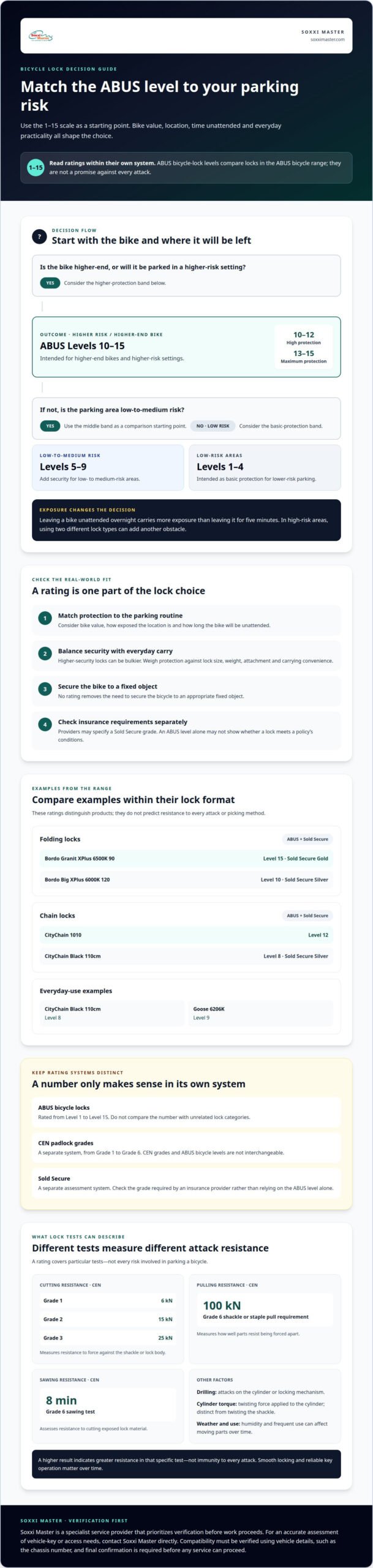
It makes sense to want a stronger lock for a valuable bike or a place where it will be left unattended. Levels 1-4 are intended as basic protection for low-risk areas, Levels 5-9 add security for low- to medium-risk areas, and Levels 10-15 are aimed at higher-end bikes and higher-risk settings. This guide explains how to read those bands and weigh them against your bike’s value, where you park, and how long it stays there. You’ll also see why a rating is a useful starting point, not the whole decision.
Key Takeaways
- Read ABUS’s 1-15 scale as a guide to protection, not a stand-alone guarantee of security.
- Consider how long your bike will be parked and how exposed the location is when choosing a lock.
- Understand why resistance to cutting and pulling can matter when judging a lock’s strength.
- Balance the protection you need against practical factors such as lock size and carrying convenience.
Is my bike lock secure enough?
A lock’s rating describes its resistance to particular attacks, not every risk involved in parking. Cutting, pulling, drilling, sawing, cylinder torque and weather exposure each test a different aspect of its protection.
Padlock standards offer useful context, but CEN grades and ABUS bicycle security levels are separate rating systems. For example, CEN Grade 3 specifies 25 kN of shackle-cutting resistance, while Grade 6 requires 100 kN to pull the shackle or staple.
Cutting and pulling resistance
Cutting resistance measures how well a lock withstands force against its shackle or body; pulling resistance measures how well those parts resist being forced apart. These tests matter because a visible shackle can be attacked directly, especially when a bike is left unattended. CEN Grade 1 requires 6 kN of shackle-cutting resistance, Grade 2 requires 15 kN, and Grade 3 requires 25 kN. A higher result signals greater resistance in that test, not immunity to every attack.
Drilling and sawing resistance
Drilling resistance concerns attacks on the cylinder or locking mechanism, while sawing resistance concerns cutting through exposed lock material. Both matter because an attacker may target the lock body instead of its shackle. CEN Grade 6 includes an 8 Mins sawing test. A rated lock may also be tested against cylinder-plug torque, which applies twisting force to the cylinder. This is distinct from twisting the shackle, which tests whether it can be rotated or deformed.
Weather resistance matters during everyday riding and outdoor parking. A high-quality lock can be resistant to ice spray, while a seal of approval indicates it has met a relevant test. Humidity and frequent use can still affect moving parts, so smooth locking and reliable key operation matter over time. ABUS says Granit padlocks can remain in use for decades.
Choosing a lock based on bike value and parking risk
Match the lock’s rating to your bike’s value, parking location and unattended time. ABUS Levels 1-4 offer basic protection for low-risk areas; Levels 5-9 add security for low- to medium-risk areas. Levels 10-15 are intended for higher-end bikes and higher-risk settings. Overnight parking carries more exposure than leaving a bike unattended for five minutes. In high-risk areas, two different lock types can add another obstacle.
Yes, ABUS ratings depend on product category, so don’t compare numbers across unrelated locks. ABUS bicycle locks use Levels 1-15, while CEN padlock grades run from Grade 1 to Grade 6. A rating for a bike lock doesn’t tell you the rating of a door lock or another product. Read each rating within its own system.
For regular everyday use, mid-level options include the ABUS CityChain Black 110cm at Level 8 and the ABUS Goose 6206K at Level 9. A higher number alone doesn’t establish fit: consider portability, how the lock attaches to your bike, and the parking setting. A mechanism that’s convenient to carry is more practical for routine riding.
Folding-lock ratings also span different levels. The ABUS Bordo Granit XPlus 6500K 90 is Level 15 and Sold Secure Gold; the Bordo Big XPlus 6000K 120 is Level 10 and Sold Secure Silver. For chain locks, the CityChain 1010 is Level 12, while the CityChain Black 110cm is Level 8 and Sold Secure Silver. These examples help distinguish ratings, not predict resistance to every attack or picking method.
Choose a suitable format and rating for your routine. Explore ABUS bicycle locks for options that fit your needs.
ABUS bicycle security rating
ABUS rates bicycle locks on a scale from Level 1 to Level 15. Levels 10-12 indicate high protection, while Levels 13-15 indicate maximum protection. Treat the number as a way to compare locks within ABUS’s bicycle range, not as a promise of protection against every thief or attack.
The rating is only one factor when choosing a suitable lock. A higher-security lock can be bulkier, so weigh its protection against its weight and how easily you can carry it while riding. A versatile lock that suits your regular parking routine may be more practical than choosing the highest level without considering everyday use.
Insurance requirements can affect your choice. Providers often specify the Sold Secure grade they require, so an ABUS level alone may not show whether a lock meets a policy’s conditions. For example, the ABUS Ultimate 420 is rated ABUS Level 12 and Sold Secure Gold. These are separate rating systems, and each describes its own assessment.
As a rough guide, the article’s suggested security spend is 10% of the bicycle’s new price. Use that as a budgeting reference, not a guarantee of security or insurance acceptance. Parking exposure, bike value, lock format and carrying weight all affect the balance. A cable-style lock, for instance, may be easier to carry, while a higher-rated option may offer stronger protection. No rating removes the need to secure the bicycle to an appropriate fixed object.
Compare ABUS bicycle lock options for a lock that fits your needs.
Soxxi Master
Soxxi Master offers ABUS bicycle locks for riders comparing ratings with bike value, parking habits and carrying convenience. The rating is a useful comparison point, but your choice also depends on the lock’s design and how you secure your bicycle. Consider whether you park briefly or leave the bike unattended for longer, and whether the lock fits your routine.
If you’re deciding between ABUS lock options, Soxxi Master can help you consider them in relation to your needs. An accurate assessment can help clarify which option fits your use, with final confirmation before you proceed.
Contact Soxxi Master for an accurate assessment
Make your next security decision with confidence
Your parking routine can change, so review your lock choice if you start leaving your bicycle somewhere new or for longer periods. Understanding what an ABUS security level rating means gives you a useful basis for that decision, but the lock’s fit with your daily habits matters too.
For other key and access needs, Soxxi Master is a specialist provider of car and motorcycle key duplication, RFID access card cloning subject to system compatibility, and an all-keys-lost service subject to vehicle compatibility. Compatibility is verified using vehicle details such as the chassis number, and final confirmation is required before any service proceeds.
Choose your next step with care, and get in touch to discuss your specific needs.
Frequently Asked Questions
Which Lock Should You Choose?
Choose a lock suited to both your bicycle and where you leave it. For a valuable bike parked overnight in a public place, consider a higher-rated lock and check whether your insurance policy specifies a Sold Secure grade. For brief stops in lower-risk locations, convenience and ease of carrying may matter more. Choose a lock you can use consistently.
What does an ABUS security level rating mean?
An ABUS security level is a comparative indicator of a bicycle lock’s intended protection. It helps distinguish models within ABUS’s bicycle-lock range, but it doesn’t account for every factor in your parking situation. For example, the rating won’t tell you whether a particular lock fits around your bicycle frame and a suitable fixed object.
What is the ABUS security level scale from 1 to 15?
ABUS bicycle locks use a scale from Level 1 through Level 15. Levels 1-4 are positioned for basic, lower-risk use; Levels 5-9 add protection for low- to medium-risk settings. Levels 10-15 are intended for more demanding situations and higher-end bicycles. Use these bands to narrow options, then consider portability and policy requirements.
How does ABUS rate bicycle locks and what tests are used?
ABUS assigns bicycle locks a level on its 1-15 scale. Relevant resistance checks include cutting and pulling force, sawing, drilling, cylinder torque and shackle twisting. Each examines a different potential point of attack, such as the locking cylinder or exposed shackle. Treat the level as a useful comparison, rather than a prediction of how long an attack would take.
What do the different ABUS security levels indicate about theft resistance?
Higher levels indicate that a lock is intended to provide stronger protection than lower-level options within the bicycle range. For example, a Level 12 lock sits in ABUS’s high-protection band, while Level 15 is in its maximum-protection band. These labels help compare choices, but insurance acceptance depends on the grade specified by your policy.