

You watch your key fob tumble toward the pavement, and although the plastic casing remains intact, the buttons suddenly fail to respond. If you find your car remote not working after drop, the issue often lies deeper than a simple battery displacement. It’s a stressful moment, especially when you’re stranded or worried about the potential costs associated with modern electronic vehicle systems. You aren’t alone in feeling confused by how a minor accident can lead to a complete loss of vehicle access.
You’ll gain a clear understanding of how physical impact affects delicate internal circuitry and why professional diagnostic tools are essential for restoring access. We will examine common internal failures, such as microscopic circuit fractures or component misalignment, which often require specialized frequency testing to identify. You’ll also learn why compatibility must be verified using your specific vehicle details, such as a chassis number, before any service can proceed. This methodical process ensures that technical issues are addressed with precision, helping you understand the exact steps required to get back on the road safely.
Key Takeaways
- Understand how impact shock causes invisible internal failures like fractured solder joints or dislodged quartz oscillators.
- Learn why a car remote not working after drop often involves delicate electronic damage that a simple battery change cannot resolve.
- Discover the professional diagnostic process, which utilizes signal frequency analysis to confirm if your remote is broadcasting accurately.
- Understand that restoring access depends on precise verification of vehicle details, such as the chassis number, to ensure component compatibility.
- Identify potential solutions ranging from external casing replacement to circuit-level repairs, subject to a specialist’s assessment of your specific model.
Why Your Car Remote Stopped Working After a Drop
A sudden impact on a hard surface is one of the most common reasons for a car remote not working after drop. While the outer plastic shell might appear unscathed, the internal electronics are far more fragile. Modern vehicle keys are essentially miniature computers. They rely on delicate surface-mount components soldered onto a printed circuit board (PCB). When the remote hits the ground, the force travels through the casing and into these micro-components, often causing them to shift or crack. This internal trauma happens in a fraction of a second, regardless of whether the casing shows a scratch.
It’s helpful to understand how car remotes work to realize why impact is so destructive. These systems use radio frequency signals to communicate with your vehicle’s immobilizer. If the impact disrupts the connection between the battery and the circuit, or if it fractures a solder joint, the signal transmission stops. Physical drops are a leading cause of intermittent signal loss, where the remote functions only when squeezed or shaken. This usually isn’t a battery issue; it’s a structural failure within the electronics that requires a methodical diagnostic approach.
The Physics of a Fob Drop
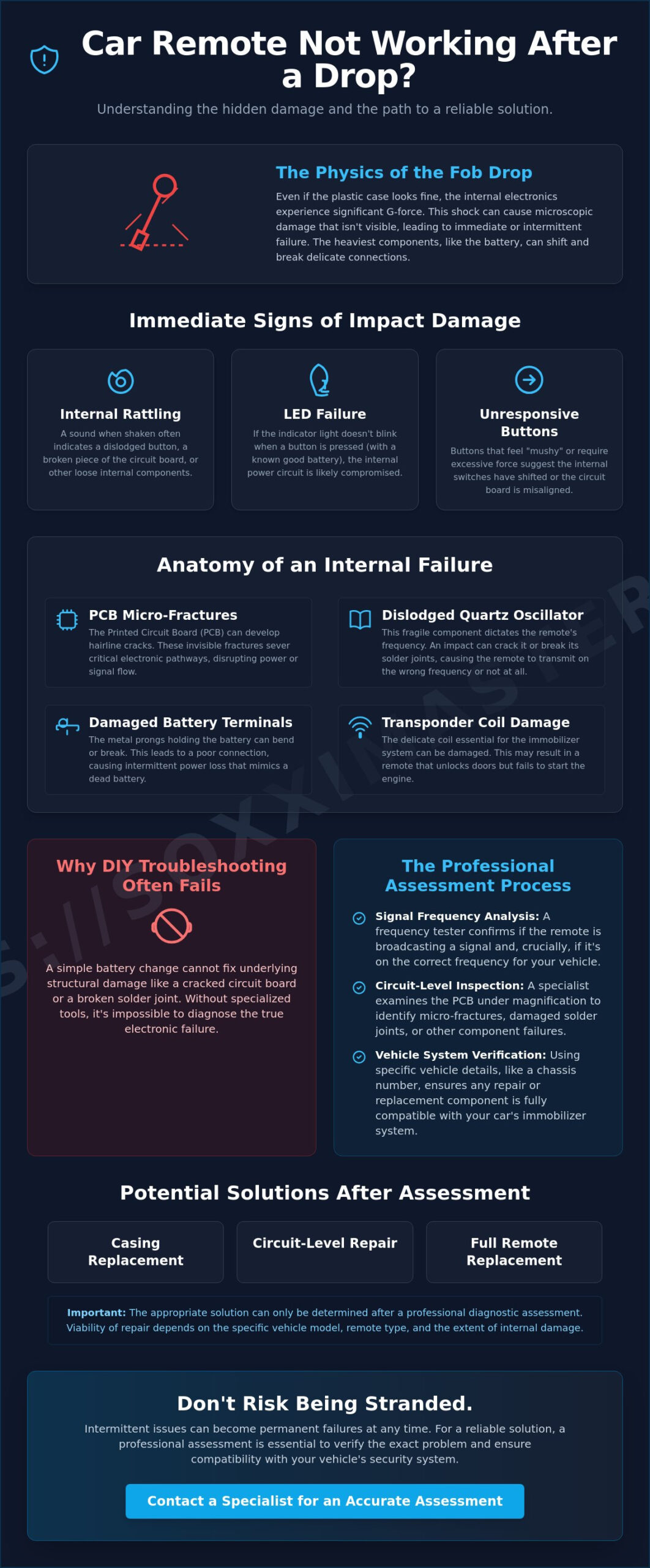
When a key fob hits concrete, it experiences significant G-force. This sudden deceleration causes the battery, which is often the heaviest component, to shift violently. This movement can bend the metal contact prongs that hold the battery in place. If these prongs lose their tension, the circuit won’t receive steady power. Additionally, the transponder chip is highly sensitive to vibration. Damage to this chip might mean you can unlock the doors but cannot start the car. Because the internal components might still be touching slightly, you may find the remote works “sometimes” before failing completely as the parts move further apart.
Immediate Signs of Impact Damage
Identifying the symptoms of a dropped remote helps in determining the next steps for a professional assessment. You should look for these specific indicators:
- Internal Rattling: If you hear a small clicking or rattling sound when shaking the remote, it often indicates a dislodged button or a broken component inside the casing.
- LED Failure: Most remotes have a small indicator light. If this light doesn’t blink when you press a button, despite having a fresh battery, the internal circuit is likely broken.
- Unresponsive Buttons: If the buttons feel “mushy” or require excessive force, the internal switches may have shifted or the PCB might be misaligned within the shell.
In many cases, the external shell integrity does not reflect the internal circuit health. A remote can look brand new on the outside while being non-functional on the inside. If you’re experiencing these issues, it’s advisable to seek a specialist diagnostic to confirm the damage. You can contact Soxxi Master for an accurate assessment of your original car remote keys to see if a repair or replacement is required based on your specific vehicle model and system type.
Common Internal Failures Caused by Physical Impact
While a battery change is the most common DIY attempt, it rarely addresses the structural electronic failures that occur when a key fob hits the ground. A car remote not working after drop often suffers from internal fractures that aren’t visible to the naked eye. These failures are typically concentrated in four specific areas: the printed circuit board (PCB), the quartz crystal oscillator, the battery terminals, and the transponder coil. Each component plays a vital role in the communication between your key and the vehicle’s security system, and even a microscopic shift can lead to a total loss of function.
The Role of the Quartz Oscillator
The quartz crystal oscillator is perhaps the most fragile part of the remote’s assembly. This component is responsible for maintaining the precise frequency timing required for the car to recognize the remote signal. Scientific research into Internal Failures Caused by Impact shows that even a small drop can dislodge these surface mount packages or cause internal crystal fractures. If the oscillator is misaligned or cracked, the remote might still broadcast a signal, but it will be on the wrong frequency. This is why professional frequency testing is necessary. Guessing at the problem often leads to unnecessary part replacements without solving the root cause.
PCB Fractures and Connectivity
The PCB acts as the nervous system of your remote. Impact can create microscopic cracks in the copper traces that carry electrical signals. You might notice that your remote works only when you squeeze the casing tightly or if it’s a particularly warm day. This happens because pressure or heat can temporarily bridge the gap in a fractured circuit. These instances are unreliable and temporary. There is also a significant risk of permanent data loss if the main microcontroller chip pins are severed from the board. If the chip itself is compromised, the remote may lose its programming entirely, requiring a more complex solution.
Mechanical shock also affects the battery terminal clips. These metal prongs can bend or snap, leading to a complete power loss. More critically, the transponder coil, which is a fine copper wire wrapped around a ferrite core, can sustain micro-cracks. This component is essential for the immobiliser system. If the coil is damaged, your car won’t start even if the remote buttons still work to unlock the doors. Because these systems are highly integrated, you should contact Soxxi Master for an accurate assessment and confirmation of your specific needs based on your vehicle’s technical requirements.
Why DIY Troubleshooting Often Fails for Dropped Remotes
Many vehicle owners instinctively reach for a new battery when they find their car remote not working after drop. While this is a logical first step for a remote that has gradually lost range, it rarely addresses the mechanical trauma caused by an impact. Opening the casing without specialized tools often leads to further complications. Small internal components, such as tactile switches or the transponder chip, can easily fall out and be lost forever. Handling the internal circuit board without anti-static protection introduces the risk of Electrostatic Discharge (ESD), which can permanently damage sensitive microchips.
The Battery Myth in Dropped Keys
A physical drop doesn’t suddenly drain a battery’s voltage. Instead, the impact often bends the contact prongs or fractures the solder holding the battery holder in place. You might assume the battery is dead because the LED doesn’t light up, but the power simply isn’t reaching the circuit. One hidden danger is “button mashing.” If you repeatedly press the buttons on a damaged remote hoping for a response, you can actually drain a perfectly good battery or cause a short circuit that damages the PCB further. Professional diagnostics can confirm if the power path is intact before you waste money on multiple battery replacements.
The Danger of DIY Soldering
Attempting to repair a fractured circuit at home is often counterproductive. Modern car remotes utilize multi-layer PCBs where traces run through the middle of the board, not just on the surface. Standard soldering irons often run too hot for these delicate assemblies. Excessive heat can de-program or physically destroy the immobiliser transponder, turning a repairable remote into a total loss. Professional service providers use precision equipment to ensure the integrity of the electronic package is maintained. This level of care is necessary because hardware must be verified as functional before any software-based “reprogramming” can even be attempted.
You can’t program a remote that isn’t broadcasting a stable signal. Verification of vehicle details like the chassis number is essential to ensure the correct internal components are used for your specific model. Compatibility is never assumed and must be verified before any service proceeds. For a professional assessment of your hardware, you can contact Soxxi Master to see how expert diagnostics can help restore your access. Our team focuses on original car remote keys, ensuring that any repair or replacement is subject to compatibility and your specific vehicle system requirements.
The Professional Assessment Process in Singapore
When you bring in a car remote not working after drop, the diagnostic process begins with a methodical technical evaluation. A visual inspection alone is insufficient for modern electronic keys. Our specialists utilize a multi-step verification system to pinpoint the exact failure point. This process ensures that we address the root cause rather than just the symptoms, preventing future reliability issues. Every assessment is handled with precision to maintain the security integrity of your vehicle’s access system.
A critical first step involves the verification of vehicle details, specifically the chassis number. This information is essential because remote components and frequencies vary significantly depending on the vehicle model and regional variant. We also perform a signal frequency analysis using digital counters. This test confirms if the remote is broadcasting a stable signal or if the internal quartz oscillator has shifted off-frequency due to the impact. Identifying the specific reason for a car remote not working after drop requires this level of technical accuracy to ensure the correct repair path is chosen.
Physical inspection is equally vital. Specialists examine the Printed Circuit Board (PCB) under high-power magnification to identify microscopic fractures in the copper traces or solder joints. We also perform a diagnostic scan of the transponder chip integrity. This chip is responsible for the immobiliser system, and if it’s compromised, the vehicle will not start even if the remote buttons are functional. Final confirmation is required before any service can proceed, as technical solutions are subject to compatibility with your specific vehicle variant.
Specialist Equipment vs. Standard Tools
Standard household tools or generic electronics kits lack the precision required for automotive security systems. Specialists use digital frequency counters capable of detecting even the weakest signals. Transponder cloners are also employed to verify the health of the security chip without risking data corruption. Understanding the nuances of these components is why a specialist guide to key repair is essential for anyone dealing with modern fobs. These advanced tools allow for a non-invasive diagnostic that protects the existing data on your key.
Verification and Security Standards
Security is a priority during every assessment. Ensuring the repair or replacement matches the specific vehicle variant is a mandatory requirement. This is why visiting a professional key specialist in Ang Mo Kio is recommended for secure handling of your vehicle’s data. Chassis-based verification ensures that any components used are technically compatible with your car’s immobiliser system. This structured approach reinforces the reliability of the repair and ensures your vehicle remains secure.
To ensure your vehicle access is restored correctly, you can consult with a specialist at Soxxi Master for a detailed technical verification and accurate assessment of your needs.
Specialized Repair and Replacement Solutions
Dealing with a car remote not working after drop requires a balanced approach between electronic restoration and physical refurbishment. If the internal circuit board remains functional but the plastic housing is cracked or the buttons are missing, reshelling is a practical solution. This process involves transferring your existing electronics into a new, high-quality casing. However, if the impact caused circuit-level damage, such as dislodged surface-mount devices, a professional assessment is needed to determine if the components can be re-secured. These specialized repairs are highly technical and vary by system; making expert verification essential before proceeding.
When the original hardware is deemed beyond repair, specialized duplication becomes the next logical step. Modern smart keys and traditional transponder remotes require precise matching to the vehicle’s existing security protocols. Unlike generic solutions, professional duplication ensures that the new remote integrates seamlessly with the immobiliser system. This all-in-one approach addresses both the electronic signal and the physical key blade, providing a complete restoration of your vehicle access without the long wait times often associated with traditional distribution channels.
When to Repair vs. When to Replace
Evaluating whether to repair a fractured PCB or opt for a full replacement depends on the severity of the internal trauma. For many owners, choosing original car remote keys offers long-term reliability, as these components are designed specifically for your vehicle’s architecture. While a dealership might suggest an immediate full-system replacement, a specialist can often provide a duplicate car key much faster. This efficiency is particularly valuable when you’re down to your last working key or facing a total lockout situation. Every solution is subject to compatibility and requires verification of your vehicle’s specific details, such as the chassis number.
Restoring Full Vehicle Access
Restoring access involves more than just fixing a button; the repaired or new remote must be properly synced to the vehicle’s onboard computer. This synchronization process ensures that the rolling codes match, preventing unauthorized access and ensuring the immobiliser recognizes the transponder. A thorough test of the mechanical emergency key is also performed alongside the electronic remote testing. This ensures you have a manual backup in case of future electronic failures or battery depletion. Because vehicle security systems are complex, you shouldn’t rely on unverified DIY methods that could compromise your car’s security.
To ensure your vehicle access is restored correctly, contact Soxxi Master for a professional assessment of your dropped car remote. Our team provides an accurate confirmation of your needs based on your specific vehicle variant and security system requirements.
Restoring Your Vehicle Access with Technical Precision
Understanding why you have a car remote not working after drop is the first step toward a reliable resolution. You’ve learned that impact shock often causes microscopic failures in the circuit board or timing components that a simple battery replacement cannot address. Because modern vehicle security is highly integrated; professional diagnostics are essential to identify whether a repair or a specialized replacement is the most effective path forward.
As a pioneer in automotive key replacement in Singapore, Soxxi Master utilizes specialized diagnostic equipment for all vehicle makes. We focus on accuracy and verification to ensure your security system remains intact. Whether your remote requires a physical reshelling or a more complex electronic restoration, our team at 37 Jalan Pemimpin is ready to assist. Every solution is subject to compatibility and requires final confirmation before service begins.
We invite you to contact Soxxi Master for a professional remote assessment to confirm your specific needs. Restoring your access with precision helps you return to the road with confidence and security.
Frequently Asked Questions
Can I still start my car if the remote is broken after a drop?
You can often still start your vehicle if the immobiliser transponder chip remains functional, even if the remote buttons fail to respond. For vehicles with a physical ignition, the mechanical key blade should still turn the lock. In push-to-start systems, most manufacturers provide a backup method, such as holding the key fob directly against the start button. This functionality is subject to compatibility and varies by system, so it’s best to verify your specific model’s backup procedures.
How do I know if my transponder chip is damaged or just the remote buttons?
If the car doors won’t unlock electronically but the engine starts when you use the key, the transponder is likely intact while the remote circuit has failed. If the buttons work to unlock the doors but the car won’t start, the transponder coil may have suffered a micro-crack from the impact. Because these components are separate but housed together, a specialist diagnostic scan is the only way to confirm the health of each individual part accurately.
Will dropping my key fob cause it to lose its programming?
Physical impact usually causes hardware failure rather than a software de-programming event. If you find your car remote not working after drop, the issue is typically a broken solder joint or a dislodged quartz oscillator rather than lost data. However, if the impact is severe enough to sever the pins of the main microcontroller chip from the circuit board, the remote will stop communicating. Hardware integrity must be verified before any software synchronization is attempted.
Is it possible to reshell a car remote if the buttons are cracked from a fall?
Reshelling is a practical solution if the internal circuit board is confirmed to be broadcasting a stable signal. This process involves transferring your functional electronics into a new, high-quality plastic casing to restore the tactile feel and appearance of the buttons. This is a common solution for remotes with only external damage, provided a professional assessment confirms that the internal components haven’t suffered from impact-related fractures or component displacement.
Why does my car remote only work when I am standing right next to the car after I dropped it?
Reduced range often indicates that the internal antenna or the quartz crystal oscillator has been partially dislodged or damaged by the fall. The impact may have weakened the electrical connection between the battery and the transmitter, resulting in a significantly lower power output. A specialist can utilize a digital frequency counter to verify the signal strength and determine if the internal circuit requires repair to restore its original broadcasting range.
What should I bring when visiting a specialist for a remote repair?
You should bring the damaged remote, all other available spare keys, and your vehicle’s chassis number or log card for verification. Proof of ownership and specific vehicle details are mandatory before any service can proceed to ensure security standards are maintained. Having all keys present allows the specialist to verify that any repair or replacement is properly synced to the vehicle’s computer without disrupting your existing access setup.
Can a dropped key fob be fixed if it was submerged in water during the fall?
Success depends on the extent of the short circuit and how quickly the battery was removed after the immersion. While impact damage is often repairable, water introduces the risk of corrosion on the printed circuit board traces. A specialist will need to perform a physical inspection under magnification to see if the board is salvageable. Final confirmation is required after a thorough cleaning and diagnostic test to determine if a repair is technically feasible.